 huntress.comarticle
RMM Abuse: When IT Convenience Bites Back
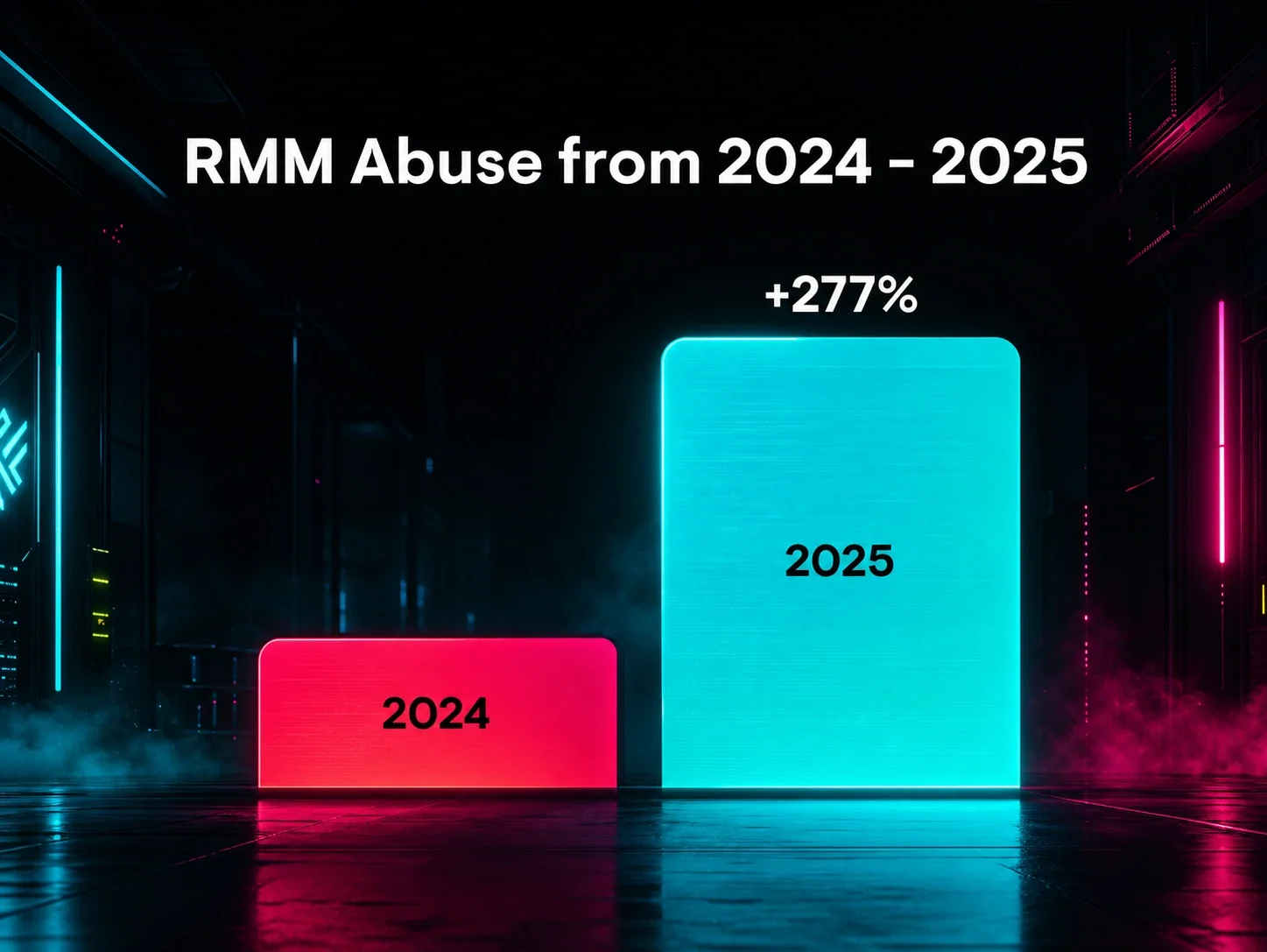
Huntress breaks down the surge in Remote Monitoring and Management (RMM) tool abuse, citing a 277% jump in 2025 and finding that over 50% of suspicious Atera RMM activity cases tie back to ransomware. It walks through a real SOC incident where a threat actor used stolen RMM credentials to gain initial access to an MSP partner's environment, ran enumeration commands, and attempted to disable the Huntress agent before being contained within 12 minutes, and recommends shifting from trusting approved-tool presence to behavioral baselining and executable/endpoint fingerprinting of RMM software.
What it is
Huntress's breakdown of RMM (Remote Monitoring and Management) abuse as an attack technique, tied to the 2026 Cyber Threat Report's 277% year-over-year increase in 2025. The core argument is a defender-side one the summary doesn't carry: approved-tool trust is the vulnerability, and detection has to move from "is this software present/approved" to "is this specific session behaving normally."
How it works
Attackers favor pre-installed, legitimate RMM binaries over custom malware because valid RMM binaries carry no bad signature and slip past EDR "in the name of business continuity." Once an RMM is compromised (via rogue-agent phishing or stolen credentials), the attacker inherits its designed persistence — interactive hands-on-keyboard access to automate tasks, move laterally, run commands, and drop ransomware while looking like an IT admin. The MSP angle is the multiplier: compromising an RMM used by a managed service provider yields direct interactive access to every customer that MSP manages, which is why the SOC case (stolen IT-technician credentials) could have reached all MSP-managed environments.
Preconditions / Affected
Matters for any org running approved RMM tooling, and acutely for MSPs and their downstream customers. The trust assumption that makes it exploitable: an admin seeing expected RMM traffic (e.g., a remote employee reaching their laptop) marks it "normal" without checking the session's timing, user, or behavior.
What to do
The page's actionable guidance:
- Verify behavior, not presence. Don't treat every instance of an approved tool as trusted. Flag strange timing, unexpected users, or unusual behavior for a second look even when the tool itself is authorized.
- Define a normal-activity baseline and watch for anomalies against it.
- Keep up tool fingerprinting to spot unauthorized or unusual remote-access activity quickly.
- Treat people as a detection layer — security awareness training, mindful IT reviews, and a "see something, say something" culture to catch suspicious behavior before ransomware/exfiltration.
The 2025 phishing lure themes to train users against (a rogue RMM install often hides behind these), by share:
- E-signature request — 14.2%
- Invoice notification — 7.8%
- Voicemail notification — 7.5%
- File share — 6.8%
Caveats
This is a vendor blog; the mitigations are directional (baseline, fingerprint, train) rather than specific detections, rules, or product configuration. The fetched text cuts off at the start of the "Define the baseline" section, so any concrete baselining steps beyond the summary above are not captured here.
Organisations named here
- Huntress 2026 Cyber Threat Report
Technologies named here
- RMM tools
- Atera RMM
- Atera
- RustDesk
- ScreenConnect
- Huntress agent
- Managed Security Awareness Training
- Huntress
Techniques named here
- RMM abuse for interactive hands-on-keyboard access
- Phishing/social engineering to deliver malicious RMM agent
- Use of stolen RMM credentials for initial access
- Enumeration commands post-intrusion
- Defense evasion by disabling security agent
- Supply chain compromise via MSP-managed RMM
Threat actors named here
- Unnamed threat actor
Related in Threat Intel
 huntress.comwriteup
Reverse Engineering the Six Stages of MacSync Stealer and RAT
 huntress.comwriteup
AI-Coded Malware | Analyzing Vibe-Coded AD Enumeration | Huntress

 blog.talosintelligence.comtool
Introducing CAIRN: Frontier tracking for AI-integrated malware (Cisco Talos)
 huntress.comwriteup