 socket.devwriteup
MemTensor npm and PyPI Packages Compromised in Credential-Stealing Supply Chain Attack
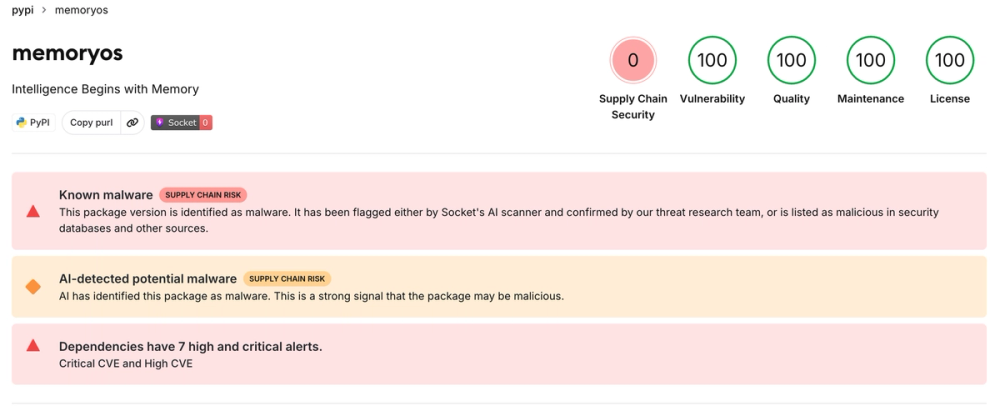
Socket details a supply-chain compromise of MemTensor's MemOS packages: npm package @memtensor/memos-cloud-openclaw-plugin (versions 0.1.21, 0.1.23, 0.1.25) and PyPI package MemoryOS (2.0.34), both published as the latest release on their registries. Each malicious release bundles a stripped, statically-linked Go binary called sckit that launches on import/plugin-load, scans $HOME for npm, PyPI, GitHub, GitLab, AWS, Vault and SSH credentials, and exfiltrates them to C2 servers under skyleen[.]fr, with the npm variant also capturing OpenClaw agent prompt text and the code additionally showing potential worm-like republish capability using stolen registry tokens.
What it is
Supply-chain compromise (published September 23, 2026) of MemTensor's MemOS. Malicious releases: npm @memtensor/memos-cloud-openclaw-plugin 0.1.21, 0.1.23, 0.1.25 and PyPI MemoryOS 2.0.34, each currently tagged latest. Last known-good releases are npm 0.1.20 and PyPI 2.0.33. Note the version churn: npm 0.1.22 and 0.1.24 differ from clean 0.1.20 only in version strings, and all six bundled sckit binaries are byte-for-byte identical across the malicious npm releases. The PyPI compromise is visible in size: the 2.0.34 wheel is 19,201,772 bytes vs 951,210 for 2.0.33.
How it triggers
Load/import is enough — no explicit API call.
- PyPI: the wheel modifies
memos/log.pysoconfigure_logging()callsmemos._stage0.trigger(). 149 modules callget_logger()at module level (including one imported bymemos/__init__.py), soimport memosfires the payload once per process. All exceptions swallowed. - npm:
index.jsimportslib/sckit.jsand callslaunchStageZero()twice — once when the OpenClaw gateway starts, and again inside the memory-recall hook with the user's prompt inSCKIT_EVENT_TEXT.
The binary runs detached with the full host environment. Config passed base64 via --config64; C2 servers under skyleen[.]fr expose /config, /status, /batch. Config has a not_after expiry of October 22, 2026. Malicious code also appears in GitHub commits e0c1ca3 (plugin) and b52958f (MemOS), both altering release tooling to grab the publish token.
Affected
Any host that loaded the npm versions or imported MemoryOS 2.0.34 — developer machines, CI runners, and containers that only ran tests are all in scope.
What to do
- Pin or remove. Search
lockfiles, requirements*.txt, poetry.lock, uv.lockand SBOMs for the two package names. Pin npm to0.1.20, PyPI to2.0.33, or uninstall. Do not trustlatest. - Rotate every secret reachable from the affected user's
$HOME/environment: npm, PyPI, GitHub, GitLab tokens; AWS keys; Vault tokens; SSH keys; Hugging Face, Slack, Stripe, SendGrid keys;.envand shell-env values. - Clean artifacts. Kill any running
sckitprocess, then delete the package directories plus~/.openclaw/.cache/runtime/and~/.memos/.cache/runtime/. - Block and hunt. Block
skyleen[.]frand all subdomains; review DNS/proxy/egress logs for it since September 23, 2026. - Check your own releases. If an affected host held npm/PyPI publish tokens, audit your packages for versions you did not publish (worm-republish behavior is suspected from strings about encoding manifests and installing repo files).
- Prompt exposure. For the npm plugin, assume prompts sent while an affected version was loaded reached the attacker.
Caveats
Findings are from static analysis only — Socket did not execute the samples, and payload/C2 details are still being analyzed. Socket could not confirm how publishing access was obtained; the npm releases came from the legitimate leason1974 account but without a gitHead, indicating they bypassed CI.
Organisations named here
- cloud-openclaw-semi-nuclear
- leason1974
- MemOS
- memos-semi-nuclear
- MemTensor
- sckit
- sckit.runtime.v1
- skyleen.fr
Technologies named here
- sckit
- npm:@memtensor/memos-cloud-openclaw-plugin
- OpenClaw
- PyPI:MemoryOS
- sckit_poetry_build.py
- MemTensor MemOS
- npm
- PyPI
- Go
- GitHub
- @memtensor/memos-cloud-openclaw-plugin
- MemoryOS
Techniques named here
- Supply chain compromise via package registry publish
- Malicious code injection into source repositories
- Execution via module import/logging hook
- Execution via plugin lifecycle and memory-recall hook
- Detached background process execution
- Credential and secret exfiltration
- Release tooling tampering
- TLS trust manipulation for C2 communication
- Error suppression to evade detection
Threat actors named here
- Unnamed threat actor behind MemTensor compromise
- sckit
Related in Supply Chain






