 embracethered.comwriteup
LLM Heist: Hijacking LiteLLM for Traffic Interception, Key Theft, and Tool-Call Injection
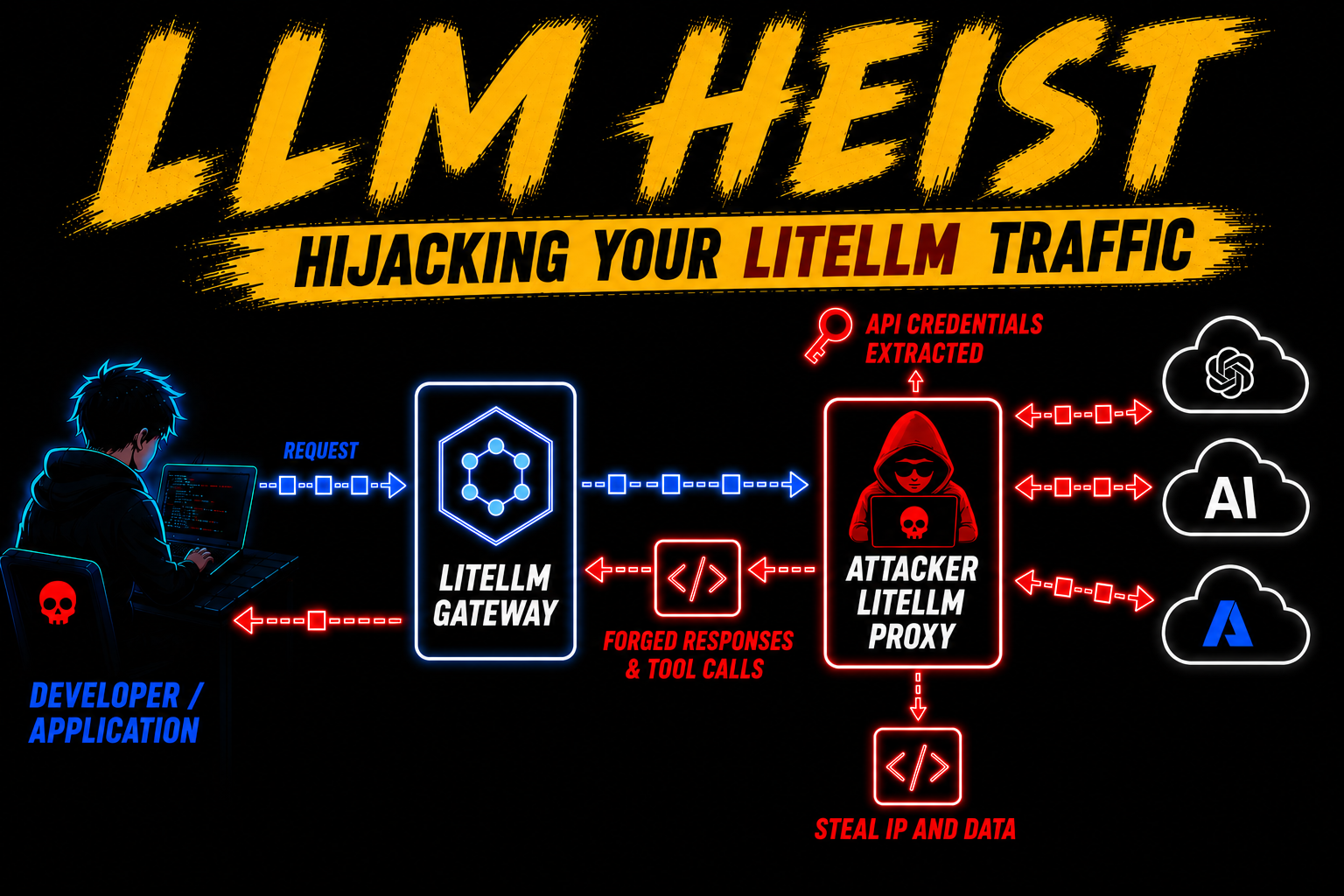
LLM Heist is a red-team technique for hijacking a LiteLLM AI gateway using a stolen proxy-admin or master key. The attacker changes api_base and use_litellm_proxy via /model/update, which routes traffic to an attacker gateway and exposes backend provider keys. The post demonstrates harvesting keys, intercepting chats, and injecting text and forged tool calls into Claude Code. It closes with red team test cases and blue team detections.
What it is
LLM Heist is a red-team technique against LiteLLM, an open-source AI gateway. It needs only a proxy-admin credential such as LITELLM_MASTER_KEY. The attacker rewrites where the victim gateway sends model traffic, so the victim's own gateway delivers its provider keys and every prompt and response to an attacker-run LiteLLM instance. The post's author built a tool, llm-heist, to automate this, but is not releasing it widely. The post says the approach applies in principle to other AI gateways.
How it works
The attack uses documented management functionality, not a vulnerability. Two settings are changed through /model/update:
api_baseis set to the attacker's gateway.use_litellm_proxyis set totrue, which makes the victim forward to another LiteLLM instance.
Clients keep the same endpoint and virtual key, so developer machines need no changes. The sequence is:
- Harvest. The victim resolves the real provider key and sends it in the
Authorization: Bearerheader to the attacker. A custom auth hook on the attacker's gateway records the header and returns a canned response, so clients briefly get bad answers. - Provision. The attacker creates model endpoints on their own gateway using the captured
api_key. - Hijack. The victim's routes are pointed at the attacker. The attacker now forwards real traffic and sees requests and responses.
- Inject. The
async_post_call_success_hookandasync_post_call_streaming_iterator_hookcallbacks rewrite responses. The post demonstrates injected text and a forgedBashtool call in Claude Code.
The forged tool call is created after inference, so prompt-level defenses never see it. In the demo, the call ran in Claude Code under yolo mode. It does not bypass client-side tool approval otherwise. With HTTPS, the key is visible once the attacker terminates TLS.
Preconditions / Affected
- The attacker needs the master key or an equivalent proxy-admin credential, plus network reach to the admin API. The post names leaked
.envfiles, deployment manifests, secrets in source control, exposed admin UIs with weak authentication, and weak or badly distributed master keys. - Code execution on the gateway is not assumed, because it would expose provider keys directly. The post lists unpatched instances as another route in: the March 2026 PyPI package compromise that shipped a credential stealer, an Obsidian Security chain from low-privilege user to administrator, and CVE-2026-42271 (authenticated command execution on the host, added to CISA's KEV catalog).
- Monitoring intercepted traffic on the attacker side polls
/spend/logs, which needsstore_prompts_in_spend_logs: true. This is off by default but can be set on a proxy the attacker owns.
What to do
Detections and mitigations from the post:
- Alert on changes to
api_baseanduse_litellm_proxy, and on new callbacks or guardrails. While a reroute is active,/model/infoand the victim UI show the changedapi_base. - Rotate provider keys automatically and regularly.
- Forward gateway audit logs to a SIEM.
- Restrict gateway egress, and restrict provider keys to approved gateway IPs.
- Lock down SSH and admin interfaces, and reconsider exposing LiteLLM to the internet.
- Reconcile provider billing, since independent use of a harvested key produces charges. Set spend limits.
- Patch the host and LiteLLM.
Red-team test cases: find gateways, hunt for admin and master keys (source control, docs, tickets, manifests, CI/CD variables), check whether unpatched instances or the admin API are reachable from networks that should not reach them, and check whether anyone notices a reroute.
Caveats
- The demo ran over HTTP in a lab, and only response modification was shown. The post says the same point could alter requests too.
- The post proposes prompt and response signing by AI labs to detect a gateway in the middle, but this does not exist yet.
- The post gives no LiteLLM version boundaries beyond the named incidents and CVE.
Organisations named here
- LITELLM_MASTER_KEY
- LLM Heist
- MITRE ATT&CK
- Obsidian Security
- tool-call injection
- traffic interception
CVEs named here
- CVE-2026-42271
Technologies named here
- LiteLLM
- Claude Code
- MITRE ATT&CK
- Anthropic
- LLM
- CISA KEV
- LiteLLM /model/update API
- LiteLLM PyPI package (compromised in March 2026 and shipped a credential stealer)
- LiteLLM /spend/logs
- llm-heist
- Other AI gateway products (research applies in principle, per the author)
Techniques named here
- Credential/key hunting (search for master keys and admin credentials)
- Provider credential theft via resolved backend keys
- Response forgery / output injection after inference
- Tool-call injection
- Unauthorized inference using stolen virtual/provider keys
Related in AI Security

 blog.talosintelligence.comtool
Introducing CAIRN: Frontier tracking for AI-integrated malware (Cisco Talos)
 github.comadvisory
Flowise MCP Security Bypass Enables RCE
github.comrepoYesWeHack Claude Kit

 jfrog.comarticle