 huntress.comwriteup
The Tale of Two INC Ransom Notes: A Ransomware Timeline | Huntress
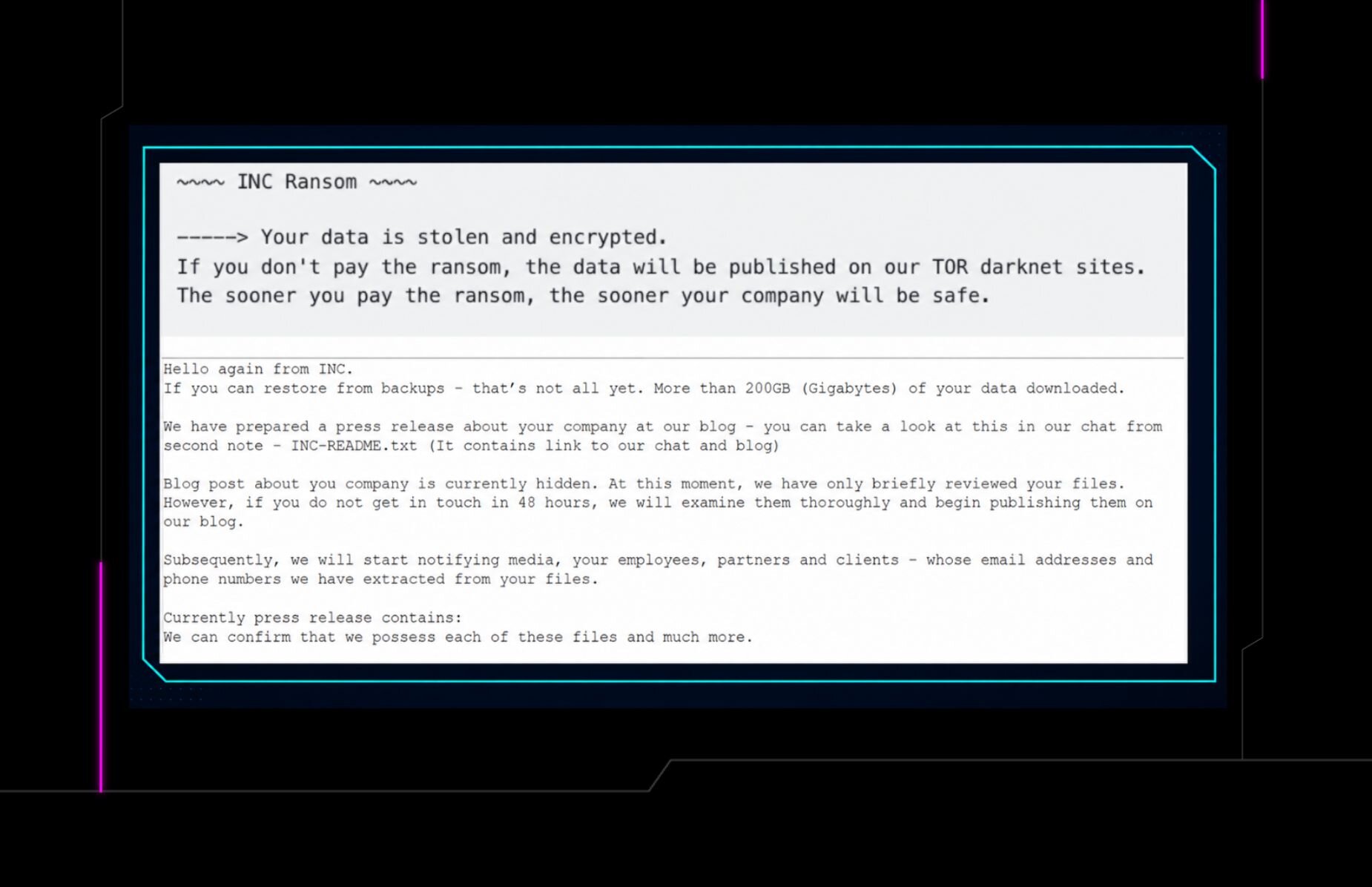
Huntress details a post-incident investigation into an INC ransomware attack that hit 175+ endpoints, reconstructed from surviving EDR telemetry and Windows event logs rather than live detection. The intrusion shows a 17-day gap between initial scheduled-task persistence and RDP lateral movement (possibly an initial access broker), and a second wave using AnyDesk, a BYOVD tool (hwau.exe loading the HwAudio kernel driver) to disable security controls, and Impacket's atexec.py to deploy INC ransomware. Attackers dropped two distinct ransom notes 53 minutes apart: a standard INC-README.txt and a detailed DATALEAK_PRESS_RELEASE.txt threatening to notify media, employees and partners with a full inventory of stolen files.
What it is
The INC ransomware intrusion Huntress reconstructed (details in the catalog summary) carries a concrete set of host- and network-level indicators the summary doesn't list. This document exists to surface those artifacts for hunting, plus one detail the summary omits: a renamed legitimate vulnerability-remediation tool used as attacker tooling.
Indicators
Network:
- AnyDesk C2 IP:
213.111.185[.]108 - Obfuscated PowerShell implant beacon domain:
throughoutes[.]net
Host / persistence:
- PowerShell implant:
C:\ProgramData\Vendettister\jocularities.ps1(heavily obfuscated) - Example scheduled task with randomized name:
Nonweighise\Cancellationizing\Illuminateers, description"nationhood kinestheticization preironish fictionallyes"— the campaign used multiple such random-named tasks for persistence and, later, for atexec.py execution - BYOVD dropper:
hwau.exeinC:\Users\Public(on a domain controller) - Vulnerable kernel driver / service:
HWAuidoOs2Ec.sysinC:\Users\Public, loaded as serviceHwAudio - Recon tool
netscan.exedeployed via the AnyDesk instance alongside the BYOVD
The renamed vRx binary (not in the summary)
On one endpoint a scheduled task pointed to C:\Program Files\7-Zip\HealthUpdater.exe — a renamed vRx executable from Vicarius Inc., a legitimate remediation platform. Two tells: it sat in an unusual folder (under 7-Zip) and was renamed, though its embedded file-version metadata did not carry the original filename. Worth noting because the file-version string won't betray it — detection has to key on path/hash, not internal name.
What to do
The page's stated hardening measures:
- Limit and monitor remote access; enforce MFA; restrict privileged accounts to only the systems they need.
- Monitor for unusual scheduled tasks, unexpected remote-management tools (AnyDesk here), and new or unsigned driver services — the
HwAudioservice load is the pivot point where security controls get disabled. - Maintain tested offline backups and an IR plan with rapid isolation, to contain before lateral movement and exfiltration complete.
Caveats
This is a post-incident reconstruction from surviving EDR telemetry and Windows Event Logs; logs had "rolled over," so the initial access vector was never determined. The two-actor / IAB hypothesis rests on the 17-day gap and the shift in tooling, not on direct attribution evidence. The random task names shown are per-incident and unlikely to recur verbatim — hunt on the pattern (random-named tasks pointing to ProgramData scripts), not the literal strings.
Technologies named here
- Windows domain controllers
- Huntress EDR
- Windows endpoints
- AnyDesk
- netscan.exe
- hwau.exe / HwAudio driver
- Impacket atexec.py
- vRx
- PowerShell implant
- Impacket
- PowerShell
- RDP
- Active Directory
- Windows
Techniques named here
- Scheduled task persistence
- Lateral movement via RDP
- BYOVD
- Remote monitoring and management tool abuse
- Remote task execution via Impacket atexec.py
- Data exfiltration and double extortion
- Ransom note psychological pressure / escalation threats
Threat actors named here
Related in Threat Intel
 huntress.comwriteup
Reverse Engineering the Six Stages of MacSync Stealer and RAT
 huntress.comwriteup
AI-Coded Malware | Analyzing Vibe-Coded AD Enumeration | Huntress

 blog.talosintelligence.comtool
Introducing CAIRN: Frontier tracking for AI-integrated malware (Cisco Talos)
 huntress.comwriteup