 orca.securityadvisory
Orca Security: Zoom Zero-Click RCE Flaws Allow Any Meeting Attendee to Compromise All Participants
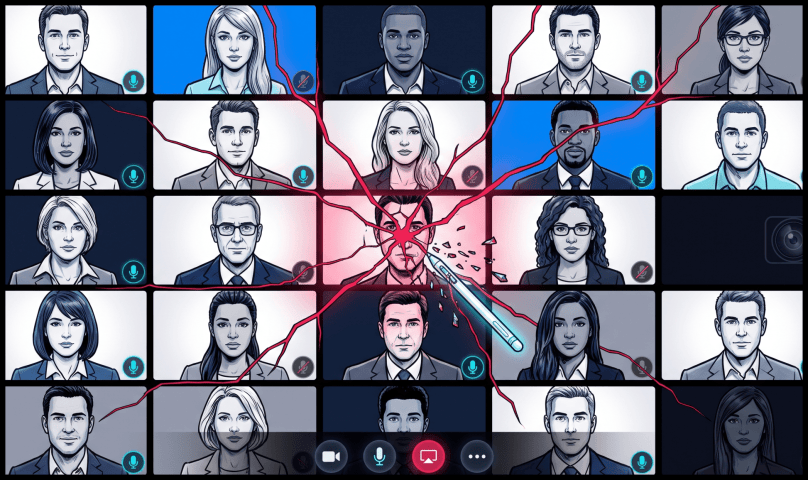
Orca Security details four Zoom vulnerabilities in the cross-platform annotation engine (libannotate.so): CVE-2026-53413, a stack buffer overflow in CAnnoFormatBlock::Deserialize from unchecked 32-bit character counts, and CVE-2026-53415, a use-after-free in auto-shape metadata handling giving a write-what-where primitive, both enabling zero-click RCE against every meeting participant via crafted annotation messages during screen sharing. Also disclosed are CVE-2026-53414 (heap over-read/DoS) and CVE-2026-53416 (path traversal in the Windows VDI client). The write-up notes a working exploit chain built in under 24 hours with fewer than 20 AI-model prompts, platform-specific exploitation details (macOS ARM64 ASLR bypass, Android heap spraying/vtable corruption), and that E2EE meetings bypass Zoom's server-side message filtering.
CVEs named here
- CVE-2026-53413
- CVE-2026-53414
- CVE-2026-53415
- CVE-2026-53416
Technologies named here
- Zoom Workplace clients
- libannotate.so
- Orca Security Platform
- Zoom Workplace VDI Client for Windows
- Zoom Rooms
- Zoom Meeting SDK
- Orca Security
- Android
- macOS
- iOS
- Windows
Techniques named here
- Zero-click RCE via malicious annotation messages
- ASLR bypass using leaked pointers
- Heap spraying and vtable corruption
Related in AppSec
 github.comadvisory
Flowise MCP Security Bypass Enables RCE

 huntress.comwriteup
Inside an Oracle Database SQL Injection Attack | Huntress
github.comrepoOASIS

 blog.trailofbits.comwriteup