
 github.blogarticle
GitHub’s model for secret detection: Finding more secrets with less noise
GitHub describes its secret scanning pipeline for generic secrets. Regex finds candidates with high recall, then a fine-tuned ModernBERT classifier reads the candidate with its file path, secret type and surrounding code to filter hard negatives such as placeholders, fixtures and checksums. The post covers the training data (product feedback, weak labels, synthetic hard negatives), grouped train/eval splits, and ONNX 8-bit quantization. Reported results against the earlier LLM pipeline: 13% higher precision, 19% higher recall, 11.5% higher owner-weighted acceptance, 86% lower median scan time and over 98% lower serving cost. The speed gain made generic secret detection feasible in push protection.
What it is
GitHub's account of replacing an LLM-based generic-secret pipeline in secret scanning with a regex candidate stage plus a fine-tuned ModernBERT classifier. The useful parts for someone building something similar are the design rules and how the results were measured, more than the headline numbers.
How it works
- Regex stays as the deterministic, high-recall first stage. The classifier only decides between "looks like a secret" and "is likely a real secret". It never finds new candidates.
- Each model input is the candidate value, file path, secret type and a bounded window of surrounding context. The page does not give the window size, model size or latency figures.
- The output is a score. The threshold is chosen offline, then validated on production-like traffic before rollout.
- Synthetic hard negatives (docs secrets, fixtures, public keys, checksums, near-miss pairs) go through deterministic validation and model-based quality review before they enter training.
- Rows sharing a repository, candidate value or example are grouped before the train/eval split, so near-duplicates can't leak across it.
- The model is exported to ONNX with 8-bit quantization.
What to do
If you are building or evaluating something similar, the page implies these practices:
- Keep the rules engine for recall and use the model only to suppress false positives.
- Split data by group (repo, value, example), not by row.
- Mine hard negatives deliberately.
- Evaluate in two stages: offline precision and recall against the incumbent on the same traffic, then an A/B test on user behavior.
- Weight acceptance by repository owner. GitHub does this so customers who bulk-resolve many alerts don't distort the average.
Caveats
- All results are relative to GitHub's previous LLM pipeline. No absolute precision, recall, latency or cost figures are given.
- The offline numbers (+13% precision, +19% recall) are for post-push scanning on public traffic. The page says nothing about how recall ground truth was established.
- The 86% scan-time reduction is also post-push. Push protection gets no measured numbers, only the claim that the speedup made it practical.
- Because regex generates the candidates, the classifier cannot recover secrets the regex stage misses. The page says GitHub is investigating single-step detection and extraction models.
- The page presents acceptance as a proxy for precision. It does not say how many accepted alerts were true secrets.
Organisations named here
- hard negatives
Technologies named here
- GitHub secret scanning
- Regex candidate generation
- ModernBERT
- GitHub
- ONNX
- LLM
- Push protection
Techniques named here
- Two-stage detection pipeline
- Hard-negative training
- Reported results
Related in DevSecOps

 jfrog.comarticle
JFrog: The Governance Gap Between Your Policy and Your Pipeline
 stepsecurity.ioarticle
Dev Machine Guard Now Supports Windows - StepSecurity
 socket.devwriteup
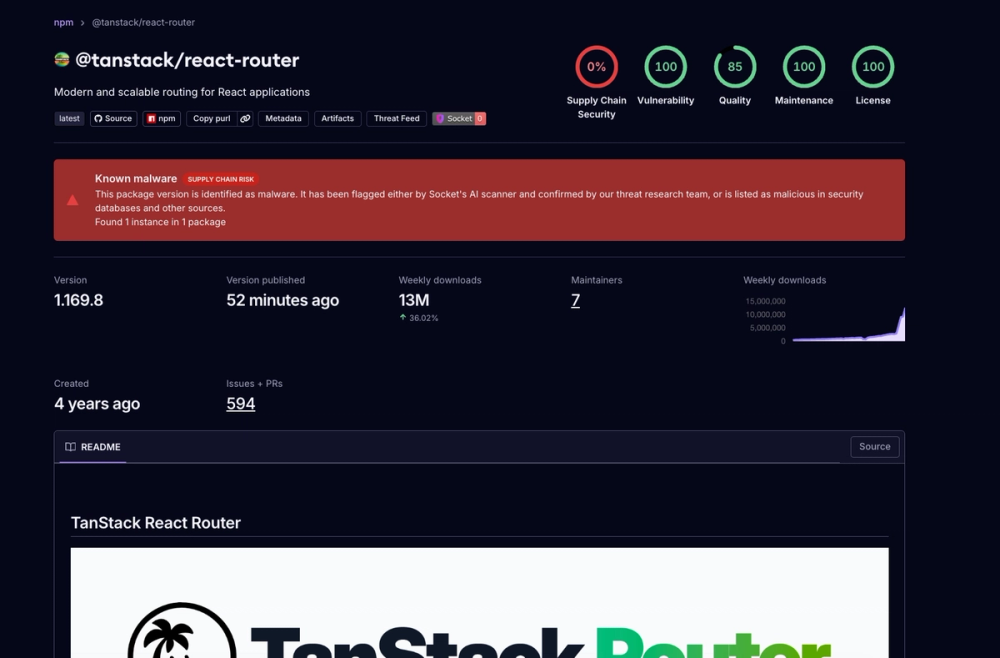
Socket: TanStack npm Packages Compromised
 securitylab.github.comadvisory