
 endorlabs.comarticle
PWN Request Threat: A Hidden Danger in GitHub Actions | Endor Labs
Explains the "pwn request" weakness in GitHub Actions. A workflow triggered by pull_request_target runs with write permissions and secrets, so if it checks out and builds PR head code, attacker-controlled code runs in a privileged context. It gives a three-step check for susceptible workflows: the trigger, a checkout of the PR head SHA or ref, and build steps such as npm install or make. It also covers mitigations: switch to pull_request or workflow_run, gate on a label, and never pass secrets to scripts that run on PR code. It notes safe patterns and cites the puppetlabs finding.
What it is
Endor Labs' description of the "PWN request" weakness in GitHub Actions. A pull_request_target workflow gets write permission and repository secrets, and it becomes exploitable when it checks out and runs code from the PR. The page cites a PWN vulnerability found in puppetlabs but gives no CVE or other details.
Preconditions / Affected
The page says a workflow is susceptible when all three hold:
flowchart LR
  A[Trigger is pull_request_target] --> D{All three?}
  B[PR code checked out] --> D
  C[Build or script runs on it] --> D
  D -->|yes| E[Attacker code runs with write token and secrets]
  D -->|no| F[Not this pattern]
Strings the page lists as signs of a PR checkout (step 2):
actions/checkout@"${{ github.event.pull_request.head.sha }}""refs/pull/${{ github.event.issue.number }}/head"
The last ref uses issue.number, which points to comment-driven workflows. The page says Endor's scanner also examines issue_comment triggers, not only pull_request_target. It also follows workflows called by parent workflows, so a risky pattern in a called workflow still counts.
Step 3 is any build step that interacts with the checked-out code: npm install, make, custom scripts or other tools.
What to do
- If the workflow needs neither write access nor secrets, use
pull_requestinstead. - Grant privileges only where needed, using
pull_requestandworkflow_run. - Gate
pull_request_targeton a specific label. The label signals that someone with write access has vetted the PR. - Never pass credentials to custom scripts that run on checked-out PR code.
- Avoid checking out PR code and then running build commands on it.
The page names three patterns where combining pull_request_target with a PR checkout can be safe, because the PR code is not executed:
- Reformatting and committing code.
- Generating a diff by checking out both the base and head repositories.
- Running
grepover the checked-out source.
Caveats
pull_requestruns from a same-repo branch also get write permission and secrets. Only external forks lack them, so the safe default depends on where the PR comes from.- The page's closing advice to review repository contribution and merge controls is not elaborated.
- Roughly the last third of the page is a pitch for Endor Labs' scanner.
Technologies named here
- Endor Labs Software Supply Chain Security platform
- puppetlabs
- GitHub Actions
- GitHub
Techniques named here
Related in DevSecOps

 jfrog.comarticle
JFrog: The Governance Gap Between Your Policy and Your Pipeline
 stepsecurity.ioarticle
Dev Machine Guard Now Supports Windows - StepSecurity
 socket.devwriteup
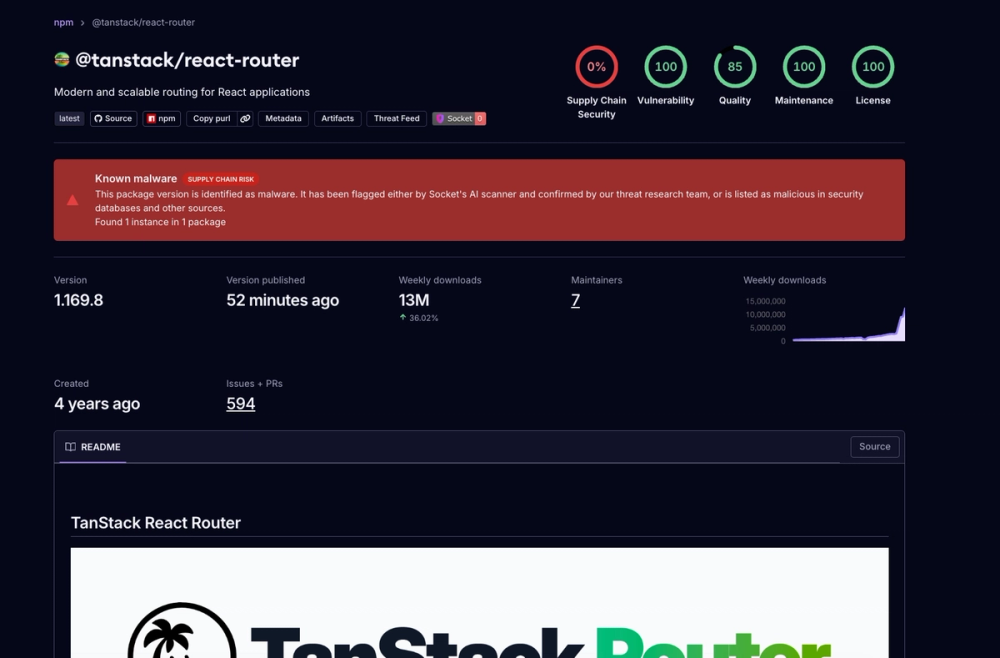
Socket: TanStack npm Packages Compromised
 securitylab.github.comadvisory