 opensourcemalware.comtalk
The OpenSourceMalware Show #7
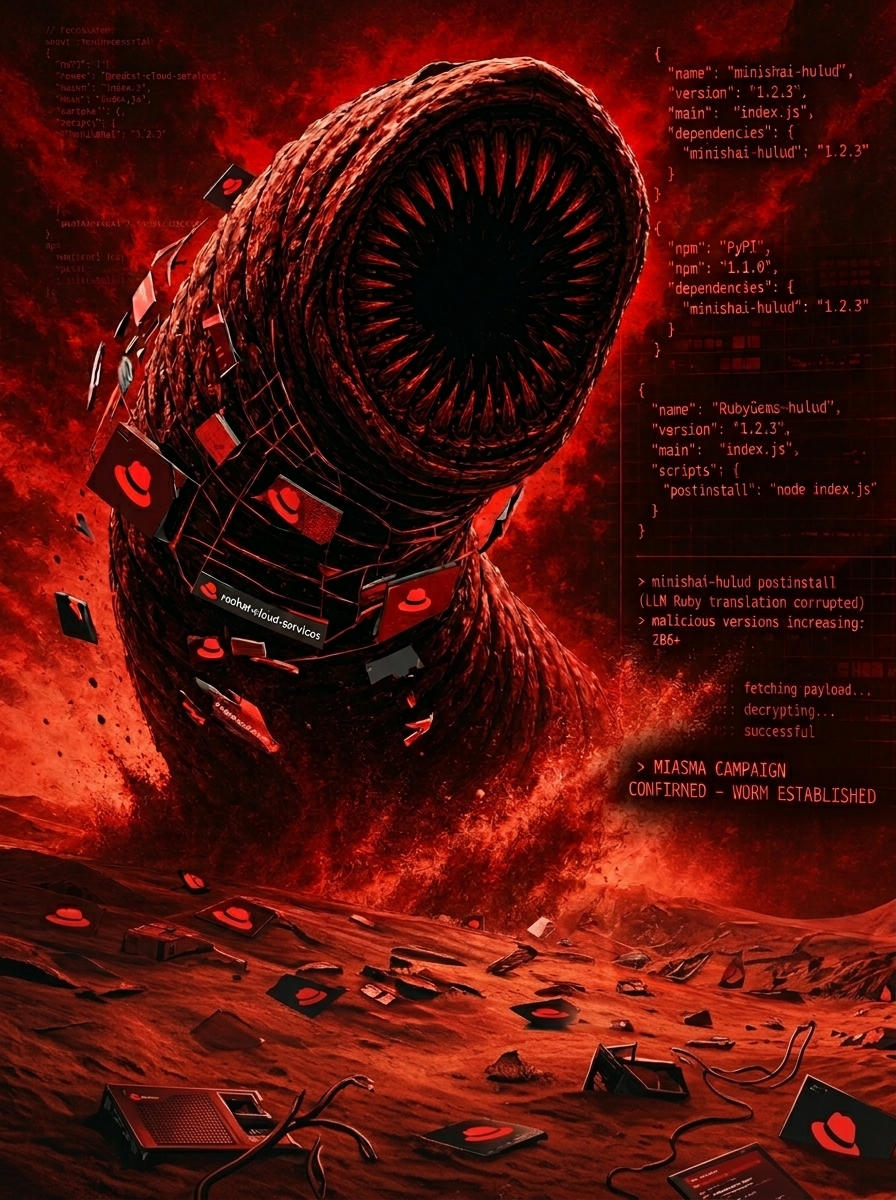
Podcast/show episode from OpenSourceMalware covering the Miasma worm campaign that compromised 32+ Red Hat @redhat-cloud-services npm packages (later 80+ packages, 286+ malicious versions) via abused npm trusted-publishing gaps rather than a GitHub Actions vulnerability, using the first in-the-wild deployment of TeamPCP's open-sourced Mini Shai-Hulud worm code across npm, PyPI, and an LLM-translated RubyGems variant. It also presents six months of OpenSourceMalware threat-report data (npm vs PyPI growth correlation, account takeovers reaching 60-65% of new weekly records, 700+ malicious ClawHub agent skills targeting marketers via SEO/TikTok/Klaviyo themes), and dissects the Moika campaign (~300 packages, oob.moika.tech C2, 260+ threat reports) as a gray-area case mixing bug-bounty-researcher signals with overtly credential-stealing payloads, alongside the long-running phenomenon of bug-bounty researchers accounting for 25-41% of malicious OSV packages and AI-hallucinated package names (e.g. Events Channel) being weaponized as typosquats.
What it is
Episode 7 of The OpenSourceMalware Show (recorded June 4, 2026), reporting on the Miasma npm worm campaign and adjacent threats. Beyond the summary, the page carries specific indicators and mechanisms an engineer can act on: the campaign's scale, the trusted-publishing abuse path, a still-live weaponized package, and Moika's fingerprints.
How it works
Miasma: Began June 1 with 32 @redhat-cloud-services packages (~80,000 combined weekly downloads), expanding to 80+ packages and 286+ malicious versions within days. Entry was not a GitHub Actions vulnerability (the initial theory, corrected live on-air by Francois of BoostSecurity) but abused gaps in npm trusted publishing. It is the first in-the-wild use of TeamPCP's open-sourced MiniShai Hulud worm; it spreads across npm, PyPI, and RubyGems, with the Ruby variant appearing LLM-translated rather than original.
Moika: 260+ reports tied to oob.moika.tech, ~300 packages. Tell: version numbers set to 99.9 to float above legitimate packages. Some payloads are benign PoCs (bug-bounty pattern), others overtly steal credentials — one researcher attributes it to a Russian nexus.
AI-hallucination vector: LLM-hallucinated package names get registered and weaponized. Example cited: Events Channel, still live on npm with 168,000 downloads despite being reported.
Preconditions / Affected
- Consumers of
@redhat-cloud-servicesnpm packages, or anything installed via multi-ecosystem CI that pulls npm/PyPI/RubyGems. - Pipelines relying on npm trusted publishing — the abused surface here.
- Anyone whose tooling or LLM suggests package names without verifying they map to real, trusted publishers (Events Channel risk).
What to do
The page gives no commands, but names concrete checks:
- Audit for compromised
@redhat-cloud-servicesversions and any of the 286+ malicious versions in your lockfiles. - Treat
oob.moika.techand packages versioned99.9as IOCs. - Remove/block Events Channel — reporting did not get it taken down; it remains live.
- Given credential abuse now begins within seconds of compromise (not manual follow-through), rotate secrets immediately on any suspected pop rather than investigating first.
Caveats
- This is a podcast/video episode, not an advisory — no patch list, hashes, or affected-version manifest is provided here.
- TeamPCP has not claimed credit for the worm despite it being their open-sourced code.
- Moika is explicitly gray-area: mixed benign-PoC and credential-stealing behavior, attribution unconfirmed.
- The 25–41% "bug bounty researcher" share of malicious OSV entries covers Oct 2024–Jan 2025, not the current window.
Organisations named here
- ClawHub
- oob.moika.tech
- slopsquatting
Technologies named here
- Red Hat @redhat-cloud-services npm packages
- OpenSourceMalware
- npm ecosystem
- OSV
- ClawHub
- PyPI ecosystem
- HackerOne
- RubyGems ecosystem
- STEP
- ClawHub skills platform
- Events Channel
- Nx Console VS Code extension
- npm
- PyPI
- RubyGems
- GitHub Actions
- GitHub
- axios
- Nx Console
- Red Hat
Techniques named here
- npm trusted publishing abuse
- Multi-ecosystem worm propagation
- Automated post-compromise credential abuse
- CI pipeline / automated build targeting
- Dependency confusion
- Typosquatting
- AI package hallucination / slopsquatting
- Aged/dormant account takeover for malicious publishing
- Malicious AI agent skills targeting non-developers
- Bug-bounty-style malicious package research
- Phantom Gyp
Threat actors named here
- Miasma Campaign
- TeamPCP
- Mini Shai-Hulud
- Moika campaign
- Axios compromise
- PollenWriter
- events-channel
- NX console VS Code extension compromise
- Darshan
- PhantomRaven
- Miasma
- Miasma worm
- Moika
- PolinRider
Related in Supply Chain







