 huntress.comarticle
Huntress Tragic Quadrant: Top Cyber Threats Wrecking Businesses
Huntress's "Tragic Quadrant" ranks the cyber threats its SOC sees most often against small/mid-sized businesses by prevalence and blast-radius risk, drawing on 2026 telemetry from 5M+ endpoints and 15M identities. It highlights RMM abuse (45% of endpoint incidents in Q1 2026), mailbox-rule manipulation feeding BEC (24.6% of ITDR signals), AiTM session-token theft bypassing MFA (18.9% of identity threats), plus device code phishing (the EvilTokens PhaaS kit hit 344 orgs in 16 days using Railway-hosted infrastructure and spoofed Cisco/Trend Micro/Mimecast redirect links), ClickFix clipboard-paste infections leading to LummaC2 infostealer compromise, and emerging AI-platform abuse (the FakeAgent campaign hosted a malicious Claude Artifact on claude.ai to drop SectopRAT, hitting 29 organizations in two days).
What it is
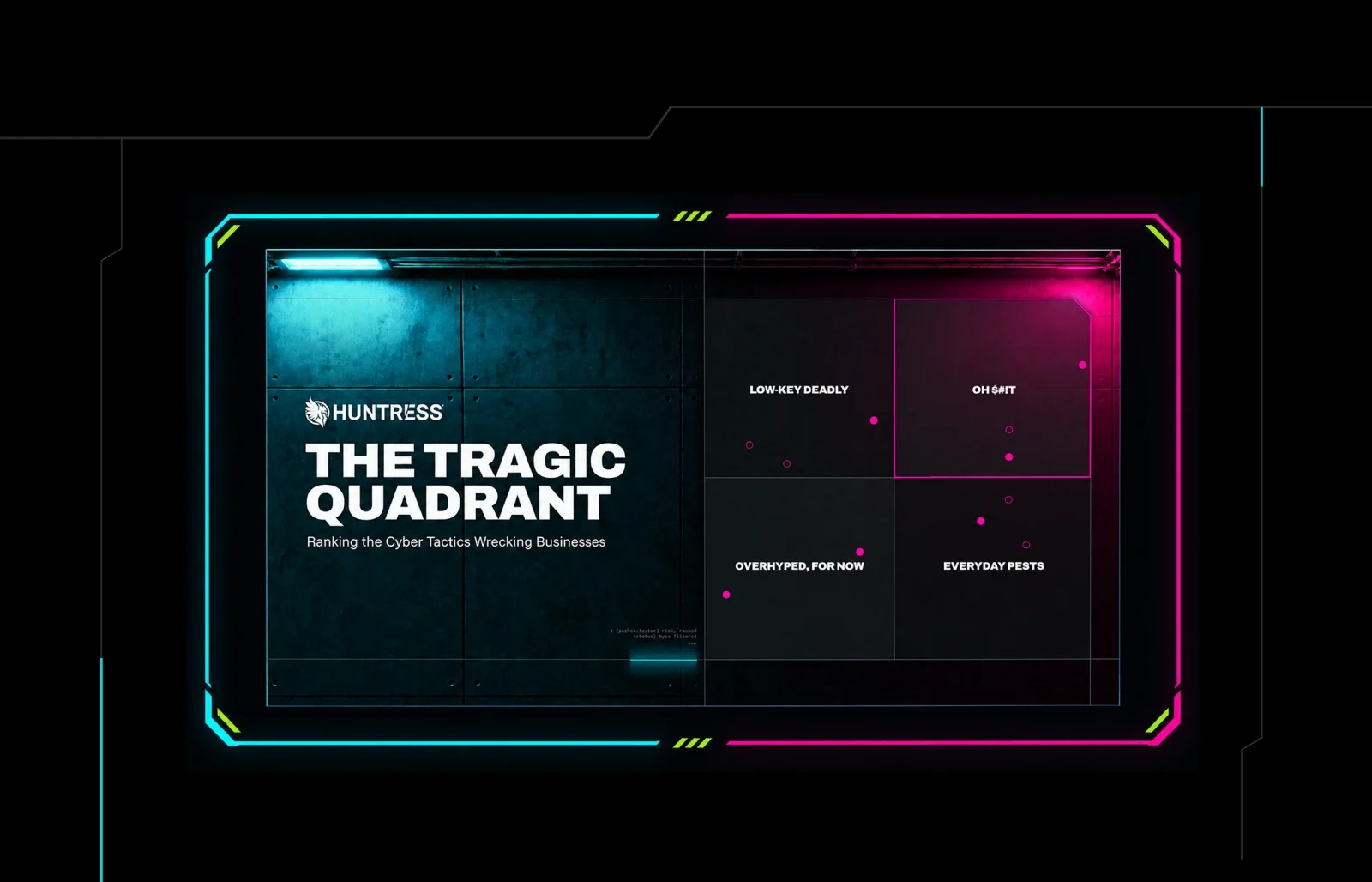
Huntress's "Tragic Quadrant" plots cyber threats against SMB/MSP environments on two axes: prevalence and "pucker factor" (closeness to a major disruption like ransomware, data theft, or BEC). It's built from telemetry across 5M+ endpoints, 15M identities, and ~300,000 organizations, current through Q1 2026.
How it works
The quadrant has four zones. The top-right "OH $#!T corner" (high prevalence + high pucker factor) holds RMM abuse, mailbox manipulation, and AiTM session-token theft — the summary already names these with their percentages. Outside that corner, three threats are placed differently: device code phishing is "low-key deadly" (low prevalence, high severity), ClickFix is a "daily pest with high stakes" (low prevalence, high severity — 2.2% of EDR signals but ~99% of those are high-severity), and AI-platform abuse is "overhyped, for now" (an emerging, still-low-volume pattern). A solid dot on the chart marks threats Huntress has observed being AI-accelerated.
What to do
The page's concrete recommendation is to triage using three questions tied to the OH $#!T corner: which RMM tools are approved for use, how mailbox rule changes are monitored, and how unusual session/token behavior is caught before escalation. For device code phishing specifically, it advises monitoring for unusual device code prompts and anomalous token use rather than relying on URL inspection, since the flow runs through Microsoft's legitimate login pages.
Caveats
AI-platform abuse is explicitly labeled by Huntress as not yet a high-prevalence threat — it's flagged as an emerging pattern worth watching rather than a current top-tier risk, despite the attention-grabbing claude.ai example already noted in the summary. The quadrant reflects Huntress's own SOC telemetry (its customer base), not industry-wide incident data.
Organisations named here
- ClickFix
Technologies named here
- Microsoft 365
- Remote Monitoring and Management tools
- Identity Threat Detection and Response
- Windows Run box
- Managed Endpoint Detection and Response
- Claude
- ChatGPT
- Huntress SOC
- Grok
- Railway
- Cisco, Trend Micro, and Mimecast redirect URLs
- Huntress
Techniques named here
- RMM abuse
- Mailbox manipulation and persistence
- Adversary-in-the-Middle account takeover
- Device code phishing
- ClickFix
- AI platform abuse
Threat actors named here
- EvilTokens
- LummaC2
- FakeAgent
- SectopRAT
Related in Threat Intel
 huntress.comwriteup
Reverse Engineering the Six Stages of MacSync Stealer and RAT
 huntress.comwriteup
AI-Coded Malware | Analyzing Vibe-Coded AD Enumeration | Huntress

 blog.talosintelligence.comtool
Introducing CAIRN: Frontier tracking for AI-integrated malware (Cisco Talos)
 huntress.comwriteup