 huntress.comwriteup
dMSA Ouroboros: Self-Sustaining Credential Extraction in Windows Server 2025
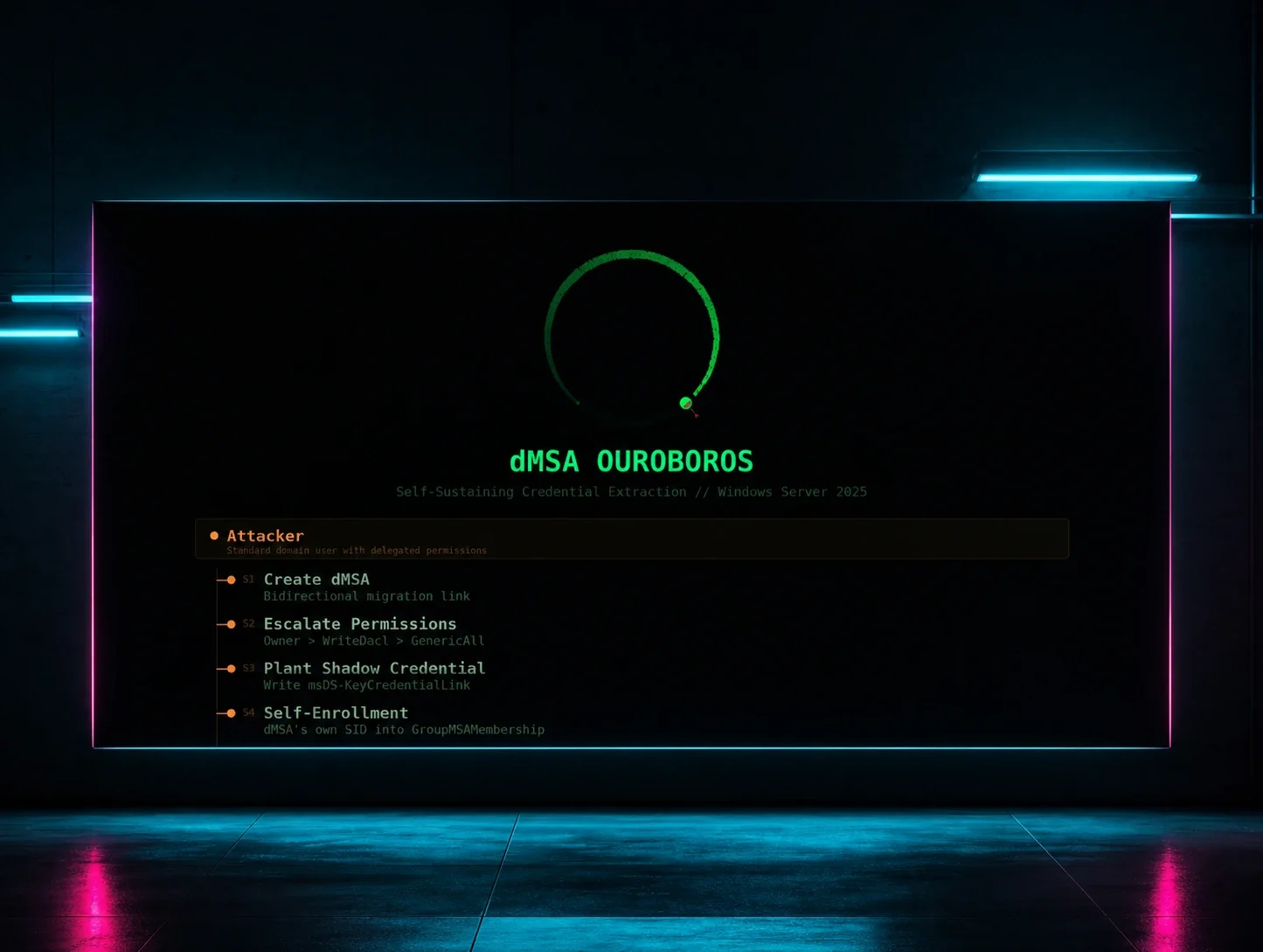
Huntress and Akamai researchers detail "dMSA Ouroboros," a technique where a low-privileged domain user with CreateChild on any OU/container plus WriteProperty on a target account creates a delegated Managed Service Account (dMSA), plants a Shadow Credential via msDS-KeyCredentialLink for PKINIT auth, and writes the dMSA's own SID into msDS-GroupMSAMembership so it authorizes itself via S4U2Self to continuously extract the superseded account's NT hash. The resulting loop survives password rotation, survives deletion of the original attacker account, and can lock Domain Admins out of remediation, with deletion of the dMSA object being the only effective fix; the post also proposes BloodHound detection edges and Microsoft declined to service it as a CVE, classifying it as persistence rather than privilege escalation.
What it is
"Ouroboros" is a self-sustaining credential-extraction and persistence technique against Windows Server 2025 delegated Managed Service Accounts (dMSAs), from Huntress in partnership with Akamai. It is not a bypass of a single check — it engineers a dMSA configuration that continuously satisfies both of the KDC's authorization gates on its own, so the loop keeps extracting a target account's NT hash after the original attacker account is deleted, after password rotation, and — per the page — while locking Domain Admins out of remediation. It works on fully patched Server 2025 in six commands.
How it works
The page's contribution beyond the summary is the two-gate mental model that explains why the post-BadSuccessor patch does not stop this:
- Gate 1 (retrieval) is genuinely closed. Unlike gMSA's constructed
msDS-ManagedPasswordblob, dMSA denies that attribute by default in thedefaultSecurityDescriptorand adds a DC-side check blocking LDAP reads regardless of ACL. The classic "read the blob, derive keys" gMSA path does not work. - Gate 2 (
msDS-GroupMSAMembership) shifts meaning. For dMSA it authorizes who may operate as the account — who can obtain a TGT via theS4U2Self --dmsaflow and receive theKERB-DMSA-KEY-PACKAGEholding the superseded account's credentials.
Crucially, authenticating as the dMSA is separate from inheriting the superseded identity. Ouroboros satisfies both independently: it authenticates via a planted Shadow Credential and authorizes itself by writing its own SID into GroupMSAMembership.
Preconditions / Affected
Windows Server 2025 dMSAs, fully patched. Attacker needs only CreateChild on any OU/container and WriteProperty on the target account. The CVE-2025-53779 patch requires bidirectional links (msDS-ManagedAccountPrecededByLink on the dMSA and msDS-ManagedAccountSucceededByLink on the target) before the KDC issues credential material — but it does not stop a low-privilege user with the right delegated rights from creating those legitimate links, and does not govern who can write the dMSA's security-relevant attributes after creation. That post-creation ACL/attribute gap is the entry point.
Caveats
- The fetched text is truncated before the actual six-command chain walkthrough and the "how defenders should respond" section — the concrete detections and mitigations are not captured here; consult the source.
- Golden dMSA (Semperis) received no CVE: Microsoft's position is that the KDS root key is only reachable by Domain/Enterprise Admins and SYSTEM, and dMSA was never intended to protect against DC compromise.
- The authors frame Gate 1 as a real improvement; Ouroboros does not defeat it, it routes around it via Gate 2.
Organisations named here
- Adi Malyanker
- MSRC Case 107173
- MSRC Case 107235
- PKINIT
- S4U2Self
- Shadow Credentials
- VULN-173664
- VULN-173807
- Yuval Gordon
CVEs named here
- CVE-2025-53779
- CVE-2022-26923
- CVE-2021-42278
- CVE-2021-42287
Technologies named here
- BloodHound
- Windows Server 2025
- Certipy
- bloodyAD
- Impacket
- badS4U2self
- System.DirectoryServices.ActiveDirectorySecurity
- Python ldap3
- Active Directory
- Kerberos
- Windows
- Kali Linux
Techniques named here
- dMSA Ouroboros
- BadSuccessor
- Golden dMSA
- Shadow Credential attack
- PKINIT authentication
- S4U2Self --dmsa
- UnPAC-the-hash
- DCSync
- SELF principal audit
- Ownership -> WriteDacl -> GenericAll privilege chain
- RBCD abuse
- Certifried technique
- noPac technique
- Targeted Kerberoasting
- Constrained Delegation abuse
Related in Offensive Security
 huntress.comwriteup
AI-Coded Malware | Analyzing Vibe-Coded AD Enumeration | Huntress
 github.comrepo
YesWeHack Claude Kit
 huntress.comwriteup
Inside an Oracle Database SQL Injection Attack | Huntress
 huntress.comwriteup