 socket.devwriteup
TeamPCP SAP CAP Attack
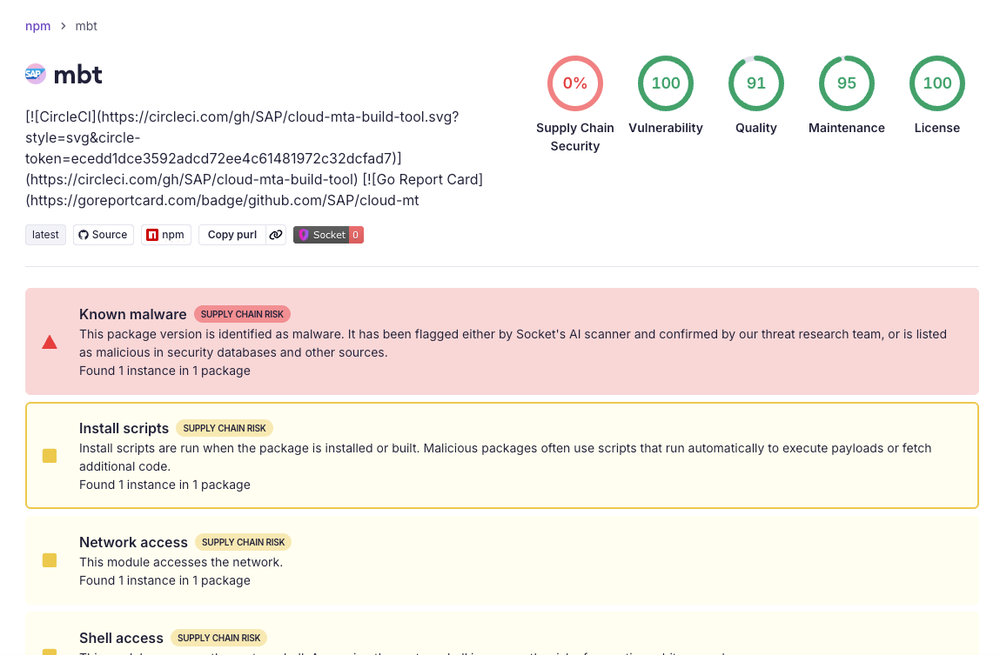
Socket documents a TeamPCP-linked supply chain attack compromising four SAP-affiliated npm packages (mbt, @cap-js/sqlite, @cap-js/db-service, @cap-js/postgres) via a malicious preinstall script that downloads and runs Bun to execute an 11.7MB obfuscated payload. The payload steals SSH keys, cloud/K8s/npm/GitHub credentials, AI tool configs, and crypto wallets, scrapes secrets from CI runner memory bypassing log masking, exfiltrates via attacker-created GitHub repos, self-propagates by publishing trojanized versions of hardcoded SAP CAP dependencies, and persists via Claude Code and VSCode hooks. Socket attributes the campaign with medium confidence to TeamPCP based on shared __decodeScrambled cipher, Russian-locale kill switch, and GitHub-as-C2 patterns previously seen in Checkmarx, Bitwarden CLI, and Trivy incidents.
What it is
A suspected supply-chain compromise of npm packages tied to SAP's Cloud Application Programming Model (CAP) and cloud deployment tooling, attributed to a TeamPCP-linked actor. Affected packages: mbt (the Cloud MTA Build Tool), @cap-js/sqlite (SAP CAP's SQLite service package, not the generic SQLite library), @cap-js/postgres, and @cap-js/db-service. Suspicious versions were published in a short window on April 29, 2026; @cap-js/sqlite@2.2.2 has already been unpublished.
How it works
Each tarball keeps the real SAP source (files carry npm's standard Oct 26 1985 timestamp) but injects three files timestamped 15:25–17:43 UTC on Apr 29, 2026 — a modified package.json, setup.mjs, and execution.js — indicating tarballs were post-processed from a legitimate source. The package.json adds "preinstall": "node setup.mjs", firing on every npm install. The loader setup.mjs is byte-identical across all four packages (MD5: 35baf8316645372eea40b91d48acb067). It probes ldd --version and /etc/os-release for glibc vs. musl, downloads Bun (bun-v1.3.13) from GitHub Releases (skipped if Bun is already on PATH), chmod 755, runs execution.js via execFileSync, then deletes the temp Bun dir in a finally block. It follows HTTP redirects without validating the destination and uses PowerShell -ExecutionPolicy Bypass on Windows. Execution inherits whatever privileges ran the install.
Preconditions / Affected
Any developer or CI/CD environment that installed an affected version during the exposure window. Runs at install time before application code, so a build agent or dev machine pulling the package is enough.
What to do
- Review dependency trees and lockfiles for the affected versions; verify whether they were installed during the exposure window.
- Do not install the affected versions.
- Rotate any credentials or tokens exposed in build or developer environments.
- Review CI/CD logs for unexpected network activity or binary execution.
- Hunt for the loader by MD5 (above), for a
preinstallinvokingnode setup.mjs, or for Bun downloads fromgithub.com/oven-sh/bun/releasesoriginating from an install.
Caveats
Socket labels this a developing, "suspected" attack with technical details still emerging. npm download counts can lag or aggregate, so per-package figures (@cap-js/db-service ~260k, @cap-js/sqlite ~250k, mbt ~52k, @cap-js/postgres ~10k weekly) may be inexact.
The execution.js payload (~11.7 MB) is obfuscated with javascript-obfuscator plus a __decodeScrambled() layer — PBKDF2, 200,000 SHA-256 iterations, salt ctf-scramble-v2, Fisher-Yates keystream shuffle, XOR — whose function name, algorithm, salt, and iteration count match Checkmarx and Bitwarden payloads, but its actual objective was not yet decoded at publication.
Organisations named here
- A Mini Shai-Hulud has Appeared
- OhNoWhatsGoingOnWithGitHub
- Wiz Research
Technologies named here
- mbt
- Bun
- javascript-obfuscator
- @cap-js/sqlite
- @cap-js/postgres
- Socket
- @cap-js/db-service
- gh
- SAP Cloud Application Programming Model
- SAP Business Technology Platform workflows
- npm
- PowerShell
- GitHub
- SQLite
- SAP CAP
Techniques named here
- Malicious npm preinstall lifecycle hook
- Runtime bootstrapping via unverified binary download
- Anti-forensic timestamp cleanup
- String array obfuscation with layered cipher
- Locale-based kill switch / evasion
- CI platform detection
- Credential file harvesting
- GitHub CLI token theft
- Cloud instance metadata service abuse
- In-memory secret scraping on CI runners
- Encrypted exfiltration via GitHub repository dead-drop
- Fallback C2 channel
- npm package self-propagation / worm behavior
- OIDC token theft
- Persistence via IDE/AI assistant hooks
Threat actors named here
- TeamPCP
- Mini Shai-Hulud
Related in Supply Chain






