
 socket.devarticle
Socket: actions/checkout v7 Blocks Unsafe pull_request_target Checkouts
GitHub released actions/checkout v7, which by default blocks checkouts of untrusted fork pull request code (via refs/pull/*/merge, fork head SHA, or fork repository) when running under pull_request_target or workflow_run-from-pull-request events, closing a long-known "pwn request" vector that grants attacker-controlled code access to base-repo secrets and GITHUB_TOKEN. The protection auto-applies to workflows pinned to floating major tags and backports to all supported versions on July 16, 2026; an allow-unsafe-pr-checkout opt-out flag is provided for workflows that intentionally need the old behavior. The article ties the change to real incidents (Nx supply chain attack, Shai-Hulud second wave via PostHog, and the TanStack compromise combining pwn request with cache poisoning and OIDC token extraction) and notes the fix only covers actions/checkout itself, not git/gh CLI or other checkout mechanisms.
What it is
actions/checkout@v7 ships a default protection that refuses the most common "pwn request" checkout patterns when a workflow runs under pull_request_target, or under workflow_run where the triggering event was a pull request. These events run in the base repository's context — with its GITHUB_TOKEN, secrets, default-branch cache, and runner — so checking out fork PR code lets attacker-controlled scripts execute at full workflow privilege. The risk was first flagged by GitHub Security Lab in 2021.
How it works
The workflow definition comes from the trusted target branch, but the checkout step decides which code lands in the workspace. If that code comes from a fork PR, a routine dependency install, build, test, or helper script becomes the attacker's entry point. Under v7, checkout blocks when the config resolves to the fork repository, the PR head/merge ref, or the fork PR head/merge SHA. The blocked inputs are exactly the ones maintainers used to inspect contributor changes:
ref: refs/pull/${{ github.event.pull_request.number }}/merge
ref: ${{ github.event.pull_request.head.sha }}
repository: ${{ github.event.pull_request.head.repo.full_name }}
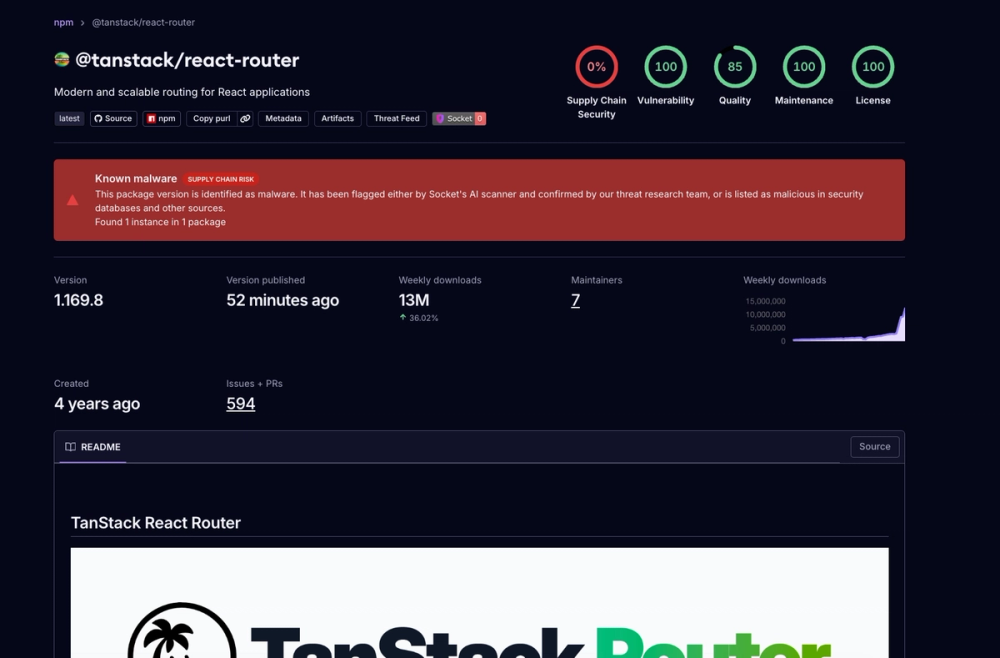
The three cited incidents show variations: Nx — a vulnerable PR-validation workflow triggered a more privileged publish workflow holding the npm token, which was exfiltrated to a webhook. Shai-Hulud wave two (PostHog) — a PR modified a script run by a workflow that had been switched to pull_request_target for reviewer assignment; the attacker stole a bot PAT, then further secrets including an npm token. TanStack — chained a pull_request_target pwn request with cache poisoning across the fork/base boundary plus runtime OIDC-token extraction from the runner, publishing 84 malicious versions across 42 @tanstack/* packages without ever stealing a long-lived npm token.
Preconditions / Affected
Any workflow using pull_request_target (or workflow_run off a PR event) that also checks out fork PR code via the patterns above. Not affected: labeling/triage automation that never checks out untrusted code.
What to do
- Move to
actions/checkout@v7, or rely on the backport landing July 16, 2026 to all supported major versions. - Workflows pinned to floating major tags (e.g.
actions/checkout@v4) get the protection automatically. Workflows pinned to a specific SHA, minor, or patch version do not — upgrade them via Dependabot or another update process.
Caveats
The block covers "the most common unsafe form" of the pattern, not every variant. It only engages for the specified events and ref/repo resolutions — other privilege-escalation paths in Actions remain out of scope. The page text is cut off before it states how a workflow can explicitly opt back in, so verify the override mechanism against GitHub's own docs before relying on it.
Organisations named here
- PostHog
- Nx supply chain attack
- OIDC token extraction
Technologies named here
- actions/checkout
- GitHub Actions pull_request_target workflows
- Dependabot
- GitHub CLI
- GitHub Actions workflow_run workflows
- Nx packages
- @tanstack/* packages
- GitHub Actions
- tanstack
- npm
Techniques named here
- Pwn Request
- GitHub Actions cache poisoning
- OIDC token extraction from runner process
- Cache poisoning
Threat actors named here
- Nx supply chain attacker
- Shai-Hulud
- TanStack compromise attacker
Related in DevSecOps

 jfrog.comarticle
JFrog: The Governance Gap Between Your Policy and Your Pipeline
 stepsecurity.ioarticle
Dev Machine Guard Now Supports Windows - StepSecurity
 socket.devwriteup
Socket: TanStack npm Packages Compromised
 securitylab.github.comadvisory