 socket.devwriteup
Socket: 141 Mastra npm Packages Compromised via Typosquatted Dependency
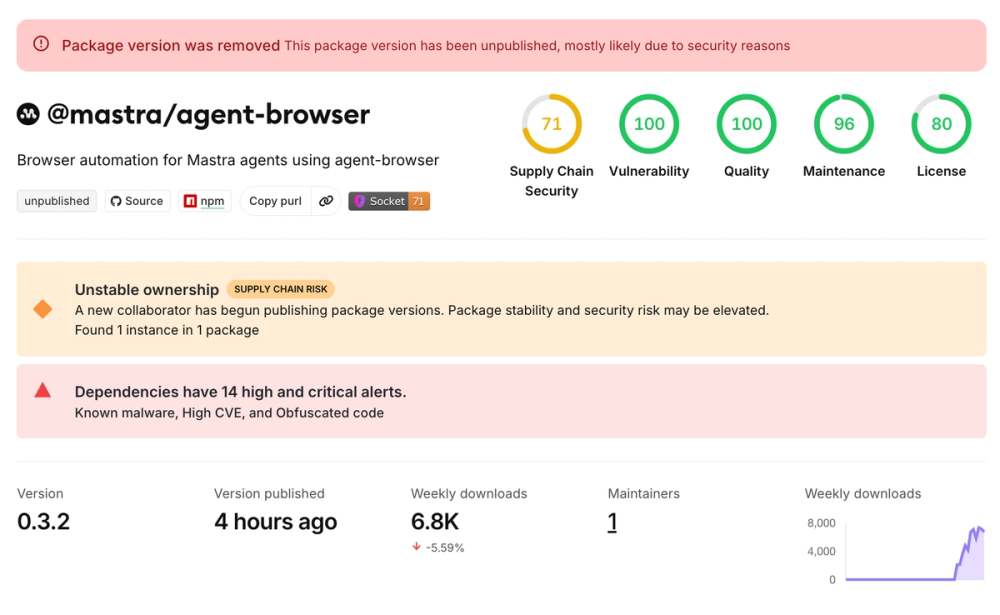
Socket's research team documents a supply chain attack in which npm account "ehindero" mass-published 141 malicious versions of @mastra/* packages (including @mastra/core, 918K weekly downloads) that were byte-identical to legitimate code but added a single new dependency: the typosquatted package easy-day-js. That package's postinstall hook (setup.cjs) disables TLS validation, fetches a second-stage cross-platform Node.js implant (protocal.cjs) that installs OS-specific persistence (Windows Run key, macOS LaunchAgent, Linux systemd unit disguised as Node/NVM tooling), inventories 166 cryptocurrency wallet browser extensions, steals Chrome/Edge/Brave history, and accepts arbitrary remote tasking (Node/Shell runners) from a hardcoded C2 over a custom ICAP-style protocol. The writeup includes full IOCs, SHA-256 hashes, and remediation guidance (rotate npm/CI/SSH credentials, treat affected hosts as compromised, disable install scripts).
What it is
A supply chain attack against the Mastra npm scope. On 2026-06-17, between ~01:15 and 02:36 UTC, a single human npm account (ehindero) mass-published malicious versions of 141 @mastra/* packages — normally released only by the project's GitHub Actions CI. The @mastra/* code itself is byte-for-byte identical to the last legitimate build; the only functional manifest change is one added dependency, easy-day-js, a typosquat of dayjs. @mastra/core alone sees ~918K weekly downloads.
How it works
The malicious logic lives entirely on the transitive dependency, so npm install of any compromised package executes it before app code is imported.
easy-day-js@1.11.21(published a day earlier, 2026-06-16, by a separate accountsergey2016) is a clean copy of dayjs with no hook — used to build benign history.easy-day-js@1.11.22adds"postinstall": "node setup.cjs --no-warnings".
Stage 1 (setup.cjs, obfuscated via obfuscator.io) sets NODE_TLS_REJECT_UNAUTHORIZED='0', beacons the victim path/campaign marker to temp files, fetches stage 2 from C2 23.254.164.92:8000, writes it to a random temp filename, spawns it detached (passing exfil target 23.254.164.123:443), then self-deletes.
Stage 2 (protocal.cjs, ~41 KB) is a cross-platform tasking client, not a fire-and-forget stealer: it installs login persistence (Windows/macOS/Linux) and beacons back to run whatever follow-on code the operator returns. It steals browser history and stored data from 160+ crypto wallet extensions.
Preconditions / Affected
Any workstation, CI runner, or build environment that ran npm install pulling an affected @mastra/* version in the exposure window. Note the article cites 141 affected packages though the title says 140+; not every package in the scope was hit.
What to do
Treat any host or CI runner that ran the install as compromised:
- Remove the affected versions, delete
node_modules, reinstall a known-good prior version. - Rotate credentials that may have been exposed during install: npm tokens, cloud provider keys, CI/CD secrets, and SSH and Git credentials.
Detection artifacts: temp files .pkg_history and .pkg_logs, connections to 23.254.164.92:8000 and 23.254.164.123:443.
Caveats
Socket flagged the malicious easy-day-js within six minutes of publication and blocks it automatically for its customers. The investigation is ongoing — Socket says it is "still analyzing exact impact" and maintains a live campaign page for the authoritative affected-version list; do not treat any partial list here as complete. The clean-then-weaponize dependency pattern mirrors the recent axios campaign.
Organisations named here
- easy-day-js
Technologies named here
- Socket
- @mastra/* npm packages
- npm ls easy-day-js
- @mastra/core
- node:sqlite
- easy-day-js
- node:dns
- Windows
- macOS
- Linux
- Chrome, Edge, and Brave browsers
- Cryptocurrency wallet browser extensions
- npm
- Node.js
- dayjs
- systemd
- SQLite
- mastra
Techniques named here
- Typosquatting
- Supply chain / dependency injection attack
- Malicious install/postinstall hook
- TLS certificate validation bypass
- Staged payload delivery
- Detached process execution
- Anti-forensics / self-deletion
- Persistence establishment
- Masquerading
- C2 tasking / beacon-and-poll
- Custom ICAP-style exfiltration protocol
- Cryptocurrency wallet extension inventory theft
- Browser history theft
- Host reconnaissance
Threat actors named here
- ehindero
- sergey2016
- easy-day-js
- protocal.cjs
- axios campaign
Related in Supply Chain






