 wagtail.orgarticle
One month coding with GLM 5.3 Flash
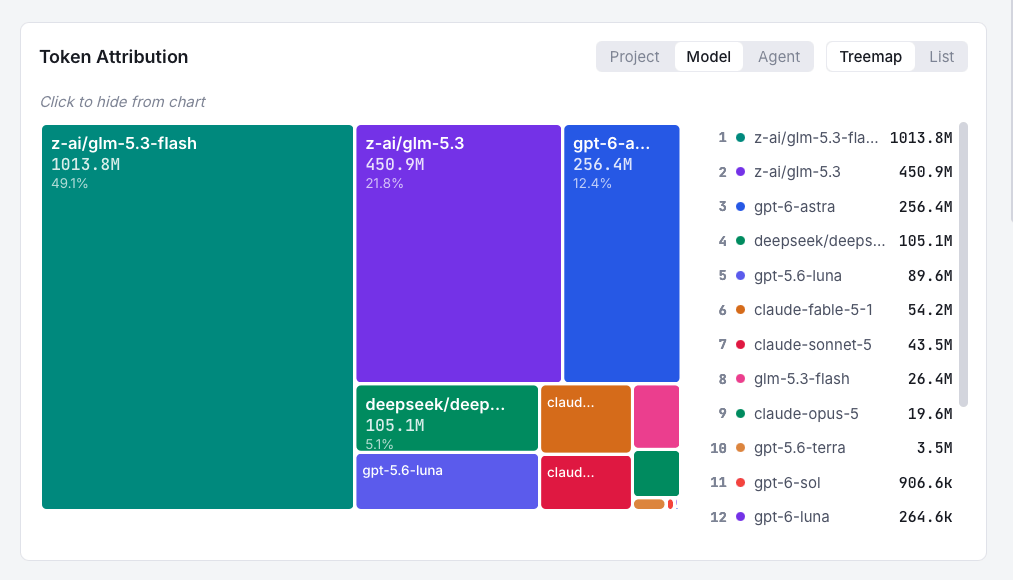
Wagtail's engineering team recounts a September challenge to run all day-to-day coding work on one efficient open model, GLM-5.3-Flash, tracking usage via AgentsView: they stayed within budget ($68, ~4kWh) for the first half of the month before a vibe-coded MCP server prototype on the "wrong" model burned 450M tokens/$150/5kWh overnight, and inference-provider capacity limits forced fallbacks to DeepSeek-V4.1-Flash and Qwen 3.8 Flash. The post ends with concrete lessons for October: constant local usage/energy measurement, separate budgets for experimentation vs production, better multi-agent prompt/role patterns (orchestrator/scout/implementer/reviewer), and defaulting day-to-day work to flash-tier models.
What it claims
Wagtail ran a September challenge to do all coding work on a single open flash-tier model, GLM 5.3 Flash. By its own measure the challenge failed. Of 2B tokens, only 1B (50%) went to the target model. Energy use was about 35 kWh against a target of about 10 kWh. The authors still conclude that one or two cheap flash-tier models can handle day-to-day developer work. They argue the goal should be measured in cost or energy, not tokens. For October they are keeping the single-model rule only for routine "production" work, which they put at 50% or more of normal usage, and excluding R&D.
Evidence
- First half of the month: GLM 5.3 Flash alone handled the work for $68, about 4 kWh and 365 g of carbon emissions.
- Overnight overrun: a vibe-coded prototype MCP server, built on a model the author calls the "wrong" one, used 450M tokens, $150 and 5 kWh almost overnight. The author estimates similar results were possible for "most likely 5x less cost" with modest extra effort. This is an estimate, not a measurement.
- Range of tasks: GLM 5.3 Flash was used on Wagtail core, sites built with Wagtail, UI tasks, AI R&D, some documentation and many evals. The author rates it "excellent" and "really polyvalent."
- Why GLM 5.3 Flash was chosen:
- 1M-token context window
- vision support, used for building from screenshots and visual QA
- availability from many providers
- Measurement: token, cost and energy figures come from AgentsView.
Limits
- Provider capacity: popular open-model providers do not have big-lab GPU capacity. Performance of GLM 5.3 Flash degraded during the month, which the authors attribute to its high demand. They fell back to DeepSeek V4.1 Flash and Qwen 3.8 Flash. Switching was easy but had to happen without warning.
- Geography: model choices were limited to open models confirmed to be available in a European data center. The authors note your Pareto frontier may differ if inference elsewhere is acceptable.
- R&D load: experimenting across many models, including an internal benchmark of model performance on Wagtail tasks, accounts for much of the off-target usage. Benchmark results are shown only as a "sneak peek," with no numbers in the text.
- Rigour: this is one team's month-long account, with no controlled comparison of task outcomes between models. The authors themselves list measuring "how well this all leads to concrete positive outcomes" as a gap still to close.
Organisations named here
- Wagtail
- DeepSeek-V4.1-Flash
- GLM-5.3-Flash
Technologies named here
- AgentsView
- GLM 5.3 Flash
- DeepSeek V4.1 Flash
- Wagtail MCP server
- Qwen3.8-Flash
- CLI prototype
- Jev-style decision diffusion models
- Model Context Protocol
Techniques named here
- Vibe coding
- Multi-agent orchestration
- Agent skills
Related in ai-policy


 futureoflife.orgarticle
Future of Life Institute AI Safety Index — Summer 2026
 interconnects.aiarticle
Lessons from the hacks
 interconnects.aiarticle