 stepsecurity.ioadvisory
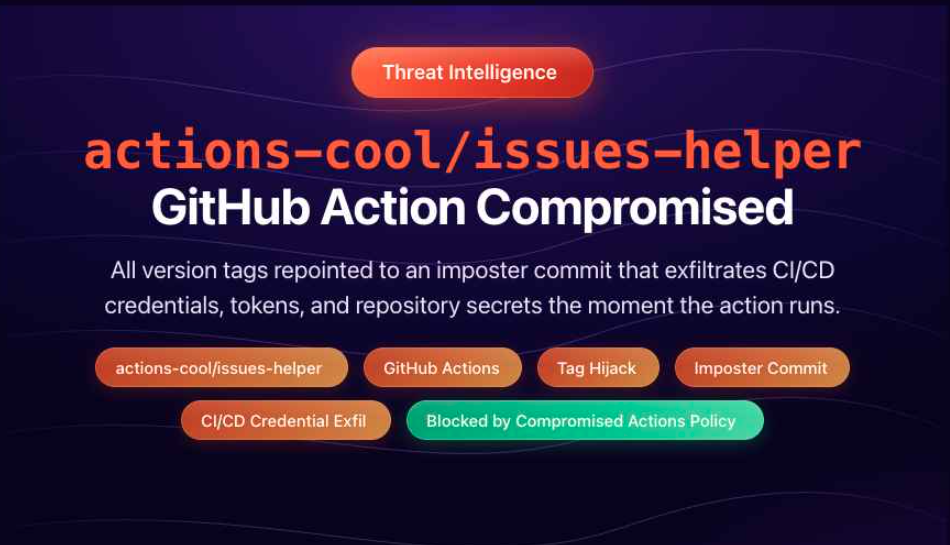
actions-cool/issues-helper GitHub Action Compromised: All Tags Point to Imposter Commit That Exfiltrates CI/CD Credentials - StepSecurity
StepSecurity discovered that all 53 tags of the popular actions-cool/issues-helper GitHub Action (and all 15 tags of actions-cool/maintain-one-comment) were re-pointed to dangling imposter commits containing malicious code. The payload downloads the Bun runtime, reads Runner.Worker process memory to harvest decrypted CI/CD secrets, and exfiltrates them via HTTPS to t.m-kosche.com — meaning any workflow referencing the actions by tag (rather than a pinned commit SHA) pulls the malicious code on its next run.
What it is
An active supply-chain compromise of two GitHub Actions in the actions-cool org — issues-helper (53 tags) and maintain-one-comment (15 tags). An attacker with tag-move access re-pointed every version tag to a per-tag "imposter commit" that is dangling (unreachable from the default branch) and carries a credential-stealing payload. Both actions use the identical payload and exfil domain, so treat them as one incident.
How it works
Each imposter commit runs code inside the Actions runner that:
- downloads the
bunJavaScript runtime to/home/runner/.bun/bin/bun; - spawns a
python3child (viasudo) that reads/proc/<Runner.Worker PID>/mem— the process holding the workflow's decrypted secrets; - pulls
gh auth tokenand pipes memory throughtr/grepfiltering for"isSecret":true; - sends the harvested credentials over HTTPS to
t.m-kosche.comon port 443.
Preconditions / Affected
Any workflow that references either action by tag or version pulls malicious code on its next run. Workflows pinned to a known-good full commit SHA are unaffected — that is the entire dividing line.
What to do
- Stop referencing these actions by tag/version. Pin to a verified pre-attack commit SHA, or remove the actions until resolved.
- Hunt runner logs for the payload markers above (bun download path,
/proc/.../memreads from python3, the"isSecret":truefilter, outbound tot.m-kosche.com). - Block egress to
t.m-kosche.comas defense-in-depth (StepSecurity has added it to the Harden-Runner global block list; enterprise Compromised Actions Policy blocks the run outright). - Use imposter-commit detection: flag any action reference resolving to a SHA that matches no legitimate tag or branch head.
Caveats
The distinguishing tell is the timestamps, not the code — the fake "Build action for vX.Y.Z" messages mimic the maintainer's real style, but all 53 issues-helper imposter commits were created within a 3-minute-16-second window and all 15 in maintain-one-comment within 39 seconds. A commit SHA alone is not proof of safety; verify the SHA is reachable from the default-branch history and predates the attack window.
flowchart TD
  A[Workflow references action] --> B{Pinned by?}
  B -->|Tag / version| C[Resolves to imposter commit]
  B -->|Verified pre-attack SHA| S[Safe]
  C --> D[bun + python3 read Runner.Worker mem]
  D --> E[Exfil to t.m-kosche.com:443]
  E -.blocked by.-> F[Egress block / Harden-Runner]
Technologies named here
- StepSecurity Harden-Runner
- actions-cool/issues-helper
- StepSecurity Compromised Actions Policy
- actions-cool/maintain-one-comment
- GitHub Actions CI/CD runners
- StepSecurity Action-Uses-Imposter-Commit detection
- Bun JavaScript runtime
- GitHub Actions
- Bun
- StepSecurity
- Harden-Runner
Techniques named here
- Git tag re-pointing / imposter commit
- CI/CD credential exfiltration via process memory read
- Outbound HTTPS exfiltration
Threat actors named here
Also named here
- t.m-kosche.com
Related in Supply Chain







