 socket.devwriteup
Miasma & Hades Worms
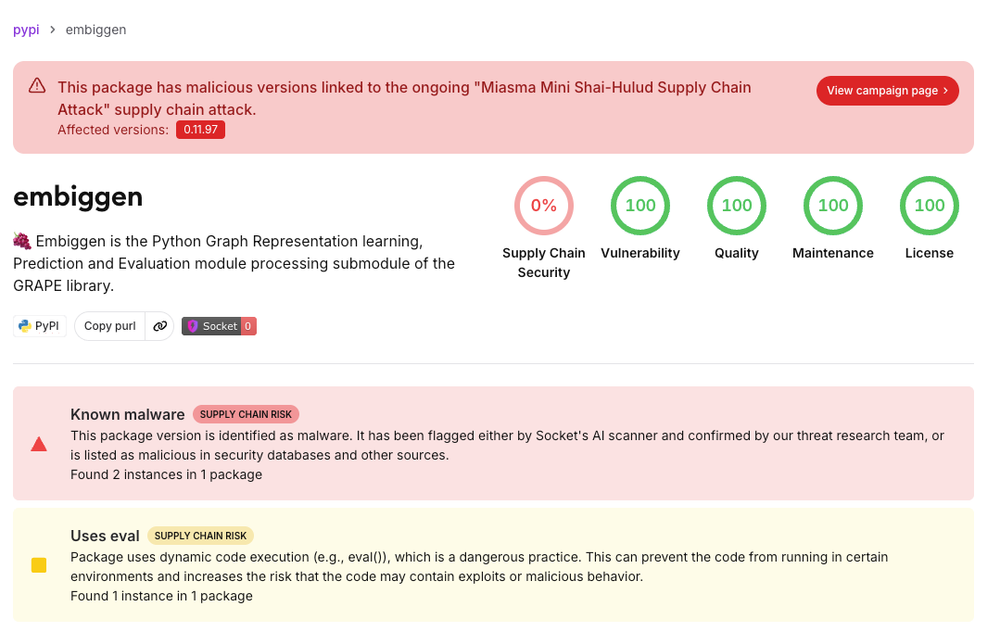
Socket's Threat Research team documents a new wave of 23 malicious PyPI artifacts (bioinformatics packages like embiggen/ensmallen/gpsea/pyphetools, typosquats like rsquests/tlask/rlask, and an MCP-themed langchain-core-mcp package) tied to the ongoing Mini Shai-Hulud/Miasma/Hades supply chain campaign. Unlike earlier .pth-hook wheels that bundled an obfuscated _index.js JavaScript stealer run via Bun, the bioinformatics cluster hides execution inside trojanized .abi3.so native extensions triggered at import time, while langchain-core-mcp ships only a .pth loader that scans sys.path for an external _index.js payload — a loader/payload split designed to evade detection rules. The payload also opens with a fake prompt-injection comment block meant to derail LLM-based static analysis tools before reaching the actual obfuscated stealer code that harvests GitHub, npm, PyPI, cloud, Kubernetes, SSH, and Docker credentials.
What it is
The newer wave in the Hades branch of the Mini Shai-Hulud / Miasma PyPI campaign: 23 new package-version artifacts, bringing Socket's tracker to 471 artifacts (411 npm across 106 packages, 60 PyPI across 37 packages). The summary already names the clusters and the three-branch delivery split; what it omits is the concrete version numbers, IOCs, and hunting artifacts an engineer needs to check an environment.
Preconditions / Affected
- langchain-core-mcp@1.4.2 and @1.4.3 (
py3-none-any-whl) — the loader-only variant. Installslangchain_core-setup.pth; the wheel does not ship_index.js. - Bioinformatics real packages, malicious versions:
embiggen,ensmallen,gpsea,phenopacket-store-toolkit,ppkt2synergy,pyphetools. - Typosquats/bait:
rsquests,tlask,rlask, plus MCP-themed packages. - Highest risk in CI/CD build/release runners, where an exposed publishing token lets the actor ship more packages.
How it works
Details the summary doesn't carry:
- The
.pthloader scans everysys.pathentry for_index.js— first directly, then one directory below each entry — rather than relying on.pthexecution context (which is unreliable in CPython because__file__may not point at the.pthfile). This decouples loader from payload across wheels. - Execution is gated by a run-once marker at
os.path.join(tempfile.gettempdir(), ".bun_ran"); if absent, it downloads Bun (v1.3.13 referenced), runs the payload, then creates the marker. - The
.abi3.sobranch executes_index.jsat import time viadlopen()module init — invisible to source-only Python review. - The
_index.jsanti-analysis header is a JS block comment (skipped at runtime) with fake system instructions to derail LLM-first triage; real code follows astry{eval(...)}over a char-code array with ROT substitution. Socket notes this is not a bypass against YARA, entropy, AST, or behavioral rules.
What to do
Socket's stated guidance: check for affected versions, preserve forensic artifacts before uninstalling, and rotate any exposed tokens. In Python environments hunt for:
- executable
.pthfiles, unexpected_index.js, Bun download logic, newly added.abi3.soextensions - specific native extensions:
ensmallen_haswell.abi3.so,ensmallen_core2.abi3.so; any.abi3.sopaired with_index.js
Hunting strings / host indicators:
thebeautifulmarchoftime,thebeautifulsnadsoftime— fallback C2 discovery strings/tmp/.sshu-setup.js— SSH propagation path- Payload discovery / exec signatures:
os.path.join(d,"_index.js"),_s.run([_b,"run",_j],check=False) - Upload User-Agent
Bun/1.3.14(not malicious alone, notable in context) - File hashes:
langchain_core_mcp-1.4.2-py3-none-any.whlSHA2566d332f814f15f19758d65026bbfd0a8c49671b319ec77b8fa1b27fc48afff7d9;langchain_core-setup.pthSHA2566506d31707a39949f89534bf9705bcf889f1ecae3dbc6f4ff88d67a8be3d01b2
In CI/CD, inspect runners for /var/run/docker.sock abuse, poisoned /etc/hosts, unexpected privileged containers, and workflow changes. Notably, the malware targets StepSecurity defenses: harden-runner, and blocks agent.stepsecurity.io, api.stepsecurity.io, app.stepsecurity.io.
Caveats
Socket offers three unresolved readings of the payload-less langchain-core-mcp wheel: a fixed reliability bug from the earlier loader, an accidental incomplete publish, or deliberate paired-package staging — but treats the behavior as malicious regardless. Full payload breakdown (GitHub dead-drop, Docker/SSH propagation) is deferred to the prior Hades PyPI report.
Organisations named here
- Shai-Hulud
Technologies named here
- embiggen
- Bun
- Socket Threat Research campaign tracker
- ensmallen
- gpsea
- Harden-Runner
- YARA rules
- phenopacket-store-toolkit
- ppkt2synergy
- pyphetools
- rsquests
- tlask
- rlask
- langchain-core-mcp
- PyPI
- Python
- LangChain
- Docker
- StepSecurity
Techniques named here
- .pth startup-hook execution
- Native extension import-time execution
- Loader/payload split via sys.path search
- Run-once marker file
- LLM-scanner anti-analysis / prompt injection
- Credential and secret theft
- Docker socket abuse
- SSH propagation
- Fallback C2 discovery
- Security tool blocking
Threat actors named here
- Mini Shai-Hulud
- Miasma
- Hades
Related in Supply Chain






