 huntress.comwriteup
Plain Text Passwords: The Risks of Storing Them
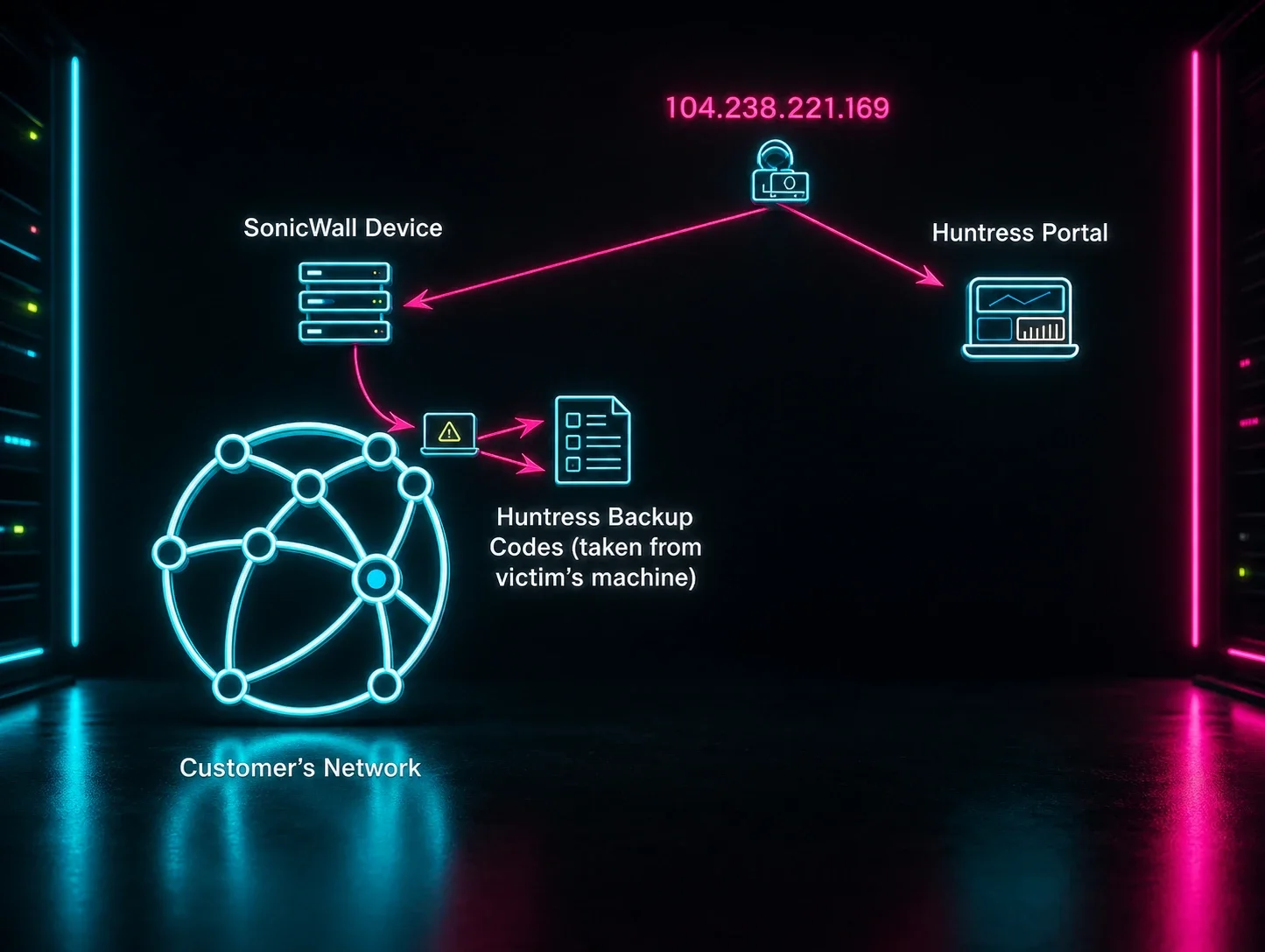
Huntress incident writeup detailing how a threat actor exploited a SonicWall VPN vulnerability to gain initial access, deployed Akira ransomware, and found a plaintext file of Huntress MFA recovery codes on a security engineer's desktop. The attacker used those codes to bypass MFA, log into the victim's Huntress portal from IP 104.238.221.69, close active incident reports, and uninstall EDR agents to blind defenses — while also exporting a certificate via certutil for potential persistence. The piece frames this as a case study for why plaintext password/recovery-code storage is dangerous and recommends hashing (Argon2/bcrypt), salting, and password managers instead.
What it is
A Huntress SOC incident writeup (APAC region) showing an Akira intrusion where a plaintext Huntress_recovery_codes-<redacted>.txt file on a security engineer's desktop let the attacker log into the victim's own Huntress portal and turn the EDR against itself. The summary already has the arc (SonicWall → Akira → recovery codes → MFA bypass → closing incidents/uninstalling agents → certutil export). What it does not carry is the concrete command-level detail and the detection sequence, below.
How it works — the specifics the summary omits
The detection did not start with the portal login. Huntress SOC first caught multiple admin accounts deleting shadow copies across hosts and fired a mass isolation response — which is what stopped full-environment encryption; the Akira binary w.exe running from a desktop only encrypted the one workstation.
Attacker hosts came in over the SonicWall VPN on 192.168.x.x DHCP addresses with no Huntress agent installed, so they were invisible to EDR and blended with internal traffic — the reason lateral movement didn't trip anomaly detection.
The recovery-code file was read remotely over SMB from the DC:
"C:\windows\system32\NOTEPAD.EXE" \\192.168.1.51\c$\Users\<redacted>\Desktop\Huntress_recovery_codes-<redacted>.txtCertificate theft from the DC's personal store (potential cert-based auth impersonation, e.g. VPN/RDP):
certutil -store My
certutil -exportPFX 1d967729be08ef8c4bf86874c9542b4e C:\temp\cert.pfx
certutil -exportPFX 1d967729be08ef8c4bf86874c9542b4e C:\cert.pfx
The PFX export includes the private key. Certificate thumbprint: 1d967729be08ef8c4bf86874c9542b4e. Portal login came from malicious IP 104.238.221[.]69, already tied to other SonicWall compromises. Root cause of the cert activity was never determined.
What to do
Beyond the summary's hash/salt guidance, the page adds two storage-specific items:
- Encrypt offline storage if you can't use a manager: codes in an encrypted, password-protected file on an encrypted USB/disk.
- Rotate and monitor: regenerate recovery codes periodically; watch for unusual portal logins.
Treat recovery codes as privileged credentials — they bypass MFA with no secondary challenge, making a plaintext copy a single point of failure. Detection hooks worth building from this incident: shadow-copy deletion across multiple hosts, certutil -store/-exportPFX on a DC, and SMB reads of files matching *recovery_codes*.txt on admin share paths.
Caveats
Huntress markets its Managed ITDR here (identity attack response "in around three minutes," false-positive rate "under 5%") — vendor figures, not independently verified. The linked SonicWall CVE is not named in this post; it references a separate "Active Exploitation of SonicWall VPNs" advisory for the initial-access detail.
Organisations named here
- 104.238.221.69
Technologies named here
- Huntress Managed ITDR
- SonicWall VPN
- Huntress portal
- Huntress EDR
- certutil
- Windows Domain Controller
- Argon2
- bcrypt
- Password manager
- Huntress
- VPN
- EDR
- Windows
- SonicWall
Techniques named here
- Plaintext credential/recovery code storage and theft
- VPN compromise for internal access / EDR evasion
- Shadow copy deletion
- Certificate enumeration and export
- Administrative share enumeration
- MFA bypass via recovery codes
- Incident suppression / defense evasion
- Rainbow table attack
Threat actors named here
- Akira ransomware
- Akira
Related in Threat Intel
 huntress.comwriteup
Reverse Engineering the Six Stages of MacSync Stealer and RAT
 huntress.comwriteup
AI-Coded Malware | Analyzing Vibe-Coded AD Enumeration | Huntress

 blog.talosintelligence.comtool
Introducing CAIRN: Frontier tracking for AI-integrated malware (Cisco Talos)
 huntress.comwriteup