 securityweek.comarticle
US Disrupts Chinese State-Sponsored Hacking Tools
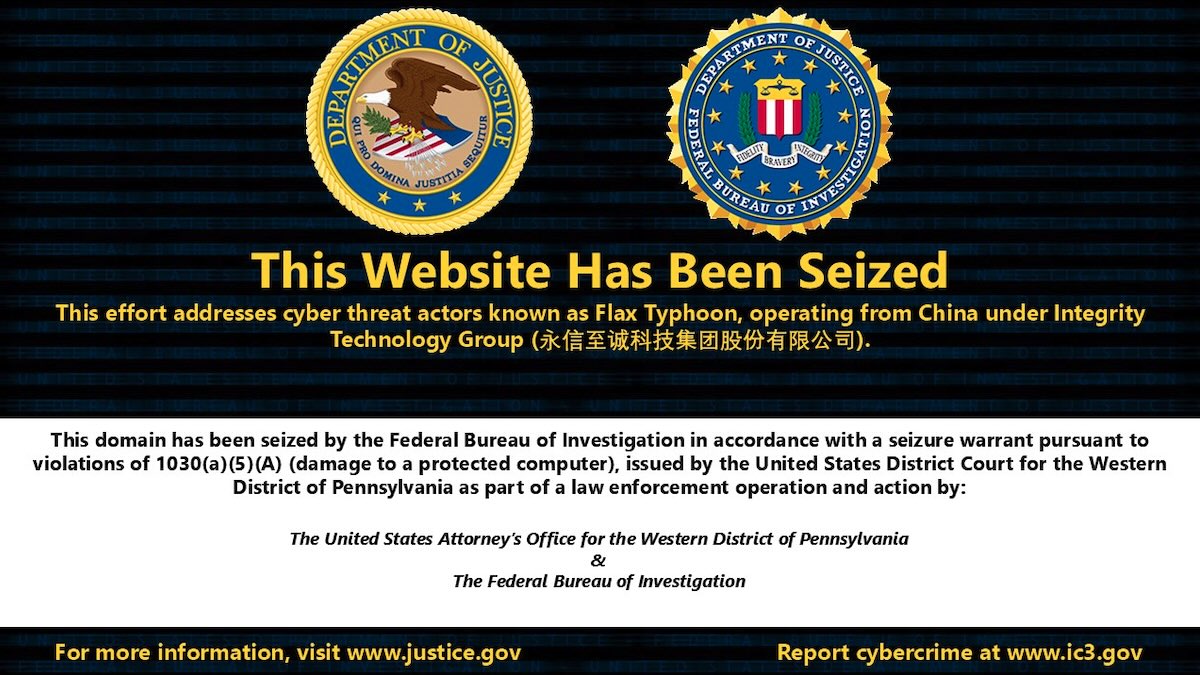
The US, alongside UK, Australian, Canadian, Japanese, New Zealand, and Spanish agencies, disrupted MicroScan and FishHub, hacking tools built by China's Integrity Technology Group and used by the state-sponsored actor Flax Typhoon (aka Ethereal Panda, Red Juliett, Storm-0919, UNC5007) against US, Japanese, Polish, and Taiwanese critical infrastructure and universities. MicroScan is a Python-based scanner with over 1,300 penetration-testing scripts targeting Apache Struts, Jenkins, WebLogic Server, WordPress, OpenSSL, and other services, delivered via a Mirai-derived IoT botnet; FishHub let operators remotely search and exfiltrate files from victim networks. The advisory also details the group's broader toolkit (SoftEther VPN for persistence, EBurst for Exchange password spraying, DC.ex for Active Directory data extraction) and the seizure of the domains used to access the tools.
What it is
Flax Typhoon's full tooling chain beyond MicroScan/FishHub, as detailed in a joint advisory from US, UK, Australia, Canada, Japan, New Zealand, and Spain. The actors behind these tools are Integrity Technology Group, previously disrupted via the Raptor Train botnet takedown in 2024 and sanctioned by the US in 2025 and the EU in March 2026.
How it works
The advisory maps the actor's kill chain tool-by-tool:
- Reconnaissance: BBScan, dirsearch, Fscan, ksubdomain, masscan, Nmap, OneForAll, ShuiZe, WPScan (alongside MicroScan).
- Initial access: command-line exploit utilities plus EBurst for Exchange password spraying.
- Persistence: SoftEther VPN.
- Data collection/exfiltration: Curlc4.txt (a PHP script) and office-cli (command-line utility) for email exfiltration; DC.ex for Active Directory data extraction; databases downloaded or manually extracted from victim mailboxes.
The advisory notes exfiltrated data access was in some cases IP-restricted to Xiamen, China, which is cited as attribution evidence.
Preconditions / Affected
Email data theft victims (via the on-prem/cloud credential and exfiltration toolchain) included government organizations, law enforcement agencies, healthcare systems, and religious institutions in Southeast Asia — a separate victim set from the MicroScan/FishHub critical-infrastructure and university targets already noted in the summary. MicroScan has been active since at least 2017 and also targets Juniper ScreenOS, Oracle, and Rejetto HFS (in addition to the services already listed).
What to do
The seized domains used to access MicroScan/FishHub are listed in the advisory as indicators: c0cc[.]cc, 98aicai[.]com, 98aicode[.]com, outlook3650[.]com, youtubecard[.]com, linkedinns[.]net. Defenders handling Exchange or AD environments should treat EBurst (password spraying) and DC.ex (AD data extraction) as named tools to hunt for, and SoftEther VPN presence as a persistence indicator.
Caveats
The advisory does not give version numbers, hashes, or detection signatures for these secondary tools (EBurst, DC.ex, SoftEther, Curlc4.txt, office-cli) — only their names and functions. Attribution to Xiamen is based on observed IP restrictions, not independently verified by the article.
Technologies named here
- MicroScan
- Apache Struts
- FishHub
- Juniper ScreenOS
- BBScan
- Jenkins
- openssl
- dirsearch
- Oracle
- Fscan
- Rejetto HFS
- ksubdomain
- WebLogic Server
- Masscan
- WordPress
- Nmap
- Microsoft Exchange
- OneForAll
- ShuiZe
- Active Directory
- wpscan
- US power company network
- Japanese and Polish airports
- EBurst
- SoftEther
- Taiwanese critical infrastructure entities and universities
- Curlc4.txt
- office-cli
- DC.ex
- Mirai
Techniques named here
- Vulnerability scanning/reconnaissance
- Spear phishing
- Remote file access and exfiltration
- Password spraying
- Persistence via VPN tooling
- Credential collection and email data exfiltration
- Active Directory data extraction
- Access restriction to exfiltrated data
Threat actors named here
- Flax Typhoon
- Integrity Technology Group
- Raptor Train
- Mirai
Also named here
- Flax Typhoon (Ethereal Panda, Red Juliett, Storm-0919, UNC5007)
Related in Threat Intel

 huntress.comwriteup
Reverse Engineering the Six Stages of MacSync Stealer and RAT
 huntress.comwriteup
AI-Coded Malware | Analyzing Vibe-Coded AD Enumeration | Huntress

 blog.talosintelligence.comtool
Introducing CAIRN: Frontier tracking for AI-integrated malware (Cisco Talos)
 huntress.comwriteup