 socket.devwriteup
TanStack npm Brand-Squat
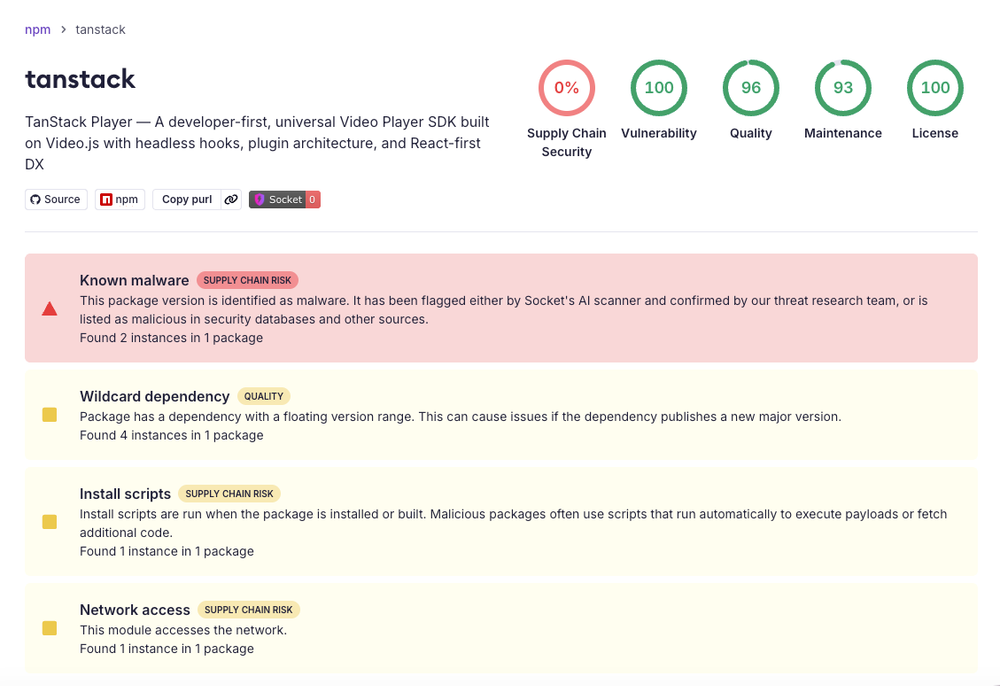
Socket's research team identified the unscoped npm package tanstack (not the legitimate @tanstack/* scope) as a brand-squat impersonating the TanStack project. Maintainer sh20raj pushed versions 2.0.4-2.0.7 within a 27-minute window containing an obfuscated postinstall script that reads .env, .env.local, .env.production and all .env.* files and POSTs them to an attacker-controlled Svix ingest URL used as a one-way dead-drop. TanStack creator Tanner Linsley confirmed no affiliation, cited a prior $10,000 extortion demand for the package name, and noted an ongoing trademark dispute; the maintainer later claimed the exfiltration code was accidental AI agent testing left in by mistake.
What it is
The unscoped npm package tanstack (maintainer sh20raj), a brand-squat of the legitimate @tanstack/* scope, shipping a malicious postinstall hook in versions 2.0.4–2.0.7 that reads dotenv files and POSTs them to a Svix ingest URL. All four versions were published within a 27-minute window, and share one Svix source ID — evidence of a deliberate, planned attack rather than a gradual compromise.
How it works
The postinstall.js script defines collectEnvFiles(), which resolves the parent directory (path.resolve(__dirname, "..")), filters for any file named .env or starting with .env., reads each, and bundles them into a JSON payload alongside package version, node version, platform and arch. The exfiltration function is named sendReadme() to look innocuous. The payload is POSTed to a hardcoded Svix ingest endpoint used as a one-way dead-drop: anyone can POST to the URL, but only the authenticated account holder can read the contents, so defenders cannot probe or enumerate what was captured.
The scope of harvesting and the tradecraft shift across versions:
- v2.0.4 / v2.0.5: staged as
README.md; v2.0.5 also touchesAGENTS.md - v2.0.6: broadens from specific dotenv names to
.env.*(all variants) - v2.0.7:
console.logcalls commented out to run more quietly
The same Svix source ID (src_3387PLMB2uhXOBe3Q8sHu) appears in all four, tying them to a single controlled inbox.
Preconditions / Affected
Any environment that installed unscoped tanstack at 2.0.4–2.0.7 with .env files present in the parent directory at install time — CI/CD pipelines, developer machines, and container build environments. The package is unscoped; legitimate TanStack is always under @tanstack/*, so exposure comes from a dependency naming tanstack (the page lists npm/portalapp@1.0.0 as a known dependent).
What to do
- Check
package.json,package-lock.json, andyarn.lockfor an unscopedtanstackdependency and remove it; use only@tanstack/*packages. - Block
api.svix.comfrom CI/CD pipelines, developer machines, and container build environments. - Treat any secrets in
.env,.env.local,.env.production(or any.env.*) as compromised on affected hosts and rotate them — the dead-drop design means you cannot confirm what was read.
Caveats
The maintainer claims (in a now-deleted X post) the exfiltration code was leftover "random testing" with an AI agent that he "forgot to remove" while studying for exams; the page rejects this as changing impact. It is also unstated whether the account was compromised or the maintainer acted directly. A full technical analysis was still underway at publication, and 2.0.7 is only the last known malicious version — later versions may exist.
Organisations named here
- postinstall npm lifecycle hook
- Svix Source ID src_3387PLMB2uhXOBe3Q8sHu
- Tanner Linsley
Technologies named here
- tanstack
- Socket AI Detection
- Svix
- npm/portalapp@1.0.0
- npm
- Node.js
Techniques named here
- Brand-squatting / brandjacking
- Malicious postinstall script
- Environment file theft
- Data exfiltration via third-party SaaS dead-drop
- Code obfuscation / logging suppression
Threat actors named here
- sh20raj
Related in Supply Chain






