 blog.talosintelligence.comwriteup
UAT-10147: Chinese-speaking adversary integrates agentic AI into post-compromise operations
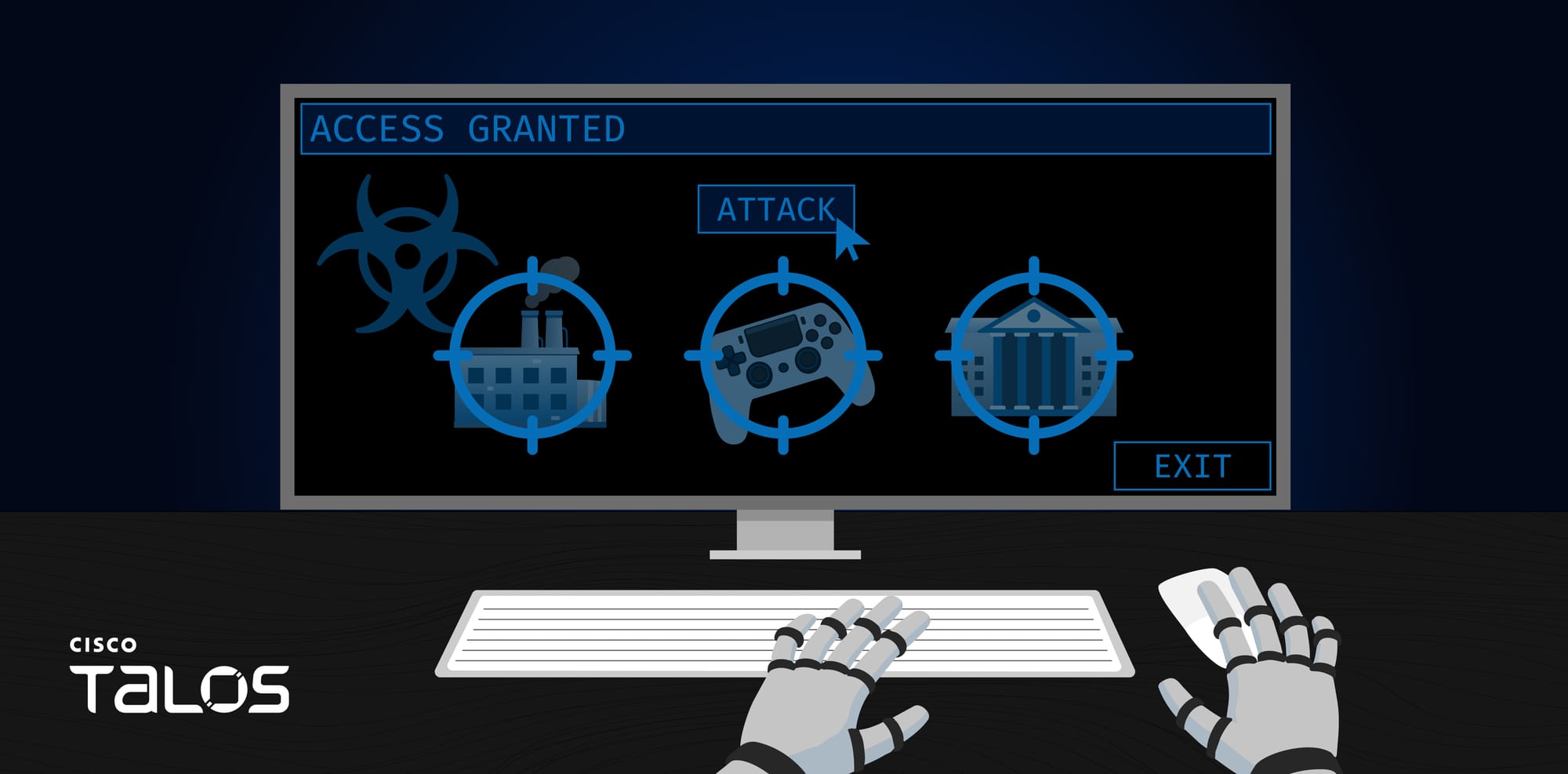
Cisco Talos details UAT-10147, a Chinese-speaking cybercrime group exploiting one-day vulnerabilities in Windows/Linux web servers to deploy BadIIS, QuasarRAT, NoodleRAT, and SPECTRE implants, while also integrating agentic AI tools (PentestGPT, DeepAudit, and AI-orchestrated ysoserial workflows) to generate exploit playbooks, automate ASP.NET ViewState deserialization RCE, validate exploit success, and run reconnaissance/exfiltration end to end. Talos recovered AI-generated Python scripts and a findings log from the actor's C2 open directory showing semi-autonomous exploit refinement, OOB callback verification via webhook.site, and privilege escalation via SeImpersonatePrivilege/Potato exploits — evidence of a shift from AI-assisted scripting toward agentic offensive orchestration.
What it is
Cisco Talos' technical breakdown of UAT-10147's Windows infection chain, with the specific indicators, file names, and defense-evasion commands the summary omits. Discovered in early 2026 via an OPSEC failure: a compromised host beaconing to a download server at 139.180.197[.]150, which exposed an open directory revealing the actor's tooling and a target list of ~170,000 URLs.
How it works
After gaining RCE (or dropping a web shell for manual setup), the actor runs a main batch script named back.txt or back.bat. It uses certutil to pull down EfsPotato (renamed prcc1.rar), a secondary script (bai.bat), and QuasarRAT disguised as svchosts.exe. EfsPotato provides privilege escalation; the script then adds IIS directories to Windows Defender's exclusion list (blinding AV to where malicious IIS modules land), and deletes staging files to hinder forensics. bai.bat establishes persistence via a scheduled task named "Google Chrome Start" that runs the payload with highest privileges at every user logon. Other implants observed in related campaigns: Gh0stCringe and SPECTRE.
Preconditions / Affected
Internet-exposed Windows and Linux web servers with publicly disclosed, unpatched vulnerabilities. Confirmed victims sit in government, universities, media, technology, and gaming; observed compromised servers in Brazil, Bolivia, China, Canada, and Vietnam. The ~170,000-URL target list was split into 17 files of ~10,000 (the actor uses "w" for 萬 = 10,000), indicating broad opportunistic scanning rather than narrow targeting.
What to do
Hunt for the Defender exclusion additions targeting IIS paths — a strong signal, since legitimate admins rarely exclude these:
powershell Add-MpPreference -ExclusionPath C:\Windows\SysWOW64\inetsrv
powershell Add-MpPreference -ExclusionPath C:\Windows\System32\inetsrv
Detections to build:
- Scheduled task named "Google Chrome Start" running with highest privileges at logon.
- Dropped/staged file names:
back.txt,back.bat,bai.bat,prcc1.rar,svchosts.exe. - Network connections to
139.180.197[.]150. certutilused to download the above artifacts.- QuasarRAT masquerading as
svchosts.exe; monitorSystem32\inetsrvandSysWOW64\inetsrvfor unexpected IIS modules (BadIIS).
Caveats
Talos assesses the agentic-AI orchestration claim (iterative exploit refinement, adaptive troubleshooting, automated post-exploitation) with moderate-to-high confidence, not certainty. The BadIIS deployment steps are described as what the actor "would likely perform," and Gh0stCringe/SPECTRE were seen in "similar campaigns" rather than confirmed in every intrusion. SPECTRE details are in a separate companion post.
Organisations named here
- Baron Samedit
- Dirty Pipe
- SeImpersonatePrivilege
- TypeConfuseDelegate
CVEs named here
- CVE-2022-0995
- CVE-2021-3156
- CVE-2015-5287
- CVE-2015-3246
- CVE-2010-3904
- CVE-2022-0847
- CVE-2022-27925
- CVE-2021-23758
- CVE-2021-29441
- CVE-2021-29442
- CVE-2019-18935
Technologies named here
- Metasploit Framework
- Windows web servers
- Linux web servers
- ysoserial
- PentestGPT
- Zimbra Collaboration Suite
- AjaxPro
- DeepAudit
- EfsPotato
- Nacos framework
- certutil
- Telerik UI for ASP.NET AJAX
- badsecrets
- Linux kernel
- Unix sudo utility
- appcmd
- webhook.site
- ABRT
- ClamAV
- libuser
- IIS
- Snort
- .NET 4.8
- Metasploit
- .NET
Techniques named here
- Publicly disclosed vulnerability exploitation
- AI-driven exploit automation and validation
- Windows Defender exclusion abuse
- Scheduled task persistence
- Rogue local user account creation
- Web shell deployment
- ASP.NET ViewState deserialization RCE
- Out-of-band exploit confirmation
- Token impersonation privilege escalation
- Exfiltration blended with legitimate SaaS traffic
- Two-step web shell deployment via relay upload handler
- SEO fraud via BadIIS
- Target list segmentation for scanning efficiency
Threat actors named here
- UAT-10147
- BadIIS
- QuasarRAT
- Gh0stCringe
- SPECTRE
- NoodleRAT
- Meterpreter
Related in Threat Intel

 huntress.comwriteup
Reverse Engineering the Six Stages of MacSync Stealer and RAT
 huntress.comwriteup
AI-Coded Malware | Analyzing Vibe-Coded AD Enumeration | Huntress
 blog.talosintelligence.comtool
Introducing CAIRN: Frontier tracking for AI-integrated malware (Cisco Talos)
 huntress.comwriteup