 asecurityguru.comarticle
wp2shell CVE-2026-63030: The WordPress RCE Putting 500+ Million Sites at Risk
Explains the wp2shell chain in WordPress core: CVE-2026-63030, a REST API batch-route confusion in /wp-json/batch/v1, smuggles input into CVE-2026-60137, a SQL injection via the author__not_in parameter of WP_Query, giving unauthenticated admin hash dump and RCE. Lists affected versions (6.9.0-6.9.4, 7.0.0-7.0.1 for RCE; 6.8.x SQLi only), fixed releases (6.9.5, 7.0.2, 6.8.6), the public GitHub PoC, temporary WAF/REST blocking mitigations, and post-patch compromise checks such as rotating admin passwords and reviewing batch-endpoint logs.
What it is
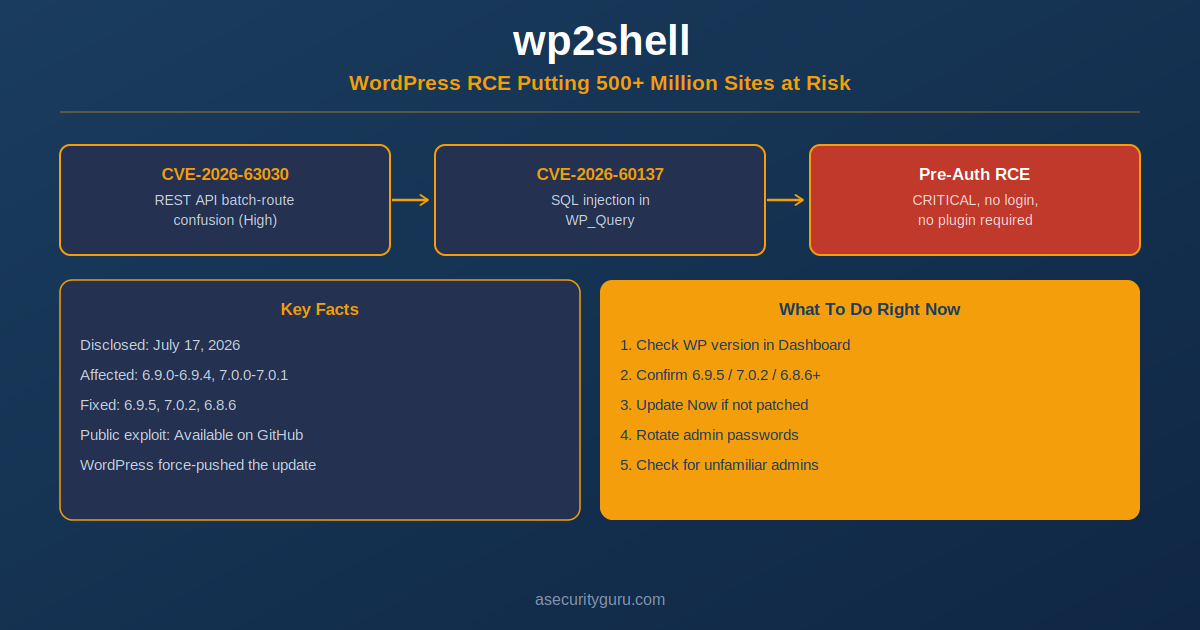
wp2shell is a WordPress core chain of two individually moderate bugs, disclosed July 17, 2026. Searchlight Cyber found them. CVE-2026-63030 is a route confusion in the REST batch endpoint (CVSS 7.5 alone). CVE-2026-60137 is a SQL injection in WP_Query. Chained, they give an anonymous attacker admin password hashes and, per the page, code execution on a default install with no plugins.
How it works
- The
/wp-json/batch/v1endpoint has existed since WordPress 5.6. The route confusion was introduced in 6.9 and misroutes attacker-controlled input to the wrong internal handler. - The SQL injection sits in the
author__not_inparameter ofWP_Queryand has existed since 6.8. Alone, it needed more direct access to reach. - The attacker sends a request to the batch endpoint and smuggles a malicious
author__not_ininto aWP_Querycall. A public PoC on GitHub dumps the user table, including admin hashes, and reaches code execution. - The RCE path needs the 6.9 route confusion. That is why 6.8.x has the SQL injection only.
Preconditions / Affected
- Full chain: 6.9.0-6.9.4 and 7.0.0-7.0.1.
- SQL injection only: 6.8.0-6.8.5.
- Fixed in 6.9.5, 7.0.2 and 6.8.6.
- No login, plugin or special configuration is needed.
What to do
- Confirm the version under Dashboard → Updates. WordPress force-pushed the update, but the page says to verify anyway. Hosts that disable auto-updates at server level, or management setups that override core update behavior, may not have applied it.
- If you can't patch yet, use these stopgaps (Searchlight Cyber's recommendation): - Install a plugin that blocks anonymous REST API access. - Block both
/wp-json/batch/v1and?rest_route=/batch/v1at the WAF. The query-string form is a second route to the same endpoint, so blocking only the pretty URL leaves a gap. - If the site ran an affected version at any point before patching: - Rotate all administrator passwords. - Look for unfamiliar admin accounts, unexpected plugin installs, theme edits or new files. - Search access logs for requests to either batch URL around the disclosure window. - Treat any finding as a confirmed compromise and run full incident response. Don't just remove the suspicious item.
Caveats
- The page says no in-the-wild exploitation was confirmed as of its reporting, but a full public PoC appeared within roughly 24-48 hours of disclosure.
- The stopgaps may break legitimate site functionality and don't replace patching.
- The page names Cloudflare WAF protections shipped alongside the patches, but gives no detail on what they cover.
- The page gives no log signatures beyond the two request paths.
Organisations named here
- CWE-89
CVEs named here
- CVE-2026-63030
- CVE-2026-60137
Technologies named here
- Searchlight Cyber
- WordPress 6.9.0-6.9.4
- WordPress 7.0.0-7.0.1
- Cloudflare WAF
- Public proof-of-concept exploit tool on GitHub
- WordPress 6.8.0-6.8.5
- WordPress auto-update
- WordPress Core REST API batch endpoint
- WAF rules
- WordPress Core WP_Query class
- Fixed in WordPress 6.9.5, 7.0.2 and 6.8.6
- Plugin blocking anonymous REST API access
- CVE Tracker
- WordPress
- Cloudflare
- CVSS
Techniques named here
- Vulnerability chaining
- Route confusion in REST API batch endpoint
- Post-patch compromise checks
Threat actors named here
- wp2shell
Related in AppSec
 github.comadvisory
Flowise MCP Security Bypass Enables RCE

 huntress.comwriteup
Inside an Oracle Database SQL Injection Attack | Huntress
github.comrepoOASIS

 blog.trailofbits.comwriteup