 huntress.comadvisory
Cleo Software Actively Being Exploited in the Wild | Huntress
test
What it is
Huntress threat advisory on active mass exploitation of an arbitrary file-write flaw in Cleo's LexiCom, VLTrader, and Harmony managed file-transfer software (CVE-2024-55956, distinct from the earlier CVE-2024-50623). The critical finding: the existing patch, version 5.8.0.21, does not fix the flaw. Huntress recreated a working proof of concept against 5.8.0.21, and Cleo confirmed the recreated attack chain over a Zoom call on December 9.
How it works
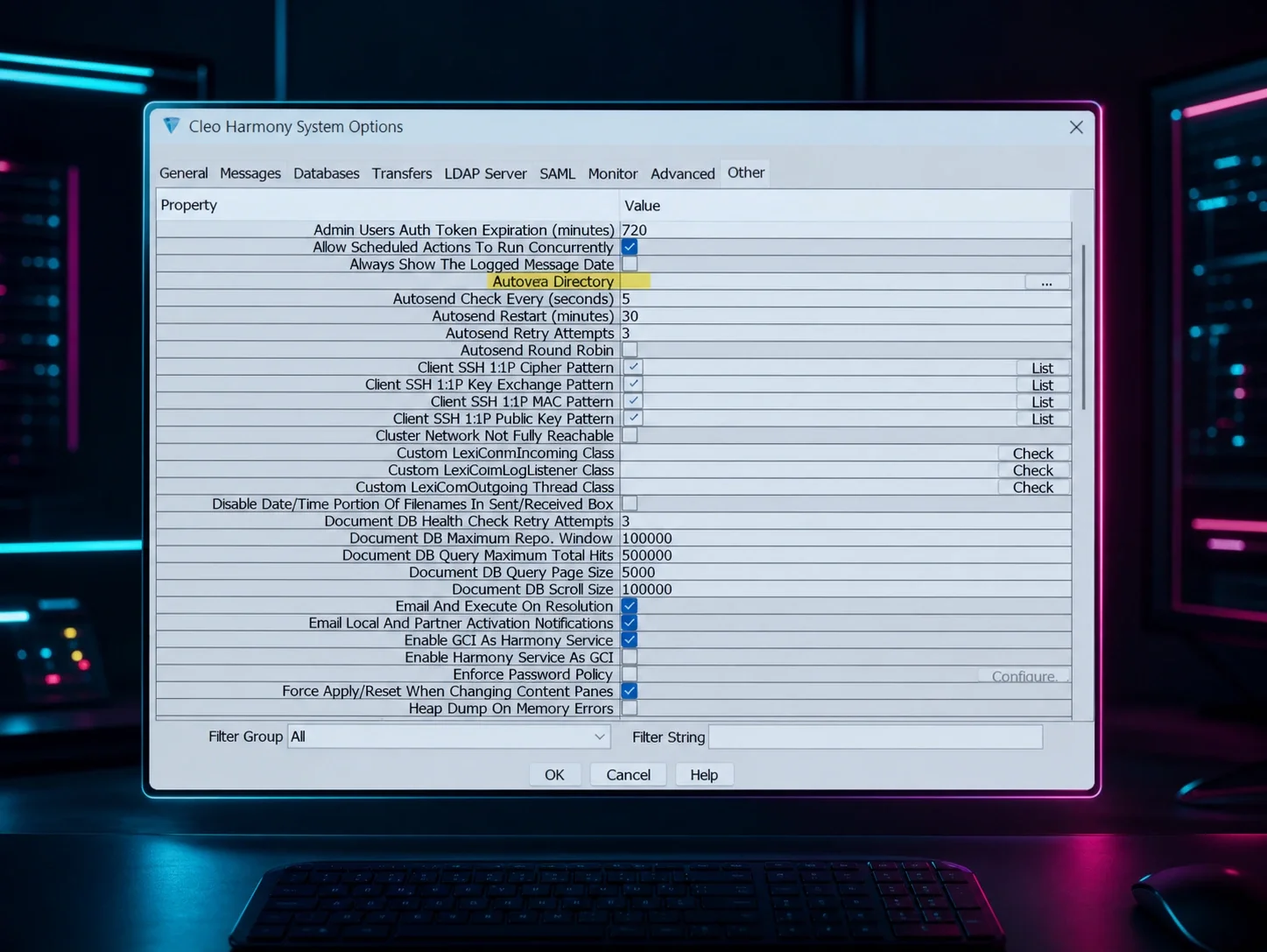
The primitive lets an unauthenticated attacker write files anywhere on disk. The chain abuses Cleo's native autorun folder, whose contents are immediately read, evaluated, then deleted:
- Attacker writes
autorun\healthchecktemplate.txt(also seen:autorun\healthcheck.txt). - That file invokes Cleo's native Import functionality against a dropped
.tmpfile intemp\— actually a ZIP containinghosts\main.xml. main.xml(bearing a decoy2020/10/10 00:00:00timestamp) stages a further autorun that launches an encoded PowerShell command.- PowerShell fetches JAR files from an external IP; the JARs provide webshell-like persistence. Attackers later delete the JARs to stay stealthy.
- Follow-on AD reconnaissance uses
nltest.exe.
Preconditions / Affected
Internet-exposed Cleo Harmony, VLTrader, or LexiCom, all versions up to and including 5.8.0.21 — including fully patched systems. Default installs sit at C:\LexiCom, C:\VLTrader, C:\Harmony, or under C:\Program Files (x86).
What to do
No fixing patch existed at time of writing. Huntress's mitigation is to move internet-exposed Cleo systems behind a firewall until a new patch ships.
Detection artifacts the page names:
autorun\healthchecktemplate.txtorautorun\healthcheck.txt(deleted after processing, so check logs, not just disk).- In
logs\LexiCom.xml, Import events loading atemp\*.tmpfile. - In
LexiCom.dbg, lines such as:
LexiCom.syncer [redacted] Request In <<< Multipart:
VLSync:SentReceipt;service=AS2;path="autorun/healthchecktemplate.txt"nltest.exespawned in an unusual parent-child chain.
Callback IPs to hunt/block:
176.123.5.126
5.149.249.226
185.181.230.103
209.127.12.38
181.214.147.164
192.119.99.42
Caveats
Huntress could not recover the contents of the healthchecktemplate.txt / healthcheck.txt autoruns because Cleo auto-deletes them. Exploitation was confirmed as early as December 3 with a sharp uptick December 8 ~07:00 UTC; at least 10 businesses were compromised, mostly in consumer products, food, trucking, and shipping, and Huntress notes others outside its visibility are likely affected. The blog was being updated as details emerged, so version and patch status may have changed after publication.
CVEs named here
- CVE-2024-55956
- CVE-2024-50623
Technologies named here
- Huntress Managed EDR
- Cleo Harmony
- Cleo VLTrader
- Shodan
- Cleo LexiCom
- CyberChef
- nltest.exe
- Python script
- PowerShell
Techniques named here
- Arbitrary file-write exploitation
- Autorun file abuse
- Malicious XML import leading to code execution
- Encoded PowerShell command execution
- Webshell-like persistence via JAR files
- Anti-forensic cleanup
- Active Directory reconnaissance
Threat actors named here
- Unnamed threat actors exploiting Cleo software
Related in Threat Intel
 huntress.comwriteup
Reverse Engineering the Six Stages of MacSync Stealer and RAT
 huntress.comwriteup
AI-Coded Malware | Analyzing Vibe-Coded AD Enumeration | Huntress

 blog.talosintelligence.comtool
Introducing CAIRN: Frontier tracking for AI-integrated malware (Cisco Talos)
 huntress.comwriteup