 huntress.comwriteup
Uptick in Bomgar RMM Exploitation
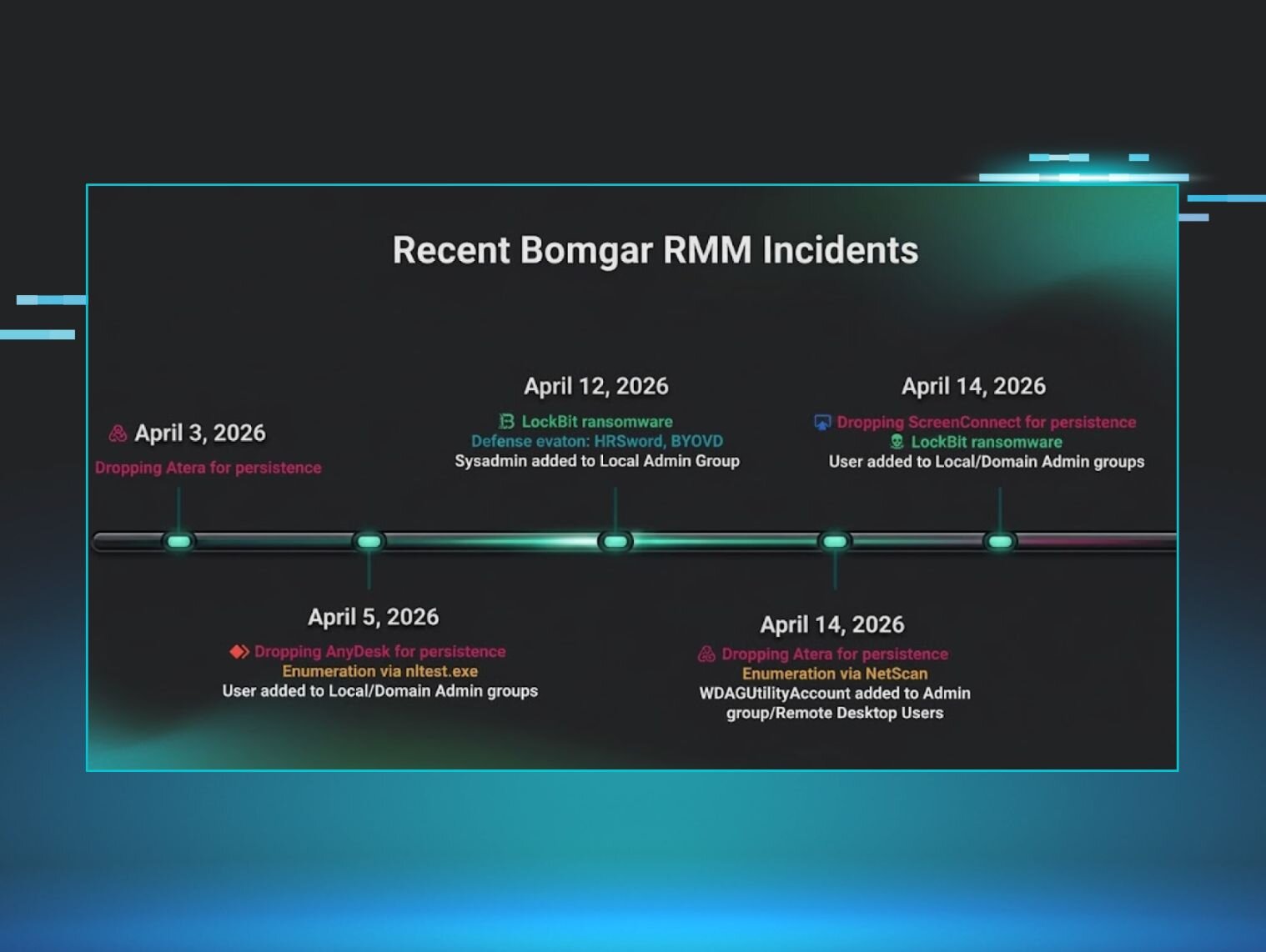
Huntress SOC documents an ongoing wave of exploitation of CVE-2026-1731, an unauthenticated RCE in Bomgar (rebranded BeyondTrust Remote Support/Privileged Remote Access), first disclosed in February 2026 and patched in versions 25.3.2/25.1. Attackers are using compromised outdated Bomgar instances — including at an MSP and a dental software vendor — to add rogue domain admin accounts, deploy LockBit ransomware (likely via a leaked LockBit 3.0 builder), drop the BYOVD EDR-killer PoisonKiller, and pivot to additional RMM tools like AnyDesk, Atera, ScreenConnect, and a renamed SimpleHelp for persistence across downstream customer environments.
What it is
Huntress SOC's report on active exploitation of Bomgar (BeyondTrust Remote Support) RMM instances via CVE-2026-1731, an unauthenticated RCE flaw BeyondTrust fixed on February 6, 2026. Exploitation came in waves: an initial spike from February 12 (≥10 organizations) and a second surge from April 3 onward. Attacks lead to LockBit ransomware deployment, persistence, and EDR kills. Root cause is not confirmed but the incidents likely stem from CVE-2026-1731 — impacted orgs were running outdated Bomgar versions.
How it works
Malicious activity spawns from bomgar-scc.exe on the compromised instance. Post-access, the actor conducts domain recon and network enumeration (NetScan), creates a local account, then elevates it into Local Administrators and Domain Admins for a domain-wide backdoor. Additional RMMs are dropped for redundant persistence: AnyDesk (C:\Users\support\Documents\AnyDesk.exe) and a ScreenConnect client under C:\Program Files (x86)\ScreenConnect Client (0a42c9161c039ecc)\. Ransomware runs as LB3.exe from the user Desktop, targeting local drives and the SQL Server install path. In one incident the actor deployed BYOVD drivers C:\temp\PoisonX.sys (possibly PoisonKiller, briefly on GitHub in early April, now removed) and C:\Windows\System32\drivers\hrwfpdrv.sys, plus HRSword.exe, to kill EDR.
Preconditions / Affected
Internet-reachable, outdated Bomgar / BeyondTrust Remote Support instances unpatched against CVE-2026-1731. The blast radius is amplified for MSPs and software vendors: one MSP compromise (April 15) triggered mass isolation of 78 businesses with exploitation across four downstream customers; a dental-software company's instance (April 14) reached three downstream companies.
What to do
Patch to a fixed Bomgar version (fixes issued February 6, 2026). Hunt for the observed indicators:
- Child processes of
bomgar-scc.exe. - Persistence account creation, e.g. credential
Adminpwd123.1and:
net localgroup administrators [REDACTED] /add
net group "domain admins" [REDACTED] /add- Unexpected AnyDesk / Atera / ScreenConnect installs (paths above).
- Driver files
PoisonX.sys,hrwfpdrv.sys, andHRSword.exe. LB3.exeexecution from user Desktop.
Caveats
Huntress states it does not yet have insight into the specific root cause; the CVE-2026-1731 link is assessed as likely, not confirmed. LockBit attribution is inferred from clues suggesting use of the leaked LockBit 3.0 builder — and the ransom notes in the April 12 and April 9 incidents did not match LockBit's usual style, so the operator may not be genuine LockBit. The PoisonKiller association for PoisonX.sys is tentative ("may be linked").
Organisations named here
- LockBit 3.0
- PoisonKiller
- WDAGUtilityAccount
CVEs named here
- CVE-2026-1731
Technologies named here
- Bomgar RMM / BeyondTrust Remote Support
- Bomgar / BeyondTrust Remote Support
- BeyondTrust Privileged Remote Access
- LB3.exe
- ScreenConnect
- AnyDesk
- Atera
- NetScan
- PoisonX.sys / PoisonKiller
- HRSword.exe
- SimpleHelp RMM
- LOLRMM
- Huntress agent
- Bomgar
- SimpleHelp
- Windows
- HRSword
Techniques named here
- Targeting MSPs to reach downstream customers
- Local/Domain Administrator account creation for persistence
- Deployment of additional RMM tools for persistence
- Domain and network reconnaissance
- BYOVD to disable EDR/security tooling
- Ransomware execution via RMM session
- Malicious use of Windows Installer for payload delivery
- Dropping tools in PerfLogs directory
Threat actors named here
- LockBit ransomware
- Unnamed threat actors exploiting Bomgar RMM
- LockBit
Related in Threat Intel
 huntress.comwriteup
Reverse Engineering the Six Stages of MacSync Stealer and RAT
 huntress.comwriteup
AI-Coded Malware | Analyzing Vibe-Coded AD Enumeration | Huntress

 blog.talosintelligence.comtool
Introducing CAIRN: Frontier tracking for AI-integrated malware (Cisco Talos)
 huntress.comwriteup