 newsletter.semianalysis.comarticle
Nvidia’s Backstop Universe – Heads I Win, Tails Who Loses?
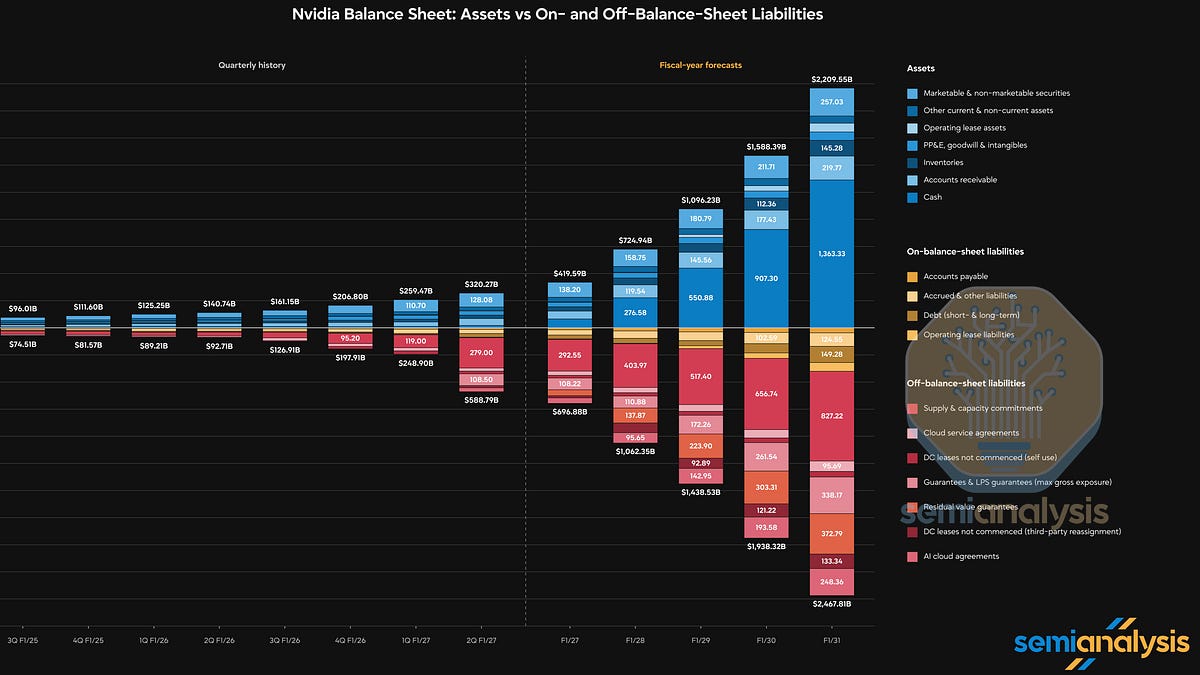
SemiAnalysis article on Nvidia's $530B of off-balance-sheet guarantees disclosed in its 2Q F1/27 10-Q, up from $184B a quarter earlier. It breaks down the AI Cloud Partner program, the SB Energy PORTS-Pike lease guarantee for OpenAI, and a proposed residual value guarantee for private equity funds. SemiAnalysis models how far Nvidia could extend each backstop given its cash generation.
What it claims
SemiAnalysis argues that Nvidia's $530B of off-balance-sheet obligations (2Q F1/27 10-Q, released August 26, 2026) are affordable, and that Nvidia should keep expanding them. The authors say Nvidia loses only if backstopped Neoclouds default while Nvidia's own cash generation slows. They concede the two risks are correlated, because a Neocloud that cannot pay its lease has also stopped buying GPUs. By their count Nvidia backstops about 6.5 GW, mostly unbuilt. They compare this with roughly 15 GW of third-party capacity that Microsoft, Meta, AWS and Oracle lease in 2026. They expect those four to lease more than 35 GW by 2028, on 15 to 20 year terms.
How it works
The authors' thesis is that the Gigascalers (Amazon, Microsoft, Google, Meta, Oracle) gatekeep investment-grade capital. Nvidia builds alternative credit anchors so that non-IG Neoclouds and Neolabs can borrow at IG pricing. Nvidia sells GPUs at full margin on day one. It then does one of three things: floors the buyer's revenue, guarantees the buyer's landlord, or signs the lease itself.
- AICP: Nvidia backstops six-year GPU rentals at about $2.35/hr/GPU for GB300, against $4.50 to $4.60 for 5-year market contracts. Neoclouds re-rent on shorter terms and can fall back to Nvidia.
- Residual value guarantee (RVG): this is the private equity program announced August 2026, targeting over $500B. SemiAnalysis infers its structure from the Google-Broadcom-Anthropic-Apollo TPU deal.
- In the TPU deal, Broadcom makes senior noteholders whole after a rack sale, and Google backstops the datacenter rents.
- Nvidia's version caps the guarantee at 25% and says nothing about a datacenter backstop.
- The authors expect the 25% to sit below senior lenders but above equity and mezzanine, giving the senior tranche enough cushion to attract banks.
Evidence
Changes from the prior quarter's $184B:
- Supply and capacity commitments rose from $119B to $279B, mostly memory. 96% is due by F1/29.
- Guarantees rose from $3.5B to $108.5B. This is the SB Energy PORTS-Pike campus in Ohio: 4.25 GW leased to OpenAI for 20 years, with Nvidia guaranteeing land, power and shell.
- Two new line items appeared: $36B of AI cloud agreements, and $20B of datacenter leases signed by Nvidia as tenant and expected to be reassigned.
On the balance sheet:
- Liabilities are $91B, including $33.4B of debt. $25B of senior notes were issued in the latest quarter.
- Cash went from $12B to $22B. Investments went from $45B (2Q F1/26) to $128B.
- The $99B equity book produced $23.7B of first-half gains, and another $25B of equity investments is committed.
AICP deals:
- Firmus, 360 MW in Batam: $21.1B.
- SharonAI: $4.2B.
- GMI: about $2.2B (SemiAnalysis estimate).
SemiAnalysis expects the AICP line to close F1/27 at $51B.
Obligation per GW enabled is $59B for AICP, $25B for PORTS-Pike and $9.4B for the RVG structure. The RVG figure excludes the unsolved datacenter leg.
Limits
- Forward figures are capacity estimates, not forecasts. SemiAnalysis says its projections show what Nvidia could support, not its base case.
- Cash reaching $1.4T by F1/31 rests on consensus EBITDA of about $441B in F1/28. Nvidia would more likely reinvest that cash.
- RVG obligations of $55B at end of F1/27 rising to $373B by F1/31 assume an "aspirational" $2.5T of funding.
- The model also assumes AICP keeps growing, although Nvidia reportedly paused new AICP deals around mid-October 2026.
- The RVG structure is the authors' inference. Nvidia has published few details.
- Context for scale: SemiAnalysis estimates about $11T of cumulative AI capex from CY24 through CY29.
- The fetched text is incomplete. It ends after the RVG section, so the authors' analysis of the remaining line items is missing.
Organisations named here
- NVIDIA
- SemiAnalysis
- OpenAI
- Amazon
- Microsoft
- Meta
- Oracle
- Broadcom
- Anthropic
- Cisco
- Apollo
- AWS
- Firmus
- GMI
- Jensen Huang
- SB Energy
- SharonAI
Technologies named here
- TPU
- GB300
Related in ai-policy


 futureoflife.orgarticle
Future of Life Institute AI Safety Index — Summer 2026

 interconnects.aiarticle
Lessons from the hacks
 interconnects.aiarticle