
 stepsecurity.ioarticle
GitHub Secret Scanning Public Monitoring for Enterprises: Coverage and Gaps
StepSecurity breaks down GitHub's new "public monitoring" secret-scanning feature (public preview, shipped July 1), which watches all of github.com — not just an org's own repos — for leaked enterprise secrets across git content, PR comments, and issues, attributing findings via GitHub's identity layer. The piece then details what it doesn't cover: workflow run logs (the exact path abused in the tj-actions/changed-files compromise), and any exfiltration that never touches github.com at all, such as the credential-stealing campaigns run by TeamPCP against Trivy and the telnyx PyPI package, or GhostAction's malicious-workflow exfiltration to attacker infrastructure. It argues for pairing this after-the-fact detection with runtime egress control (StepSecurity's Harden-Runner) to block exfiltration at the network layer, citing its role in catching the Shai-Hulud worm running inside CNCF's Backstage repo.
What it is
GitHub's public monitoring for secret scanning, shipped July 1 (2025) and in public preview for enterprises. It scans public content across all of github.com in real time — git content, PR comments, and issues — and attributes matches back to your enterprise via GitHub's identity layer and verified domains rather than commit-email guessing. The post is a StepSecurity analysis of its coverage boundary, and pitches Harden-Runner as the prevention layer.
Preconditions / Affected
- GitHub Enterprise Cloud with Secret Protection or Advanced Security — no additional cost.
- Enabled by enterprise owners or enterprise security managers from the enterprise Security tab.
- Private repos are never scanned; only already-public exposure surfaces. Enterprise Cloud with data residency is not yet supported.
What it does not see
- Off-github.com exfiltration — theft to attacker-owned infrastructure (cited: TeamPCP against Trivy and the telnyx PyPI package; GhostAction, which stole 3,000+ secrets via malicious workflows posting to attacker endpoints).
- Workflow run logs — absent from both the announcement's scan list and GitHub's secret-scanning docs (which cover commits, issues, PRs, discussions, gists). The tj-actions/changed-files compromise exposed CI credentials in build logs. Treat log-based exposure as out of scope until GitHub documents it.
- It is detection after exposure. Attackers validate and abuse dumped credentials within minutes; real-time detection shrinks the response window but does not reopen the one already closed.
What to do
The page's concrete checklist:
- Enable public monitoring from the enterprise Security tab; triage the recently-leaked secrets it surfaces and rotate anything active.
- Audit GitHub Actions workflows for exfiltration exposure. Action Advisor analyzes any public repo's workflows, free and no login.
- Run a GitHub Actions security audit for full CI/CD risk.
- Add runtime egress control (Harden-Runner) so the next exfiltration attempt fails at the network layer — in block mode it allows only explicitly-allowlisted outbound endpoints and surfaces anomalous calls at the moment they happen.
Context worth knowing
The named motivating incidents: Sha1-Hulud: The Second Coming (Nov 2025) dumped stolen credentials as JSON into 21,000+ UUID-named public repos within hours; Megalodon used 5,500 public repos. Harden-Runner reportedly caught Sha1-Hulud in practice via baseline anomaly detection in CNCF's Backstage repo.
Caveats
This is a vendor post — the "close the gap" conclusion routes to StepSecurity's own product. The coverage/gap analysis is grounded in GitHub's own documentation, but the workflow-log gap is inferred from documentation absence ("until GitHub documents log coverage"), not a stated exclusion.
Organisations named here
- Shai-Hulud: The Second Coming
Technologies named here
- GitHub Secret Scanning - Public Monitoring
- npm ecosystem
- GitHub.com
- Harden-Runner
- GitHub Enterprise Cloud
- Action Advisor
- Trivy
- StepSecurity GitHub Actions security audit
- StepSecurity leaked secrets detection
- telnyx
- GitHub Actions
- CNCF's Backstage repository
- GitHub
- GitHub Advanced Security
- npm
- PyPI
- tj-actions/changed-files
Techniques named here
- Exfiltration to public github.com repositories
- Rapid automated credential validation and abuse
Threat actors named here
- SHA1-Hulud
- Megalodon
- TeamPCP
- GhostAction
- tj-actions/changed-files compromise
Related in DevSecOps

 jfrog.comarticle
JFrog: The Governance Gap Between Your Policy and Your Pipeline
 stepsecurity.ioarticle
Dev Machine Guard Now Supports Windows - StepSecurity
 socket.devwriteup
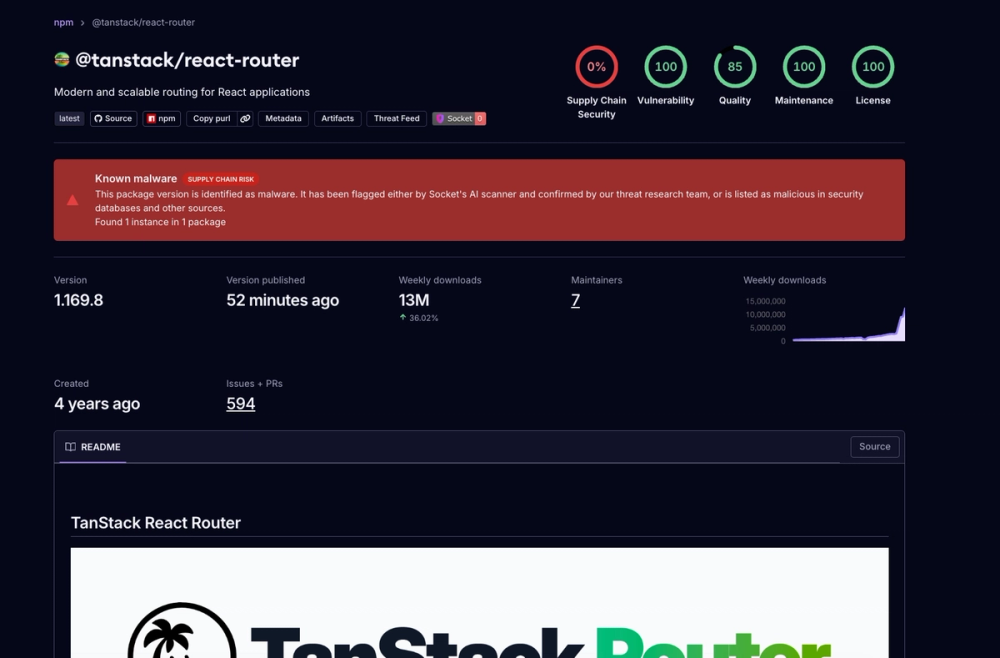
Socket: TanStack npm Packages Compromised

 securitylab.github.comadvisory