 huntress.comwriteup
Komari Red: The Monitoring Tool with a Built-in Reverse Shell
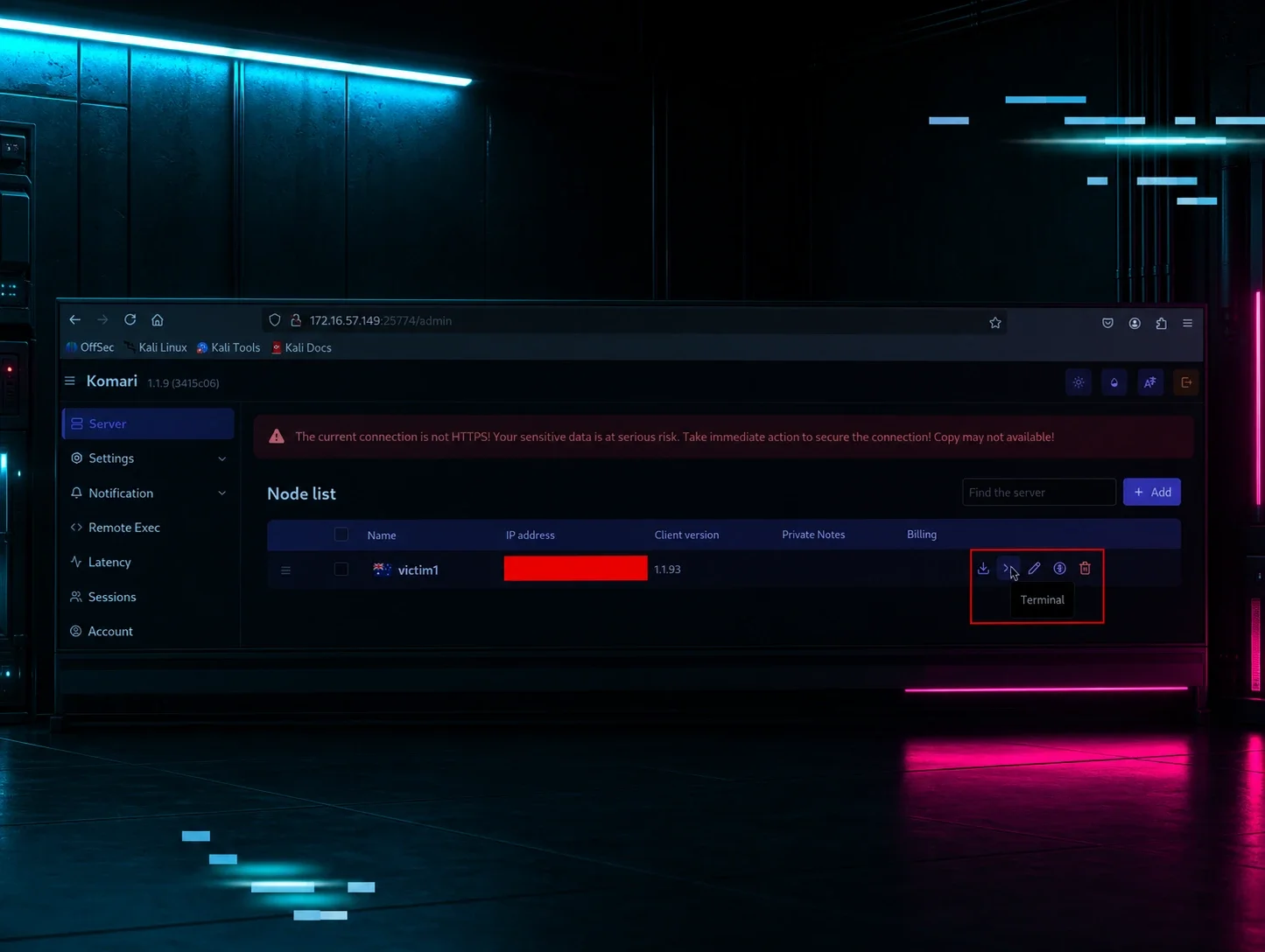
Huntress details a live intrusion where an attacker used stolen SSLVPN credentials, Impacket's smbexec.py (a customized fork with randomized artifact names) for lateral movement and registry-hive dumping, then enabled RDP via reg/netsh changes to interactively install the open-source "Komari" monitoring agent as a SYSTEM-level service named "Windows Update Service" via NSSM. Unlike other abused RMM/monitoring tools (Velociraptor, SimpleHelp, ScreenConnect, AnyDesk, Nezha, Atera), Komari ships arbitrary command exec, an interactive PTY reverse shell, and distributed ping/port-scanning enabled by default over a WebSocket that blends in as normal HTTPS traffic — turning a legitimate 4.3k-star GitHub monitoring tool into an out-of-the-box botnet-style C2 with no weaponization required.
What it is
A Huntress case study of a single-workstation intrusion (April 16, 2026 UTC) that supplies concrete IOCs and detection heuristics the summary omits. Initial access was a FortiGate SSLVPN login as [User 1] from 45.153.34[.]132 — an address resolving to VMHeaven[.]io hosting (Netherlands, ASN 51396), previously seen by Huntress as SSLVPN egress and staging infrastructure.
How it works
The operator's host announced itself to AD as workstation VM8514 and drove type-3 network logons into the target from the FortiGate-assigned tunnel IP 10.212.134[.]200. It enabled Remote Registry (Event ID 7040: disabled → demand start), attempted a hive dump (secretsdump-style over MS-RRP), then ran a customized Impacket smbexec.py chain parented to services.exe under NT AUTHORITY\SYSTEM, ending in a PowerShell one-liner that pulled the Komari agent and registered it as a SYSTEM service named "Windows Update Service."
Preconditions / Affected
Valid VPN credentials on an internet-facing FortiGate SSLVPN, plus enough access to enable Remote Registry and run remote SMB command execution as SYSTEM on the target.
What to do
Hunt for these specific artifacts:
- Network: connections to/from
45.153.34[.]132; any SSLVPN egress from VMHeaven[.]io / ASN 51396. - Komari: PowerShell fetching from
raw.githubusercontent[.]com/komari-monitor/komari-agent; a SYSTEM service named "Windows Update Service" (Komari's control channel is on by default — treat any Komari agent as live C2). - Customized smbexec: randomized 8-char batch filenames and
__output_<random>pipes parented toservices.exe. Vanilla Impacket ships a static service nameBTOBTOand a plain__outputfilename — the presence of randomized artifacts (e.g.SCnRMUvT,BPzrQOLa,HBBJLmCW,PlYHZsEC, output suffix_iDhLsdpD) indicates a fork built to evade signatures, so don't rely on theBTOBTOstatic-string detection. - Naming heuristic: flag AD workstation names matching
VM+ four digits with no domain suffix or asset-tag prefix (e.g.VM8514) as possible disposable operator VMs. - Registry dumping: Defender
Behavior:Win32/RegDump.SA(Event ID 1116) onsvchost.exe; a compressed hive-sized drop such asC:\Windows\Temp\aRhRnnHI.tmp.
Caveats
Defender quarantined the RegDump.SA staging file, but Huntress states the actor had already escalated to SYSTEM and the dumping action had completed — the quarantine did not prevent credential access, so a successful Defender block here is not evidence of containment. The fetched text is truncated before the four decoded smbexec commands and any final remediation guidance.
Organisations named here
- Behavior:Win32/RegDump.SA
- smbexec.py
- T1003.001
- VMHeaven.io
Technologies named here
- Huntress Managed EDR
- Windows
- Komari
- FortiGate SSL VPN
- Impacket smbexec.py
- Active Directory Domain Controller
- Windows Remote Registry service
- Impacket secretsdump.py
- Windows Terminal Services / RDP
- NSSM
- PowerShell
- Microsoft Defender
- Komari agent
- netsh advfirewall
- Nezha
- Velociraptor
- SimpleHelp
- Net Monitor for Employees
- ScreenConnect
- AnyDesk
- Atera
- Invoke-AtomicTest
- Impacket
- FortiGate
- RDP
- Windows Defender
Techniques named here
- Stolen credential SSLVPN access
- Remote Registry hive dumping
- LSASS memory dumping
- Lateral movement via SMB service execution
- RDP enablement via registry and firewall modification
- Persistence via malicious Windows service masquerading
- Command and Control over Web Service / WebSocket
- Remote command execution
- Interactive PTY reverse shell
- Network reconnaissance via distributed agent pinging
Threat actors named here
- Unattributed operator
Related in Threat Intel
 huntress.comwriteup
Reverse Engineering the Six Stages of MacSync Stealer and RAT
 huntress.comwriteup
AI-Coded Malware | Analyzing Vibe-Coded AD Enumeration | Huntress

 blog.talosintelligence.comtool
Introducing CAIRN: Frontier tracking for AI-integrated malware (Cisco Talos)
 huntress.comwriteup