 newsletter.semianalysis.comarticle
Everyone Says Datacenter Moratoriums Are Killing the US Buildout. We disagree
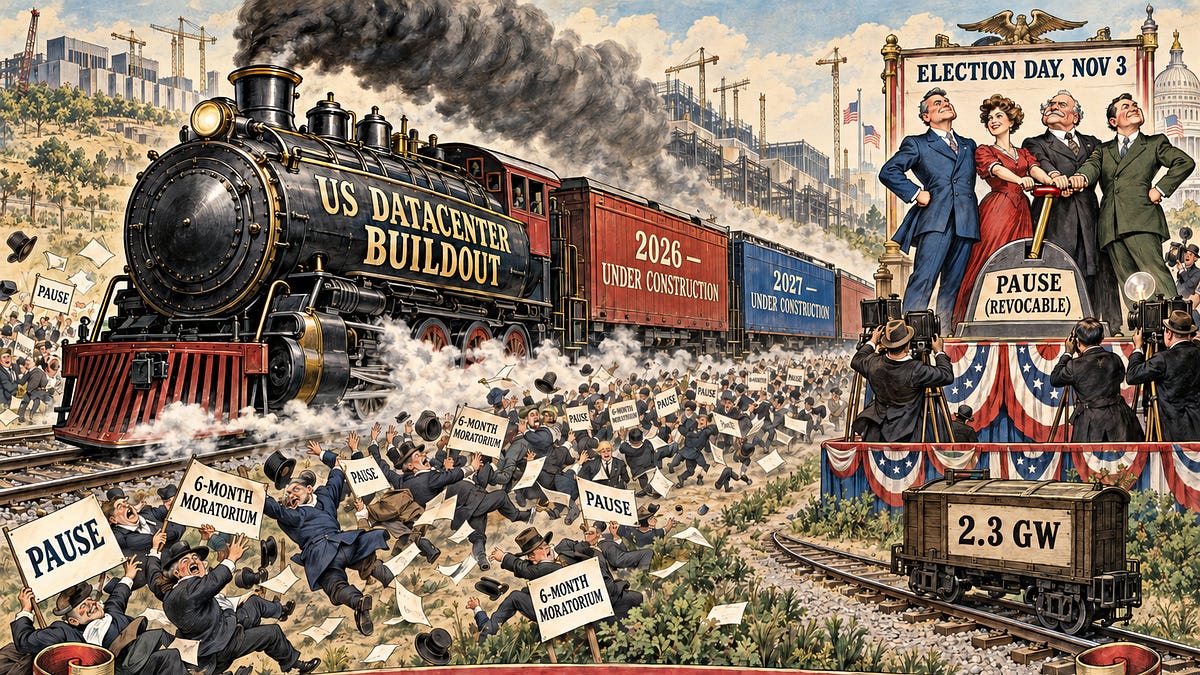
SemiAnalysis argues that datacenter moratoriums are not stopping the US buildout. It estimates only about 2.3 GW of planned capacity is delayed: 1,525 MW from local moratoriums (7.6% of roughly 20 GW inside restricted areas) and about 0.8 GW from New York's order. Its Datacenter Industry Model forecasts 38 GW of US IT capacity delivered in 2027. The full project list is paywalled.
What it claims
SemiAnalysis argues that counting moratoriums overstates their effect on US datacenter capacity, and that megawatts must be checked project by project instead. Its Datacenter Industry Model splits the forecast 38 GW for 2027 into 22 GW under vertical construction and 16 GW "planned," most of which SemiAnalysis says is already financed and doing site works. It says the forecast has barely moved in 12 months. The authors hold that moratoriums cannot touch anything under construction or fully permitted, which covers all of 2026 and most of 2027. They state that moratoriums could delay the buildout but are not yet widespread or restrictive enough to do so.
How it works
The model tracks more than 6,000 facilities through property records, permits, power-usage data, FOIA requests and satellite imagery. A separate database holds more than 400 local instruments across 17 states, each followed from proposal to enactment, expiry, lifting, replacement or rejection. More than 300 of these are enacted moratoriums or permanent bans. Analysts and research agents matched each active restriction's boundary to project parcels, then checked for unsecured approvals and other schedule gates.
A project counts as delayed only if every test passes. The moratorium must reach the parcel, be in force, and overlap the project's timeline. It must cover the use, often limited by MW or square-footage thresholds or to crypto mining. The project must still need the frozen approval and be unable to redesign around it, for example with behind-the-meter (BtM) power. It must also still be active, and have no vested rights, grandfathering or carve-out such as a utility exemption or state preemption. Four factors drive most exclusions. County moratoriums stop at city lines. Freezes apply to new applications, not existing approvals. Short pauses expire before 2028+ projects need approval. Litigation or equipment lead times already gate the schedule.
Evidence
The three delayed local projects are an AWS campus in Ohio, a powered-land developer campus in Pennsylvania, and a site in Colorado. The NorthPoint campus near Scranton, Pennsylvania, passes every test. Its township adopted a moratorium in June 2026 with no size threshold, before NorthPoint filed for its special exception, which pushes entitlement into 2027. Michigan has the most local instruments (45 enacted, 7 proposed) but almost no pipeline exposure. There, Google's campus sits on land already zoned for data processing, and Related Digital in Saline Township settled after suing over exclusionary zoning. Ohio has 40 enacted, 83% of them in 2026. Michigan, Ohio, North Carolina and Georgia hold about half of all local instruments.
At state level, Texas's ERCOT queue pause adds three to four months for grid-tied base-load projects. SemiAnalysis calls it a net positive for BtM developers and cites 75 GW of firm BtM equipment orders, more bound for Texas than any other state. Thirteen statewide bills died in 2026, almost none reaching a floor vote. In SemiAnalysis's August 2026 poll, 46% of voters viewed datacenters unfavorably against 29% favorably, and 46% would oppose one in their own town. AI drew 46% favorable and 34% unfavorable.
Limits
The project-level list, the moratorium database and the poll sit behind paid products. The free text names only the NorthPoint case in detail. Pennsylvania and Oregon actions are described but not given a MW figure. The 2.3 GW counts only local moratoriums and New York's order, the two categories where SemiAnalysis can show direct project-level impact. Research agents did part of the parcel matching, and the page gives no error rate. The authors flag the November 2026 elections, such as Vivek Ramaswamy's conditions on Ohio approvals, as a possible trigger for new restrictions.
Organisations named here
- AWS
- SemiAnalysis
- Amazon Web Services
- Microsoft
- The Washington Post
- Texas
- ERCOT
- Gallup
- Greg Abbott
- Kathy Hochul
- New York
- NorthPoint
- Oregon
- Pennsylvania
- PJM
- Related Digital
- STACK Infrastructure
- T5
- Vivek Ramaswamy
Technologies named here
- AWS
Also named here
- Elon Musk
Related in ai-policy



 futureoflife.orgarticle
Future of Life Institute AI Safety Index — Summer 2026

 interconnects.aiarticle
Lessons from the hacks
 interconnects.aiarticle