 huntress.comwriteup
Fake WatchGuard VPN Site Steals Credentials
Huntress analyzes an October incident where an admin searching Bing for a WatchGuard VPN download landed on watchguard-vpn[.]net, a lookalike site whose popup.js harvests Server/Login/Password, deliberately rejects the first submission to get a second set, and posts to watchguard-ssl[.]online. Unlike earlier iterations (Secplicity, Microsoft Storm-2561), the final payload is the genuine, validly signed WatchGuard installer from the official CDN, so no malware is present for endpoint tools to flag. Covers infrastructure timeline, thin VirusTotal detections, and defender guidance (MFA, monitoring VPN logins from hosting ASNs, blocking domains, publishing official download links).
What it is
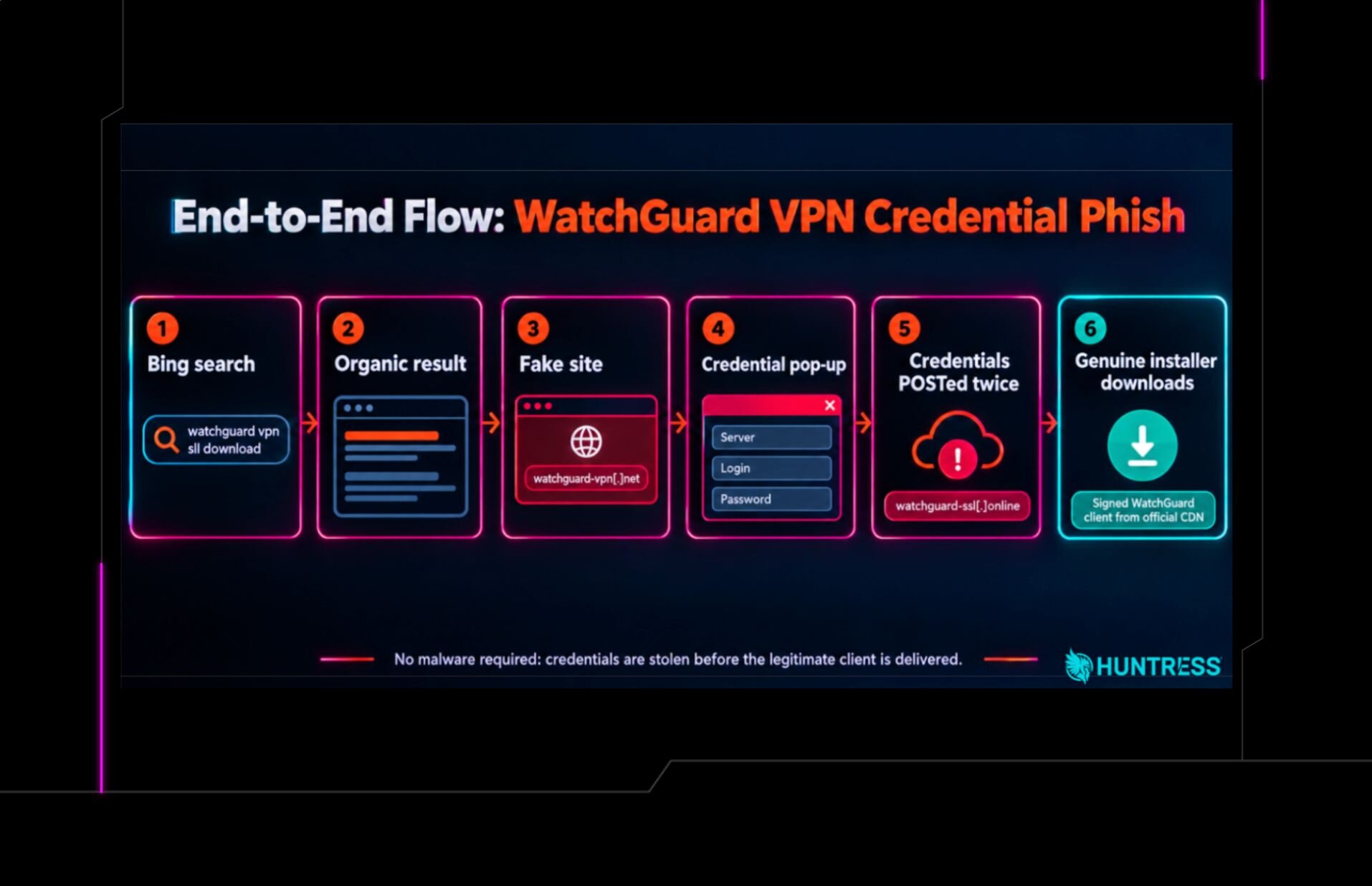
A credential-phishing chain aimed at WatchGuard Mobile VPN with SSL users. The lure is watchguard-vpn[.]net, reached through search results (SEO poisoning, per Huntress). The collector is watchguard-ssl[.]online. Huntress caught it on October 7 when an MSP administrator searched Bing for "watchguard vpn sll download" (note the typo) and clicked through eight seconds later. Managed Defender flagged it 21 seconds after the page loaded.
How it works
- The "download" buttons open a popup (popup.js, about 150 lines, unobfuscated) asking for Server, Login and Password. The Server field gives the attacker the VPN gateway address.
- The first submission is always rejected with "Incorrect data, please enter again", and
attemptis set to 2. The attacker gets a second candidate set, with each POST tagged by attempt number. - Submissions are POSTed as JSON to watchguard-ssl[.]online. A try/catch swallows failures, so the victim sees nothing even if the collector is down.
- Only after the second submission does the script fetch
https://cdn.watchguard.com/SoftwareCenter/Files/MUVPN_SSL/12_11_5/WG-MVPN-SSL_12_11_5.exe. This is an unmodified Inno Setup installer, version 12.11.5, signed by WatchGuard Technologies, Inc. (Sectigo Public Code Signing CA R36). Huntress verified the Authenticode digest matches.
Preconditions / Affected
- The victim finds the lookalike through search and enters VPN credentials into the popup.
- The VPN must be reachable with the harvested credentials. MFA is the control that breaks the chain after theft.
- Endpoint tooling has nothing to flag: no malware, and the installer is genuine.
What to do
- Block watchguard-vpn[.]net and watchguard-ssl[.]online. Also block the IPs below.
- 80.249.132[.]140 (lure; Site BV / LeaseWeb NL, AS60781)
- 158.94.209[.]19 (collector; Omegatech LTD, AS202412, Amsterdam)
- Enforce MFA on SSL VPN. Alert on VPN logins from hosting providers, unfamiliar ASNs, or countries new to the account.
- If anyone entered credentials, reset every affected account's password. Treat the VPN endpoint named in the Server field as known to the attacker.
- Publish and bookmark official download links in client documentation, including software.watchguard.com.
- Hunt on web or proxy logs for visits to the two domains, not on endpoint detections. Only 7 VirusTotal vendors flagged the lure domain and 2 flagged the collector as of October 8, and AbuseIPDB had no reports.
Caveats
- A missing cdn.watchguard.com download in browser history does not prove no theft. The download only fires after the second submission, but the first set was already posted. In the Huntress case the user likely did not finish both rounds, yet may have submitted once.
- watchguard-vpn[.]net was offline as of October 13.
- The domain was re-registered after WatchGuard's January observation (it moved from 74.208.236[.]39 to the current IP). Huntress says the evidence does not establish that the same operators ran both registrations.
Organisations named here
- credential phishing
- Secplicity
- watchguard-ssl[.]online
- watchguard-vpn[.]com
- watchguard-vpn[.]net
Technologies named here
- Huntress Managed Defender
- WatchGuard Mobile VPN with SSL client
- Huntress SOC
- WatchGuard SSL VPN / Firebox VPN credentials
- VPN clients of F5, Fortinet, SonicWall and Sophos
- VirusTotal
- Bing search results and Bing Copilot
- AbuseIPDB
- WHOIS
- popup.js
- WatchGuard
- VPN
- Huntress
- JavaScript
- Bing
- Microsoft Threat Intelligence
Techniques named here
- SEO poisoning
- Typosquatting/lookalike domain impersonating WatchGuard
- Silent failure handling to hide collector downtime
- Domain re-registration with new backend infrastructure
- Related Microsoft-reported chain
Threat actors named here
- Storm-2561
Related in Threat Intel
 huntress.comwriteup
Reverse Engineering the Six Stages of MacSync Stealer and RAT
 huntress.comwriteup
AI-Coded Malware | Analyzing Vibe-Coded AD Enumeration | Huntress

 blog.talosintelligence.comtool
Introducing CAIRN: Frontier tracking for AI-integrated malware (Cisco Talos)
 huntress.comwriteup