
 wiz.ioarticle
Securing Jenkins: Top Attack Flows & Misconfigurations | Wiz Blog
Wiz Research breaks down Jenkins' attack surface using cloud environment telemetry: 59% of Jenkins-using environments have critical core vulnerabilities, 87% run end-of-life instances, and plugins like workflow-cps-global-lib (deprecated, 31% adoption) and extended-choice-parameter (unpatched CVEs, 14% adoption) remain widely deployed despite Jenkins' otherwise mature plugin-governance model. The post maps five recurring attack chains observed in the wild - from exposed script consoles used for cryptojacking, through CI/CD pipeline secret extraction, plugin/core exploitation for controller takeover, agent compromise for lateral movement, to IMDS-based cloud credential theft used by actors like Genesis Panda and IntelBroker to pivot into cloud control planes.
What it is
Wiz's risk analysis of Jenkins across cloud environments, framing which conditions actually lead to compromise rather than just cataloguing vulnerabilities. The load-bearing insight the summary omits: most Jenkins compromises exploit misconfigurations and insecure usage, not software CVEs. That reprioritizes where an engineer should spend time — hardening config beats chasing patches.
Preconditions / Affected
The page adds privilege and exposure figures the summary skips, which determine blast radius:
- 48% of Jenkins-using environments run it on compute with highly privileged service accounts; 21% on compute with administrative privileges. Jenkins also typically has admin-level local execution rights. So a single RCE frequently converts straight into cloud compromise.
- 2% expose critically-vulnerable instances directly to the internet.
- 21% run plugins with critical/high vulnerabilities that have no patch available — meaning patching is not an option; removal or isolation is.
What to do
No commands are given, but the page yields a concrete audit checklist:
Plugins to hunt for by name:
workflow-cps-global-lib— deprecated, present in 31% of environments.extended-choice-parameter— deprecated with known unresolved vulnerabilities, present in 14%.- Any plugin marked "up for adoption" (treat as effectively end-of-life) or deprecated — these are disproportionately likely to carry 0-days.
Config to enforce: remove anonymous read access, enforce RBAC, tighten service-account scope, restrict internet-facing controllers/agents by IP, stop storing secrets in plaintext or leaking them via environment variables, rotate credentials, sandbox pipeline scripts, and gate untrusted inputs (e.g. pull-request-driven builds).
Infrastructure: don't run controllers with elevated privileges, don't share host namespaces across agents, and do not mount the Docker socket into build environments — any of these lets a Jenkins compromise escape into the host.
flowchart TD
    A[Initial access] --> B{Vector?}
    B -->|Misconfig: anon access,<br/>internet-facing, secrets| C[Foothold]
    B -->|Core CVE / unpatched plugin| C
    C --> D[RCE with admin-level<br/>local execution]
    D --> E{Privileged<br/>service account?}
    E -->|48% yes| F[Cloud compromise]
    E -->|Docker socket mounted| G[Host/container escape]
Caveats
The page is explicit that Jenkins' plugin governance is genuinely strong — signed distribution, security reviews, maintainer-transfer workflows — and states there are no publicly known supply-chain attacks against legitimate Jenkins plugins to date. So the plugin risk here is stale/unmaintained components in your deployment, not a poisoned marketplace. The "Attacks and Attackers" section is cut off in the fetched text, so attacker-attribution detail is unavailable.
Organisations named here
- Fox-IT
- NCC Group
- Praetorian
CVEs named here
- CVE-2026-0300
Technologies named here
- Wiz
- Jenkins
- workflow-cps-global-lib
- Wiz Defend
- extended-choice-parameter
- Wiz Sensor
- Palo Alto Networks PAN-OS User-ID Authentication Portal
- Docker
Techniques named here
- Script console / build functionality RCE
- CI/CD pipeline abuse to secret extraction
- Plugin/core vulnerability exploitation to controller access
- Agent compromise to credential access to lateral movement
- Cryptojacking
Threat actors named here
- Genesis Panda
- IntelBroker
- Cryptomining operators
- Opportunistic exploitation groups
- Supply-chain attackers
- Initial Access Brokers
Related in DevSecOps

 jfrog.comarticle
JFrog: The Governance Gap Between Your Policy and Your Pipeline
 stepsecurity.ioarticle
Dev Machine Guard Now Supports Windows - StepSecurity
 socket.devwriteup
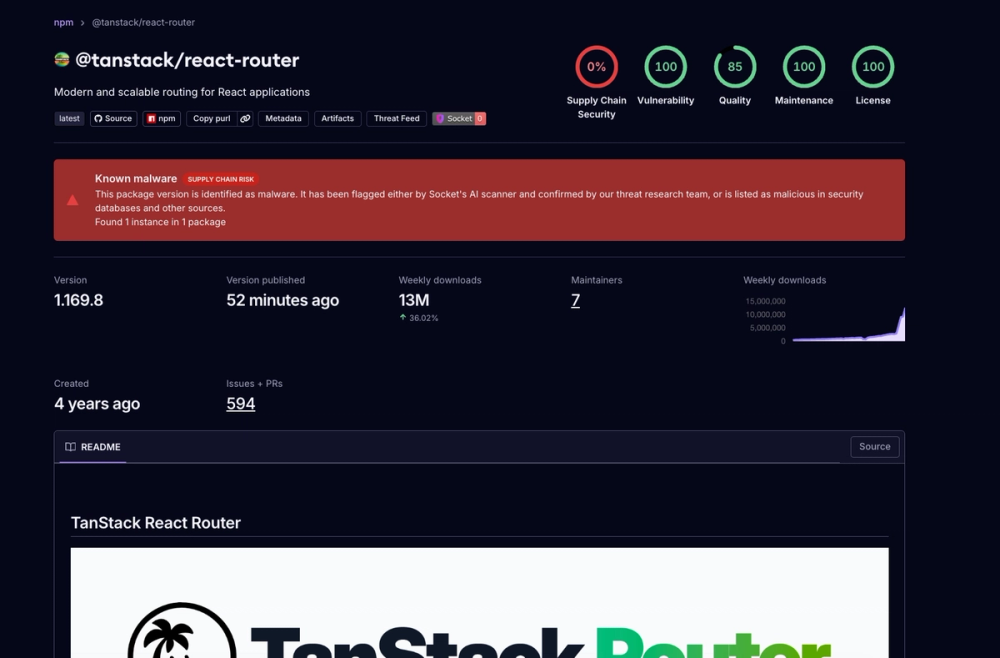
Socket: TanStack npm Packages Compromised
 securitylab.github.comadvisory