 spaceraccoon.devwriteup
Negative Days in LLM Workflows
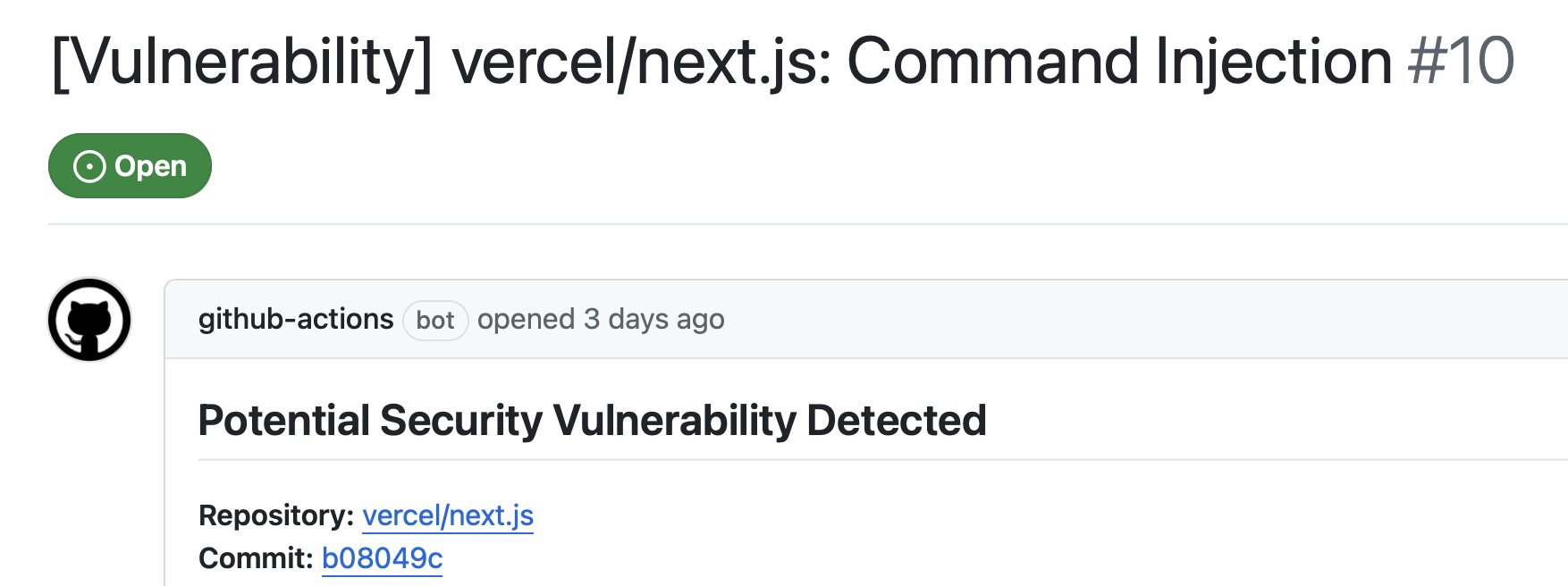
A researcher builds "Vulnerability Spoiler Alert," an open-sourced GitHub Action that uses Claude to continuously scan commits and associated pull requests in monitored repos, flagging likely security patches before a CVE is ever published. The post walks through prompt-tuning iterations (adding PR context, requiring a concrete exploit PoC, using the assistant-prefill trick to force clean JSON output), a timing case study showing an ~2-hour "negative-day" window on the React2Shell patch versus CVE feed publication, and a verified command-injection "never-day" the tool surfaced in vercel/next.js's @next/codemod (execSync with unsanitized shell interpolation), reproduced with a trojanized package.json PoC.
What it is
A DIY threat-intelligence workflow — a GitHub Action cron job — that detects security patches on open-source repos by feeding commit diffs and pull-request context to the Claude API, then opens a GitHub issue as an early-warning alert. Motivated by the "negative-days" problem: for public projects, the patch commit and PR are visible on GitHub before the CVE feed publishes. A live demo runs at https://vulnerabilityspoileralert.com.
How it works
The workflow uses a state.json to record the last-checked commit hash, checks all commits since the last run, and passes each to Claude to judge whether it patches a vulnerability. The author deliberately chose a workflow, not an agent (citing Anthropic's "when not to use agents" guidance). The initial version fed only git diff; after false positives/negatives, it added PR context via GitHub's listPu[llRequests]-type API — labels and descriptions carry more signal than short commit messages.
The tuned detection prompt instructs Claude to look for:
- Input validation being added; sanitization of user input
- Injection fixes (SQL, command, XSS, etc.)
- Authentication or authorization fixes
- Buffer overflow / memory-safety fixes
- Cryptographic improvements
- Path-traversal fixes
- Rate limiting or DoS protections
- Security keywords in commit message (CVE, security, vulnerability, fix, patch)
- PR labels indicating security ("security", "vulnerability", "CVE")
- PR description mentioning security issues, CVE identifiers, or vulnerability details
Why the window exists
The React2Shell case illustrates the gap concretely:
timeline
    10:00 PM : Patch commit pushed (public forked repo)
    11:38 PM : Pull request opened (PRs on public repos can't be private)
    11:40 PM : CVE published to MITRE
    12:00 AM : MITRE hourly cadence lets most feeds propagate
Monitoring GitHub activity directly yields ~2 hours' warning over CVE intel feeds — and React2Shell was a well-run, Meta-coordinated disclosure. Poorly-managed projects widen the gap further. The author also flags "never-days": vulnerabilities quietly patched but never assigned a CVE, so users on vulnerable versions have no signal to upgrade — especially messy when a large CVE is followed by minor CVEs and silent hardening commits.
Caveats
The page states the diff-only approach produced false positives and negatives, fixed only partially by adding PR context — so alerts still require triage. The React2Shell timeline is a best-case, tightly-coordinated disclosure; the 2-hour figure is not guaranteed for other projects. The fetched text cuts off mid-sentence at the listPu GitHub API detail, so implementation specifics beyond the prompt are incomplete here.
Technologies named here
- Claude API / Claude Opus 4.6
- React2Shell
- @next/codemod
- Vulnerability Spoiler Alert
- execa
- execSync
- MITRE CVE repository
- Mandiant reports
- Claude
- GitHub Actions
- npm
- Next.js
- Node.js
Techniques named here
- Command injection
- Prefill technique with assistant role
- LLM-based commit/PR analysis for vulnerability detection
- GitHub repository activity monitoring for early warning
Related in AI Security

 blog.talosintelligence.comtool
Introducing CAIRN: Frontier tracking for AI-integrated malware (Cisco Talos)
 github.comadvisory
Flowise MCP Security Bypass Enables RCE
github.comrepoYesWeHack Claude Kit

 jfrog.comarticle