 huntress.comwriteup
The 60ms Window: How Event 5156 Solves the ADWS Attribution Problem
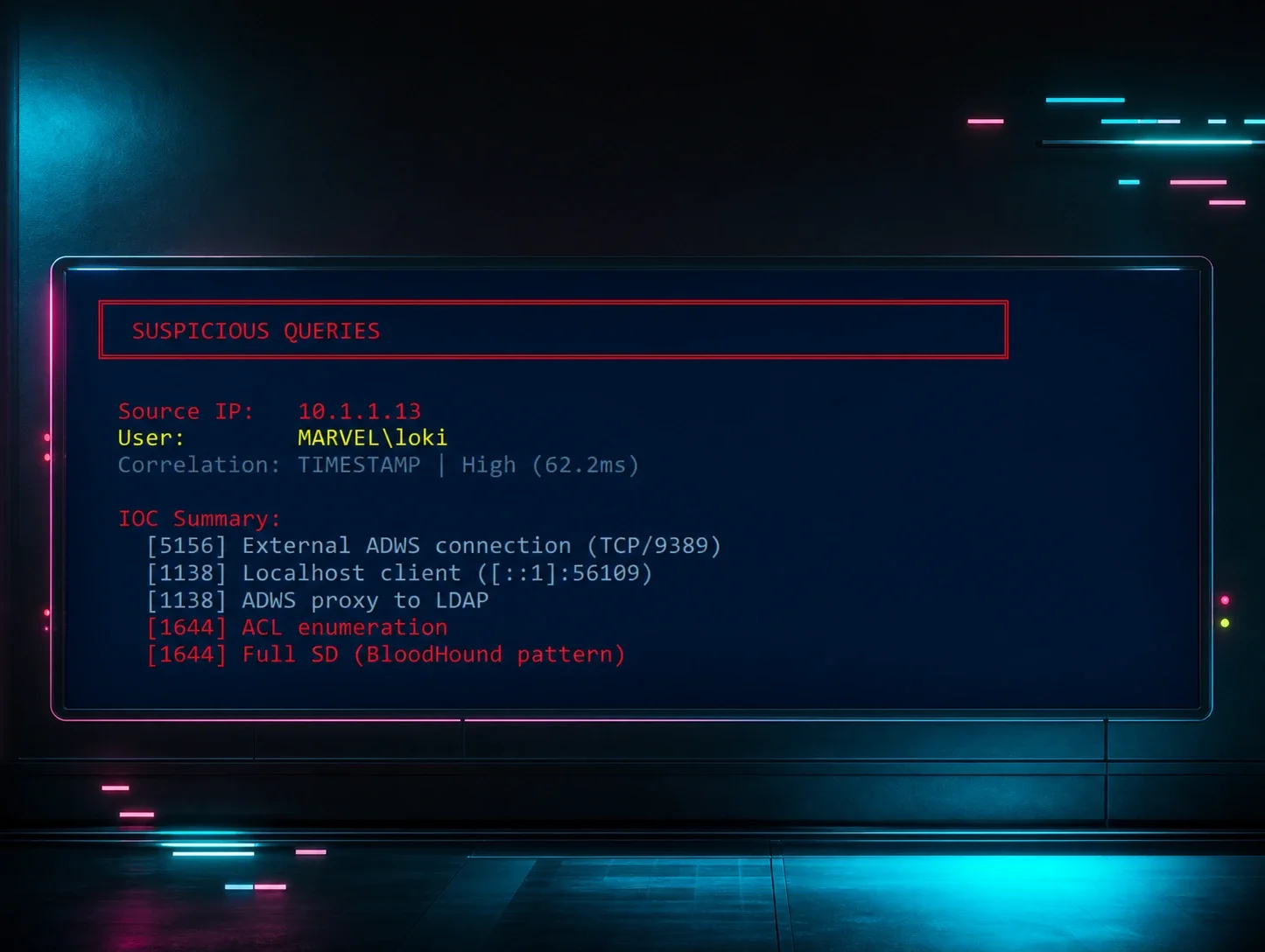
Huntress researchers solve the long-standing 'ADWS attribution problem' where tools like SOAPy abuse Active Directory Web Services to hide the attacker's real source IP behind localhost ([::1]) in LDAP diagnostic logging (Event 1644). By correlating Windows Filtering Platform Event 5156 (which captures the real inbound source IP on port 9389 before ADWS proxies to loopback) with Event 1138 (ADWS session) and Event 1644 (LDAP query) using a stable ~60-80ms timestamp window, they demonstrate reliable attribution even when port-based correlation fails due to log rollover. The post includes a released PowerShell script (Get-ADWSAttribution.ps1) and addresses the false-positive concern of RSAT tools also using ADWS via pattern detection on suspicious 1644 query attributes.
What it is
A detection-engineering walkthrough (Huntress, "Part 5B") showing how to attribute Active Directory Web Services (ADWS) enumeration — e.g. via SOAPy — back to a real originating host, despite ADWS proxying queries to LDAP over loopback so the Directory Service log shows only [::1]. It directly rebuts a claim made in the BloodHound Slack #red-team channel that 5156-based correlation, while "theoretically" possible, is impractical.
How it works
Three events are chained across a tight timing window:
- Event 5156 (Windows Filtering Platform / Security log) — fires on the inbound connection to ADWS port 9389, recording the real source IP and the owning process
microsoft.activedirectory.webservices.exe(not a genericsvchost.exe). This happens before ADWS rewrites the request to a loopback LDAP call. - Event 1138 (AD Web Services log) — logs the new connection with the client's real IP plus a unique InstanceId tying the session to later activity.
- Event 1644 (Directory Service log) — the internal LDAP query, now showing
[::1]:<ephemeral port>(page example:[::1]:60983), with user context and query details preserved but source IP gone.
Attribution comes from matching the ephemeral port in the 1644 loopback client against an internal 5156 for the ADWS→LDAP connection, then pivoting to the external 5156 to recover the source IP.
flowchart LR
  A[Remote host → :9389<br/>Event 5156: real IP] --> B[Event 1138<br/>real IP + InstanceId]
  B --> C[ADWS rewrites to<br/>loopback LDAP]
  C --> D[Event 1644<br/>client = ::1:ephemeral]
  D -. match ephemeral port .-> C
Preconditions / Affected
- Event 5156 is on by default under the Filtering Platform Connection audit subcategory — no extra config needed. The post notes it is "already being collected by most enterprise SIEMs."
- Correlation depends on all three events being retained and on the timing window holding.
What to do
- Ensure 5156 is retained rather than tuned out for volume, and correlate on ephemeral port + timestamp.
- To cut false positives (all of RSAT uses ADWS, so sysadmins trip port-9389 rules), the author advises pattern-matching on the 1644 query itself rather than the network event — flagging enumeration signatures such as
[all_with_list],SDflags:0x7, and(!(FALSE)).
Caveats
- The counterparty's concerns are real and only partly answered: 5156 is high-volume, and large identity products (e.g. MDI) reportedly don't alert on it for collection due to normal-traffic noise — so this supports triage/attribution more than turnkey alerting.
- The fetched text cuts off mid-"Phase 2," so the full correlation query and the stated 60ms window figure are not shown in the excerpt.
Organisations named here
- Charlie Clark
- Event 1138
- Event 1644
- Event 5156
- Jonathan Johnson
Technologies named here
- SOAPy
- Active Directory Web Services
- Windows
- BloodHound
- Active Directory Domain Controller
- Get-ADWSAttribution.ps1
- RSAT
- auditpol
- SIEM
- Active Directory
- PowerShell
- LDAP
Techniques named here
- ADWS-based stealthy AD enumeration/collection
- Event 5156 network correlation
- Port-based correlation
- Timestamp-based correlation
- Pattern detection in Event 1644
- SACL canaries
- NetSession enumeration
Related in Blue Team & Detection
 huntress.comwriteup
AI-Coded Malware | Analyzing Vibe-Coded AD Enumeration | Huntress

 blog.talosintelligence.comtool
Introducing CAIRN: Frontier tracking for AI-integrated malware (Cisco Talos)
 huntress.comwriteup
Inside an Oracle Database SQL Injection Attack | Huntress
 huntress.comwriteup