 interconnects.aiarticle
The current balance of power in open models
Nathan Lambert's write-up of remarks prepared for a Congressional briefing on open-weight AI models, arguing that Chinese labs (Qwen, GLM-5.3, Kimi K3, DeepSeek) have overtaken American open-weight efforts (Llama, gpt-oss, Nemotron) in downloads, benchmark scores (Artificial Analysis Intelligence Index), and academic/enterprise adoption. It distinguishes open-weight vs. true open-source models, quantifies the capability gap to closed frontier labs (OpenAI, Anthropic), discusses distillation's limited role in closing that gap, and flags emerging cybersecurity and policy risks around widely available open weights.
What it claims
Chinese open-weight models lead American ones on downloads, benchmark scores, inference usage and academic mentions, and that lead is not narrowing. The page puts timelines on it. Chinese open-weight models trail the closed American frontier by about 2-5 months. American open-weight models trail by about 6-9 months. The gap is smallest in agentic coding and largest in open-ended science such as physics and biology.
On distillation, the author estimates that fully blocking it, for example with KYC at OpenAI and Anthropic, would widen the gap by only 1-2 months. The stated reasons the Chinese labs do well are:
- they release more often, so each model is a later snapshot of steadily improving training;
- they target a narrower task distribution, which slightly flatters public benchmarks;
- since mid-2026 they have been buying agentic RL environments from US and Chinese vendors instead of building all data in-house.
Evidence
Benchmark: Artificial Analysis Intelligence Index, as of 14 Sep 2026
| Chinese model | Score | American model | Score |
|---|---|---|---|
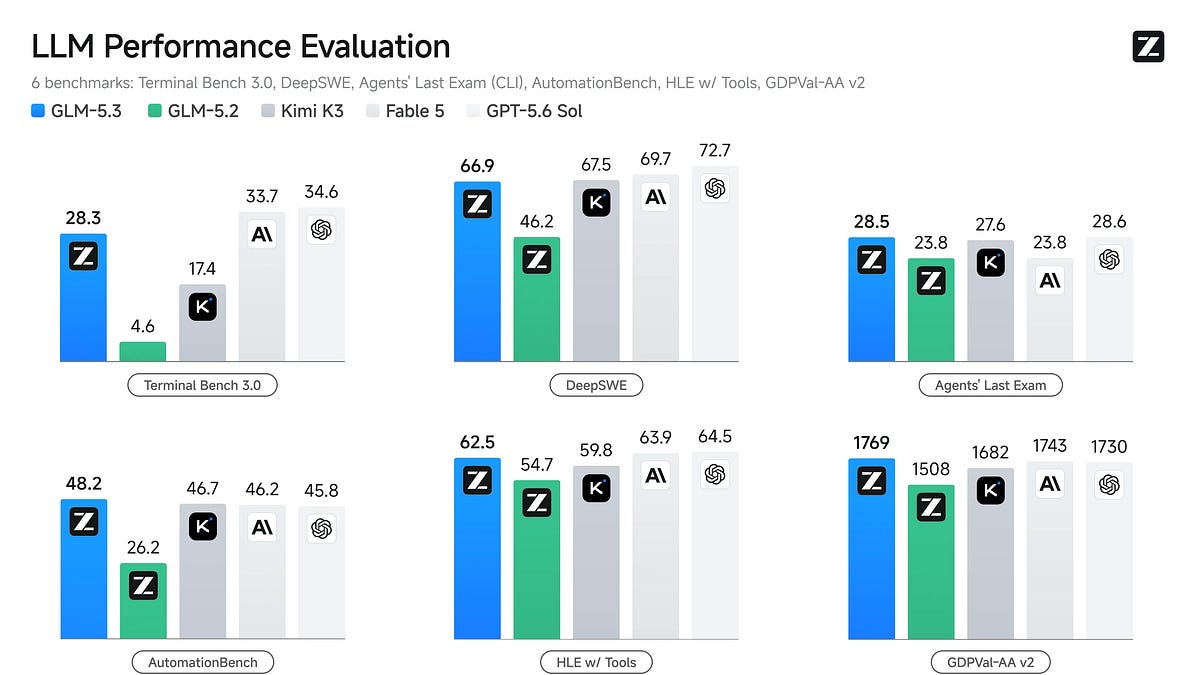
| GLM-5.3 | 45 | Thinking Machines Inkling | 26 |
| Kimi K3 | 44 | Inkling Small | 26 |
| GLM-5.3-Flash | 42 | Nvidia Nemotron 3 Ultra | 23 |
- The American models were released in June-July 2026.
- Chinese models such as GLM-5 and DeepSeek V4 Pro passed those American scores 2-6 months earlier.
- New entrants Arcee, Poolside and IBM are "not rapidly closing" the gap.
Hugging Face downloads
- China took the lead in July 2025, mainly through Qwen.
- China's lead is now about 1.6B downloads, with 3.2B total, twice America's total.
OpenRouter inference
- Open-model volume grew from about 1T tokens/week (September 2025) to about 80T tokens/week now.
- The Chinese share of that volume rose from about 70% to over 80%.
- The OpenCode coding agent shows about 95% or more of its inference on Chinese models.
arXiv mentions (scan of cs.AI, cs.CL, cs.CV, cs.LG and stat.ML)
- Papers mentioning any open model rose from 2% in January 2023 to 50% in September 2026.
- April-May 2023: about 2,600 of 12,000 papers mentioned a prominent open family. Llama was at about 5.5%, Chinese models at about 1%.
- Fall 2024: Llama about 23%, Qwen about 7.5%.
- Now: Qwen 30%, Llama 21%. Any Chinese model is mentioned in over 40% of papers, any US model in about 30%.
Named adopters of Chinese models
- Harvey and Cursor (models not specified on the page)
- DoorDash (Kimi), Airbnb (Qwen), Perplexity (DeepSeek)
- The author also reports US companies signing enterprise licensing agreements directly with Chinese labs.
Counter-signal for US models: US models that match Chinese models' capability for their size get adopted "at disproportionate rates." Examples given:
- gpt-oss is among the most adopted open-weight models ever.
- Gemma 4 matches the adoption of Qwen's popular small models.
- Nemotron gets modest adoption despite more capable models existing at its size.
Openness spectrum: Nemotron releases large parts of its training data under permissive licences but is not fully open-source. Olmo, Marin and Pythia are cited as the fully reproducible open-source models, all American.
The underlying data is in the Interconnects Dashboard and the ATOM Project trackers. The page links to them but does not reproduce them.
Limits
- Self-reported figures. These are the author's prepared remarks for a policy audience. The figures come from the author's own trackers and arXiv scan, and the scan method (keyword matching, how model families are defined) is not described.
- Inconsistent numbers on the page.
- Academic share is given as over 40% vs 30% in one place and 38% vs 28% "in recent months" in another.
- The page names both GLM-5.2 and GLM-5.3 as current leaders.
- Uncertain estimates. The 2-5 month, 6-9 month and 1-2 month distillation figures are the author's estimates with no stated method.
- Incomplete usage data. OpenRouter and OpenCode are proxies only. Together AI, Fireworks and private enterprise deployments do not publish per-model breakdowns. The author says there is little data on usage outside the US and China.
- Benchmark bias. The author concedes that Chinese labs' narrower task focus slightly inflates their public benchmark results.
- Safety and policy. Restricting Chinese weights would mainly hurt US businesses, according to the author. They cite Hugging Face using a Chinese open model to analyse a cyberattack after closed models refused the requests. No concrete policy mechanism is proposed.
Organisations named here
- Allen Institute for AI
- OpenAthena
- EleutherAI
- Meta
- Alibaba
- DeepSeek
- NVIDIA
- Z.ai
- Moonshot AI
- Thinking Machines
- Arcee AI
- Poolside
- IBM
- OpenAI
- Anthropic
- Hugging Face
- OpenRouter
- Together AI
- Fireworks AI
- Baseten
- Harvey
- Cursor
- DoorDash
- Airbnb
- Perplexity
- Interconnects
- Artificial Analysis
- Claude Code
- DeepSeek-R1
- OpenCode
- Qwen
Technologies named here
- Transformers
- GPT-4
- Claude Opus 4.5
- vLLM
- SGLang
- Llama
- Qwen
- OpenRouter
- Gemma
- OpenCode
- DeepSeek models
- Together AI
- Fireworks AI
- Olmo
- Baseten
- Marin
- Pythia
- Tinker
- Nemotron
- Claude Code
- GLM-5.2
- Cursor
- Kimi K3
- American Truly Open Models Project
- Interconnects Dashboard
- GLM-5.3
- GLM 5.3 Flash
- Inkling
- Inkling Small
- Nemotron 3 Ultra
- GLM-5
- DeepSeek V4 Pro
- gpt-oss
- Gemma 4
- DeepSeek R1
- Hugging Face
Techniques named here
- Distillation
- Know-your-customer tools
Related in ai-policy


 futureoflife.orgarticle
Future of Life Institute AI Safety Index — Summer 2026
 interconnects.aiarticle
Lessons from the hacks
 interconnects.aiarticle