 beaksec.github.iowriteup
Telegram Desktop vulnerability allowed any user's file to be stolen
Writeup of a two-bug chain in Telegram Desktop: the single-instance local-socket IPC does not escape the semicolon record separator, so a clicked tg:// link injects extra OPEN: commands, which reach the internal interpret: scheme (InterpretSendPath) that reads an arbitrary file and sends it to a chat with no authorization or confirmation. The author plants instruction files via auto-download in a group, then exfiltrates tdata/key_datas and session files (no local passcode means an empty-password KEK) to take over the account. Fixed in 7.2.9 by removing interpret: and escaping separators; the post lists mitigations such as a local passcode and restricting who can add you to groups.
What it is
A two-defect chain in Telegram Desktop that turns one clicked link into arbitrary file read and, from there, takeover of the victim's account. Fixed in 7.2.9. The fix shipped quietly: the changelog mentions only a rendering fix, the closing commit (db3405699f, 16 September 2026) is titled "Remove legacy interpret path helper", and no advisory was issued. Anyone tracking security advisories would not have seen it.
How it works
- Separator injection. A second Telegram process launched by a
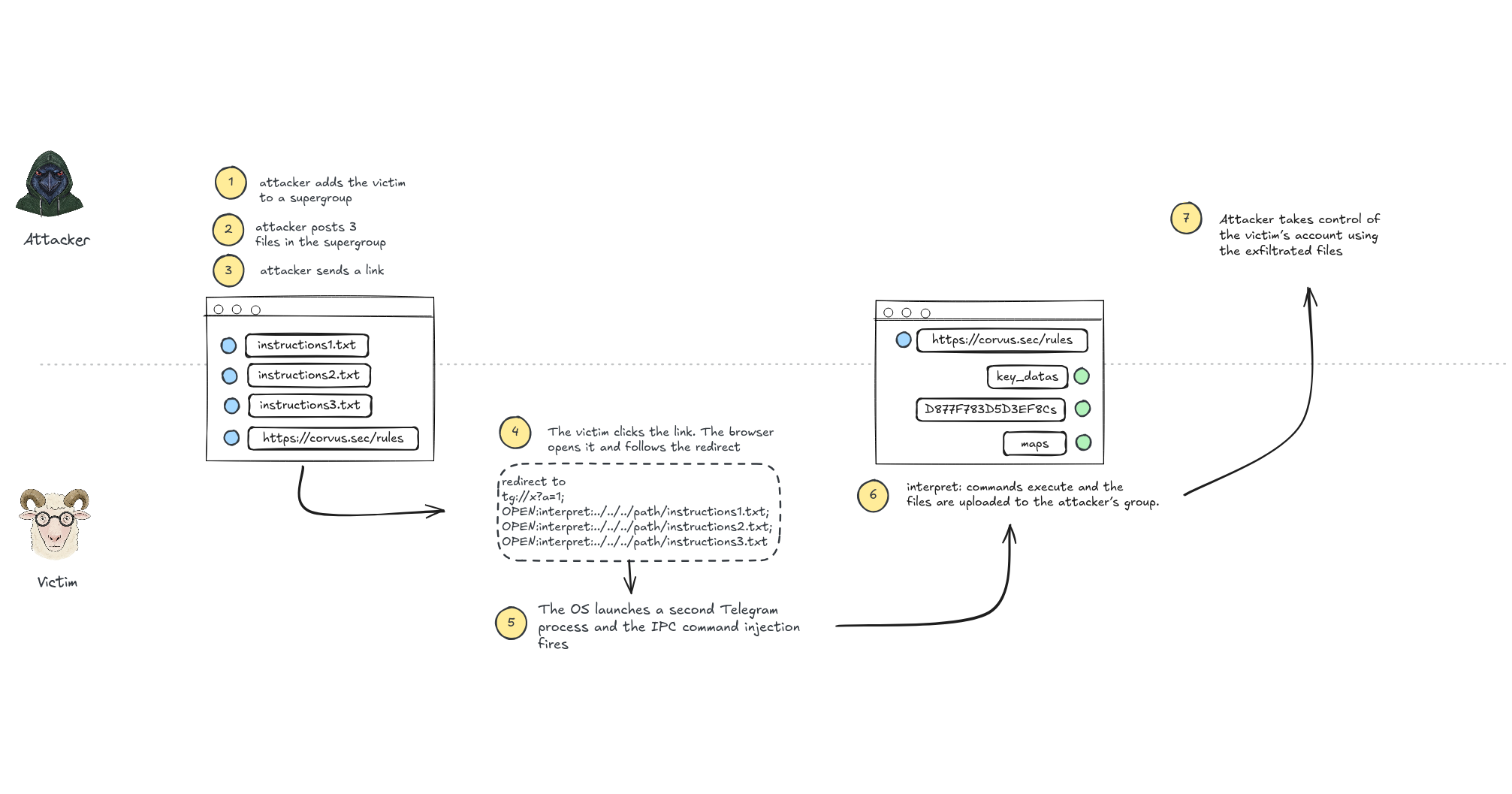
tg://link forwards the URL to the running instance over a local socket. Each record isKEYWORD:argument;, and the semicolon is never escaped. A semicolon inside the link therefore becomes extra records on the receiving side. Of the four record types,CMD:andCTRL:are harmless, butOPEN:accepts any URL with no scheme filter. - Missing authorization. Through
OPEN:the attacker reaches the internalinterpret:scheme (Support::InterpretSendPath). It was built for release scripts: it reads a file named in an instruction file and sends it to a channel or supergroup, with no confirmation and no check on who asked. The optionalfrom:account check is skipped if the line is omitted. - Planting instruction files. Default auto-download saves files up to 8 MiB received in groups to the Downloads folder under the sender's chosen filename. Relative paths resolve from Telegram's data folder, so the attacker can reach Downloads without knowing the Windows user name.
- Takeover. One file is sent per invocation, so the attacker posts three instruction files and stacks three
interpret:commands in one link. The targets aretdata/key_datas, the session file intdata/D877F783D5D3EF8C*(the folder name is the same on every install), and itsmapsindex. With no local passcode, the KEK is derived from an empty password and a salt stored in the clear inkey_datas, so the DEK and the session can be recovered. Dropping the three files into a freshtdataopens the account. - Delivery.
tg://links clicked inside Telegram are handled in-process and never reach the socket. The attacker therefore sends an https link that redirects to the craftedtg://link, and the system browser launches it.
flowchart TD
    A[Attacker adds victim to supergroup] --> B[Auto-download saves 3 instruction files]
    B --> C[Victim clicks https link]
    C --> D[Redirect to tg:// with semicolons]
    D --> E[Socket splits into 3 OPEN interpret: records]
    E --> F[Files sent to attacker's group]
    F --> G{Local passcode set?}
    G -- No --> H[Empty-password KEK: account taken over]
    G -- Yes --> I[Session files stolen but unusable]
Preconditions / Affected
- Telegram Desktop older than 7.2.9. The page does not state the earliest affected version.
- The victim can be added to a group without confirmation (the default privacy setting) and has auto-download on (the default).
- The victim clicks a link from outside Telegram. The browser may ask for confirmation before launching Telegram.
- Full account takeover additionally needs no local passcode, which is the default.
- The same primitive reads any file, such as SSH keys, browser password stores or cloud credentials.
What to do
- Upgrade to 7.2.9 or later. The page says this is the only thing that actually closes the problem.
- Turn on "ask where to save each file". This stops auto-download, so the instruction file never reaches disk. It is the most effective mitigation short of upgrading.
- Restrict who can add you to groups to contacts only. Stolen files can only go to a channel or supergroup, so this removes the attacker's delivery point.
- Set a local passcode and choose it like a real password. This does not stop the theft, but it makes the stolen session unusable.
Caveats
- Because the fix was unannounced, don't treat the absence of an advisory as a sign you are unaffected. Check the installed version.
- The fix also adds two hardening measures.
CMD:andCTRL:records are skipped when the same connection carries anOPEN:. Local file paths are dropped once a non-local URL has appeared on that connection. - Formats that Telegram saves to its internal cache (stickers, GIFs, voice messages) cannot be used to plant the file.
- A filename collision makes Telegram save the file as
instructions1 (2).txt, which changes the path. - The instruction file must be plain text with LF line endings and no byte-order mark.
Organisations named here
- db3405699f
- interpret:
- InterpretSendPath
- key_datas
- one-click account takeover
- tdata
Technologies named here
- Telegram
- Windows
Techniques named here
- Missing authorization in interpret
- Omitting the from
- Stacking several interpret
- Attacker adds victim to a supergroup
- Missing Authorization
Related in AppSec
 github.comadvisory
Flowise MCP Security Bypass Enables RCE

 huntress.comwriteup
Inside an Oracle Database SQL Injection Attack | Huntress
github.comrepoOASIS

 blog.trailofbits.comwriteup