 huntress.comwriteup
OpenClaw, Rogue Agents, and Application Hygiene
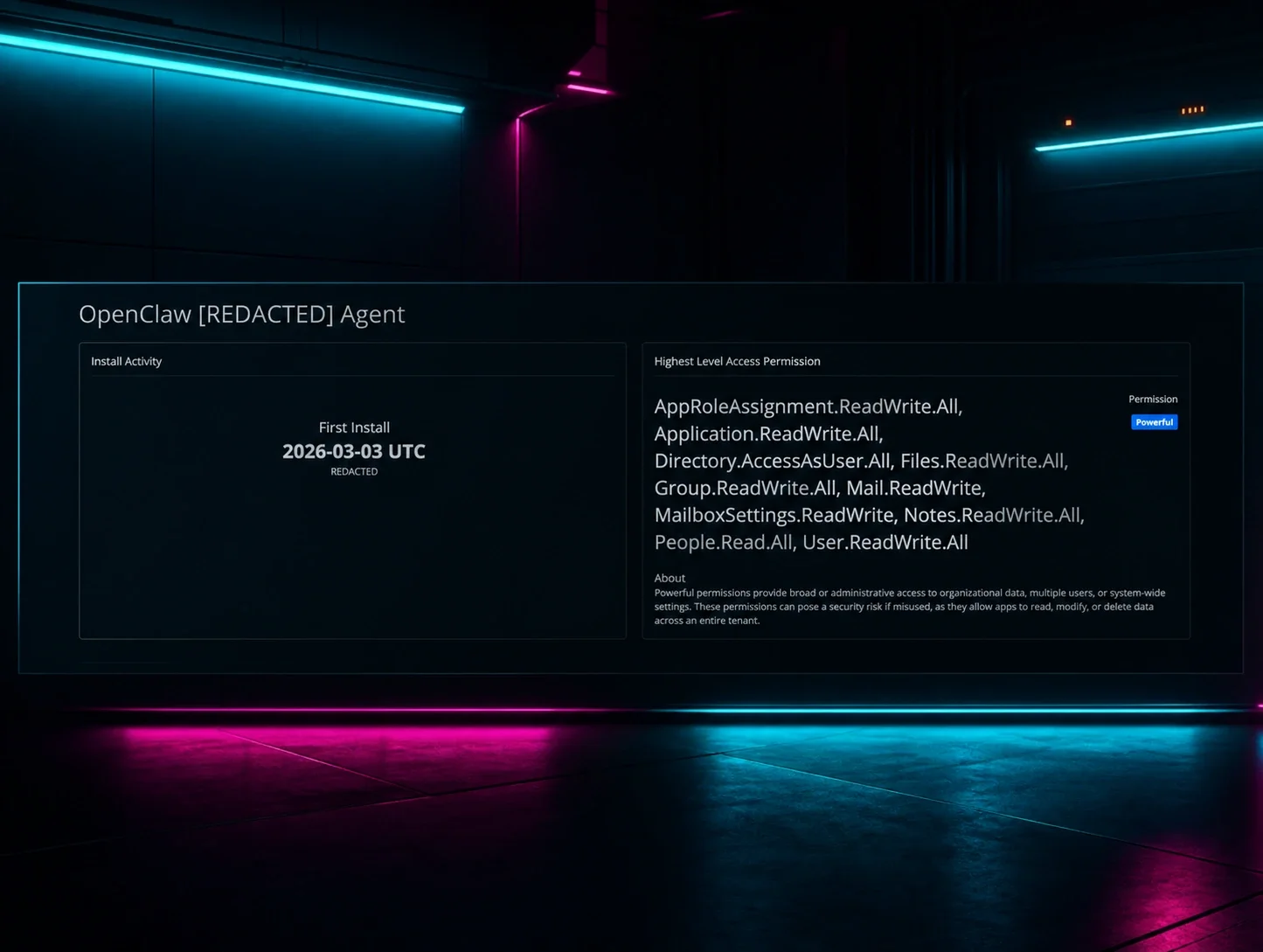
Huntress analyzes how the OpenClaw AI agent (and its earlier branding, Moltbot) manifests as a cloud service principal inside Microsoft 365/Entra ID tenants, often granted sweeping application permissions like Directory.ReadWrite.All, Application.ReadWrite.All, DelegatedPermissionGrant.ReadWrite.All, and Sites.FullControl.All. The post shows real customer-tenant findings of both user-installed and centrally-registered "too-powerful" OpenClaw instances, and walks through hunting them using Huntress Rogue Applications inventory and Managed SIEM ESQL queries against Entra audit logs to trace consent, permission changes, and downstream mailbox/SharePoint access.
What it is
Huntress analysis of how the OpenClaw AI agent (formerly Moltbot/ClawdBot) manifests as a service principal inside Microsoft Entra ID, and the specific Graph permissions that turn it into an identity attack surface. The framing is deliberately behavioral rather than code-level: treat OpenClaw as a semi-trusted service principal, regardless of the friendly label on it.
How it works
Two consent modes carry different risk. Application permissions grant tenant-wide access with no signed-in user ("read or modify every mailbox") and require admin consent. Delegated permissions are scoped to one user's rights — but by default users can grant these with no admin approval or visibility, which is the oversight gap.
Beyond the permissions in the summary, the page names two the summary omits:
- UserAuthMethod-Email.ReadWrite.All — modify user auth methods via email, a direct account-takeover path.
- DelegatedPermissionGrant.ReadWrite.All — grant OAuth permissions on others' behalf, enabling consent bypass.
Combined with AppRoleAssignment.ReadWrite.All, a compromised agent can escalate and self-grant privileges. Attackers inherit these by compromising the vendor, stealing app secrets, or tampering with backend infrastructure — bypassing endpoint-centric defenses entirely.
Preconditions / Affected
Entra ID tenants where OpenClaw/Moltbot has been installed — either self-service by an individual user (scoped, but severe if that user is IT/finance/exec) or registered centrally with sweeping directory/mail/SharePoint scope. User consent to applications must be enabled for the self-service path to exist.
What to do
The page states these concretely:
- Disable user consent to applications — named as "a key mitigation" that closes the delegated-permission oversight gap.
- Scan tenants for service principals named
OpenClaw,Moltbot, and similar variants — this is the detection method Huntress used to find dozens of apps. - Audit granted scopes, not just app presence — establish a durable process to review what assistants can do, how scope changes over time, and which approvals were granted. The page's core finding is the absence of this process, not any single permission.
flowchart TD
    A[OpenClaw install request] --> B{User consent enabled?}
    B -- yes --> C[User self-grants delegated perms\nno admin visibility]
    B -- no --> D[Blocked / requires admin]
    A --> E{Admin consent for\napp permissions?}
    E -- granted --> F[Tenant-wide service principal]
    C --> G[Persistent identity path]
    F --> G
    G --> H[Compromise agent/secrets\n= inherit privileges]
Caveats
Disabling user consent addresses only the delegated self-install path; centrally registered "too-powerful" apps with admin-consented application permissions are a separate governance problem the page flags but does not give a command for. The permission examples are observations across sampled customer tenants, not a fixed manifest — any given OpenClaw install may hold a different scope.
Technologies named here
- Huntress Rogue Applications
- Microsoft Entra ID
- Microsoft 365 mailbox/calendar
- Huntress Managed SIEM
- SharePoint
- Identity Threat Detection & Response
- OpenClaw
- Azure
- Microsoft 365
- OAuth
- Huntress
Techniques named here
- Application permissions abuse
- Delegated permissions consent bypass
- Consent/privilege escalation via OAuth permission grants
- Account takeover via authentication method modification
- Permission drift
- Hunting via ESQL queries in SIEM
Related in AI Security

 blog.talosintelligence.comtool
Introducing CAIRN: Frontier tracking for AI-integrated malware (Cisco Talos)
 github.comadvisory
Flowise MCP Security Bypass Enables RCE
github.comrepoYesWeHack Claude Kit

 jfrog.comarticle