 stepsecurity.iowriteup
400+ AUR Packages Hijacked: What the “Atomic Arch” Campaign Means for Supply-Chain Security
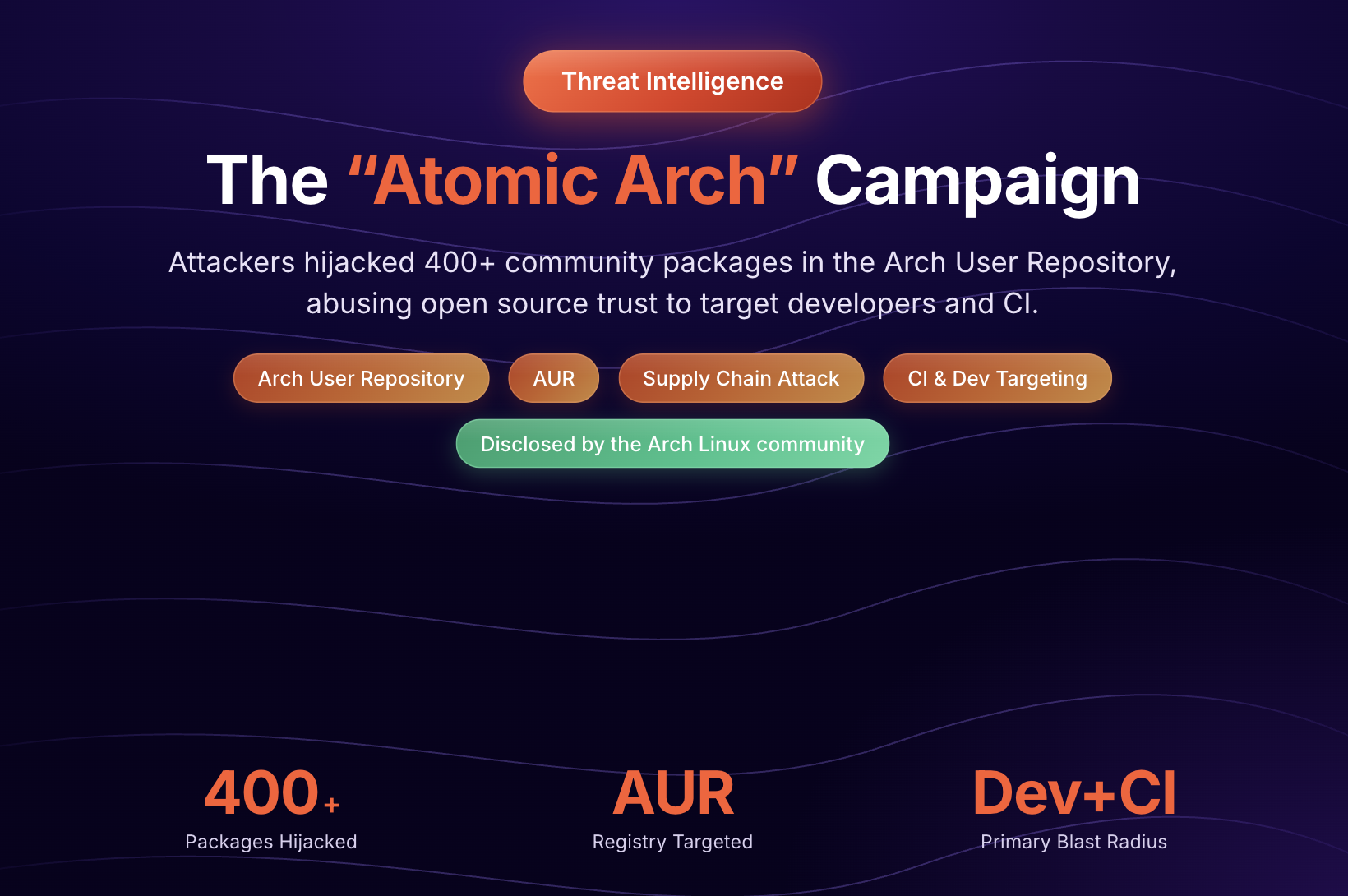
Attackers adopted 400+ orphaned AUR (Arch User Repository) packages and injected malicious build logic that pulled in a malicious npm dependency (masquerading as atomic-lockfile, also seen as js-digest), dubbed the "Atomic Arch" campaign by Sonatype researchers. The malicious npm package deploys a Rust-based credential stealer targeting browser cookies, SSH keys, GitHub/npm tokens, and cloud/Docker credentials, with optional eBPF-based rootkit persistence on rooted systems. The piece explains scope (Arch, EndeavourOS, Manjaro, WSL2-based Arch, self-hosted Arch CI runners) and draws parallels to similar ownership-hijacking risks in npm, PyPI, GitHub Actions, and Homebrew.
What it is
The "Atomic Arch" campaign (Sonatype's name), disclosed June 11, 2026 by researchers and the Arch Linux community. Attackers adopted 400+ orphaned AUR packages and modified their PKGBUILDs/install hooks to pull a malicious npm package posing as atomic-lockfile (variant js-digest), delivering a Rust credential stealer. The summary covers the payload and scope; below is what the page adds for someone deciding how to respond.
How it works
The abused mechanism is AUR's ownership transfer: an abandoned package can be adopted by anyone, inheriting its name, users, and accumulated reputation. The injected build logic runs npm install atomic-lockfile at install/update time — so the malicious dependency executes on the host during the ordinary build, not from an obviously suspicious package. The page frames this as "ownership hijacking beats typosquatting": no lookalike, the trusted name is taken over directly.
Preconditions / Affected
The vector is AUR-specific. It hits you only if an Arch or Arch-derived environment actually installs AUR packages:
- Arch, EndeavourOS, Manjaro (when AUR is used)
- Self-hosted CI runners/build agents on Arch that install AUR packages in bootstrap or job steps
- Windows developers running Arch under WSL2 and installing AUR inside it
Not affected by this vector: GitHub-hosted runners; self-hosted runners on RHEL/Rocky, Debian/Ubuntu, or Windows (unless they nest Arch); native macOS/Windows machines. The page notes the stolen assets — GitHub tokens, cloud keys, SSH keys — are the same ones that gate non-Arch production, so a single compromised Arch laptop is a pivot into everything else.
flowchart TD
    A[Orphaned AUR package] -->|attacker adopts| B[Malicious PKGBUILD]
    B -->|user installs/updates| C[npm install atomic-lockfile]
    C --> D[Rust credential stealer runs]
    D --> E{Running as root?}
    E -->|yes| F[eBPF persistence, hides processes/files]
    E -->|no| G[Exfiltrate tokens, keys, sessions]
    F --> G
    G -->|stolen GitHub/cloud creds| H[Pivot into non-Arch production]
What to do
The page's core response guidance: treat any compromised host as fully untrusted.
- Rebuild from clean media — do not clean in place.
- Rotate all exposed credentials (SSH keys, GitHub/npm/dev tokens, cloud access keys, Docker/Podman creds, browser/SSO/Slack/Discord/Teams sessions).
- A one-off malware scan is explicitly not sufficient, especially where eBPF persistence may hide activity from userspace tools.
(The post's "Immediate Response" section is truncated in the fetched text; the steps above are what it states before the cutoff.)
Caveats
Initial reports undercounted the scope; the 400+ figure came from follow-up community analysis, so the true count may still shift. The eBPF rootkit capability is conditional — it applies only where the malware gains root.
Technologies named here
- Harden-Runner
- Arch Linux
- Dev Machine Guard
- EndeavourOS
- Manjaro
- Self-hosted CI runners/build agents running Arch
- Windows under WSL2 running Arch
- GitHub-hosted runners
- Self-hosted runners on RHEL/Rocky, Debian/Ubuntu, or Windows
- macOS and Windows developer machines
- AUR
- npm
- WSL2
- eBPF
- Homebrew
- Sonatype
Techniques named here
- Ownership hijacking of orphaned/abandoned packages
- Malicious dependency injection into build scripts
- Silent execution at install/build time
- Credential and session theft
- eBPF-based persistence and rootkit behavior
Threat actors named here
- Atomic Arch
- atomic-lockfile
- js-digest
Also named here
- Arch User Repository
Related in Supply Chain







