 pjhillier.github.ioother
The Security-Engineering Convergence | Peter J. Hillier
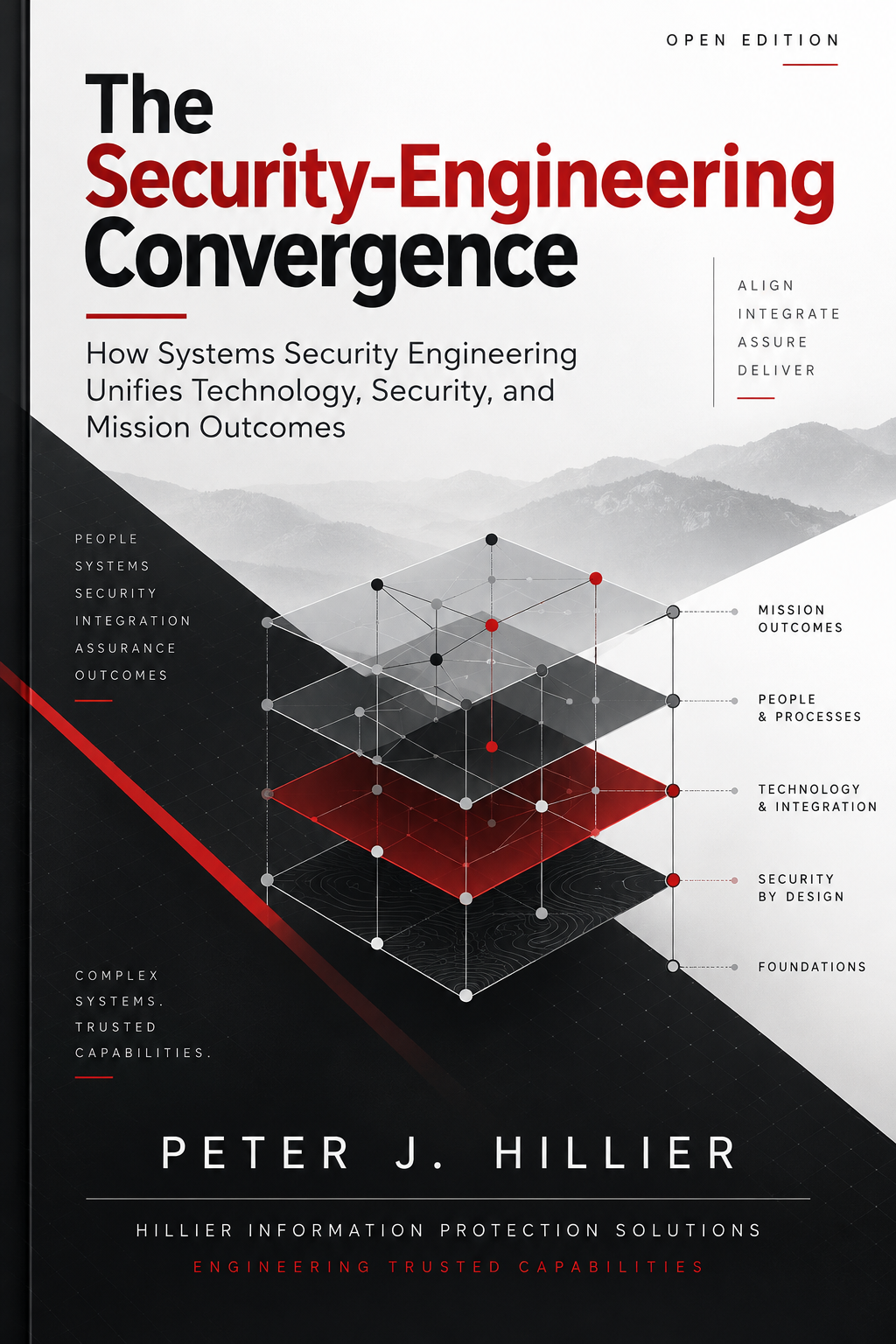
The Security-Engineering Convergence (Edition 1.1) by Peter J. Hillier is a free, CC BY 4.0 technical book on Systems Security Engineering (SSE) as the security specialty within systems engineering. It runs from mission needs and loss scenarios through requirements, secure architecture, cyber resilience, verification and validation, acquisition, assurance cases, operations and retirement. Later chapters cover supply-chain assurance, legacy and cloud-dependent systems, systems-of-systems, and AI and autonomy. It ships as PDF, EPUB and a companion ZIP of worksheets, worked cases and standards crosswalks. It argues that meeting compliance controls is not the same as engineering evidence for mission outcomes.
What it is
The Security-Engineering Convergence by Peter J. Hillier (CD, CISSP) is an open-access book on Systems Security Engineering (SSE). It is independently authored and is not an official defence, government or standards-body publication. Edition 1.1 is current, with 7 parts, 28 chapters and Appendices A–G.
What to do
- Pick the right file. The paginated PDF is the authoritative reference edition. The EPUB is reflowable, and the page warns that complex technical layouts may be more reliable in the PDF.
- Verify downloads. The page points to release notes and SHA-256 checksums for file integrity and edition changes.
- Cite the edition you used. Each edition has its own version-specific Zenodo DOI. Edition 1.0 stays available (GitHub v1.0.0 and Zenodo) for reproducibility, and earlier files are not silently replaced.
- Know what 1.1 adds over 1.0. It adds engineering-focused treatment of privacy and of adaptation under adverse conditions, clearer explanations around the technical figures, and standards-oriented crosswalks in the companion ZIP. Anyone who already used 1.0 should look at those parts first.
- Enter by role.
- Cybersecurity practitioners are pointed at connecting controls, threat analysis and assessments to requirements, architecture and verification.
- Acquisition and leadership readers are pointed at what to demand from suppliers and what evidence means. The matching chapters are 17–20 (Part V).
- Systems engineers are pointed at integrating protection needs and assurance into existing engineering artefacts.
- Use the worksheets. Appendix G and the companion ZIP cover protection needs, allocation, architectural trade-offs, evidence applicability and change impact.
Worked material
The worked cases cover administrative authority, cyber-physical motion (Appendix D, an inspection vehicle), information flow (Appendix E) and trusted-source compromise (Appendix F). Appendix C walks through completing a bounded engineering case. The book separates hypothetical case assumptions, analytical models, executed teaching-code tests, technical evidence and the decisions that evidence can or cannot support.
Caveats
- The page states that illustrative case material must not be mistaken for evidence that a real operational system has been tested, authorized or validated.
- It also states that no example constitutes verification of an actual deployed system.
- The page makes no claim of formal peer review or endorsement by any standards body. Treat the standards crosswalks as the author's own mapping.
Organisations named here
- Peter J. Hillier
Techniques named here
- Mission, stakeholder, asset and protection-needs analysis
- Adversity, threat and loss scenario analysis
- Requirements allocation and assurance planning
- Cyber resilience and controlled degradation
- Verification and validation
- Assurance cases and technical challenge of evidence
- Information-flow analysis
- Configuration, change and drift management
Related in GRC

 orca.securityarticle
Orca Security: NIST AI Risk Management Framework (AI RMF) Explained
 fossa.comarticle
FOSSA: CISA Releases the 2026 SBOM Minimum Elements

 huntress.comwriteup
Teach Yourself to Phish | Huntress