 socket.devwriteup
Socket: TrapDoor Crypto Stealer
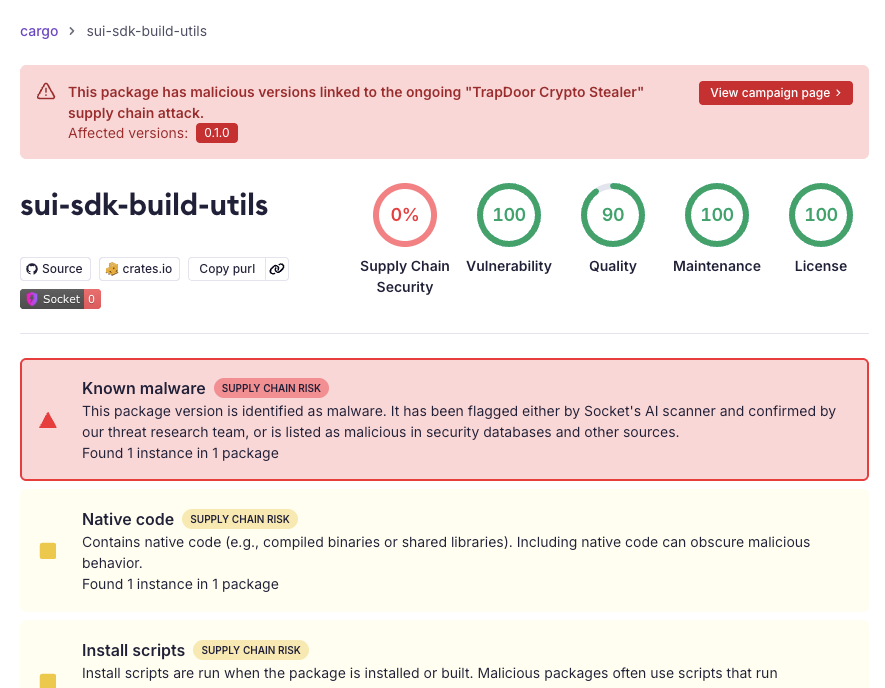
Socket researchers uncovered TrapDoor, a coordinated crypto-stealer campaign spanning 34+ malicious packages and 384+ versions across npm, PyPI, and Crates.io, targeting crypto, DeFi, Sui/Move, and AI developer communities. The npm packages use postinstall hooks to run a shared trap-core.js payload that harvests SSH keys, AWS/GitHub credentials, wallet data, and browser data, then persists via .cursorrules, CLAUDE.md, git/shell hooks, systemd, cron, and SSH lateral movement; PyPI packages fetch and run remote JS on import, and Crates.io packages use malicious build.rs to XOR-encrypt and exfiltrate Sui/Move keystores to GitHub Gists. The attacker (GitHub account ddjidd564) also opened PRs against major AI/dev tooling repos (browser-use, LangChain, Langflow, llama_index, MetaGPT, OpenHands) attempting to plant hidden .cursorrules/CLAUDE.md instructions designed to trick AI coding assistants into running exfiltration under the guise of a 'security scan'.
What it is
TrapDoor is an active crypto-stealer supply-chain campaign tracked by Socket, spanning 34+ packages and 384+ versions across npm, PyPI, and Crates.io. The summary covers the mechanism; the value here is the concrete indicators — the package names, publisher accounts, and infrastructure you can check against right now. The earliest observed artifact was the PyPI package eth-security-auditor@0.1.0, uploaded May 22, 2026, 20:20 UTC.
Preconditions / Affected
You're exposed if a developer installed any of these packages. Named indicators:
- npm (publisher
asdxzxc):async-pipeline-builder,build-scripts-utils,chain-key-validator,crypto-credential-scanner,defi-env-auditor,defi-threat-scanner,deployment-key-auditor,dev-env-bootstrapper,eth-wallet-sentinel,llm-context-compressor,mnemonic-safety-check,model-switch-router,node-setup-helpers,project-init-tools,prompt-engineering-toolkit,solidity-deploy-guard,token-usage-tracker,wallet-backup-verifier,wallet-security-checker,web3-secrets-detector,workspace-config-loader - PyPI:
cryptowallet-safety,data-pipeline-check,defi-risk-scanner,env-loader-cli,eth-security-auditor,git-config-sync,solidity-build-guard - Crates.io (Sui/Move targets):
move-analyzer-build,move-compiler-tools,move-project-builder,sui-framework-helpers,sui-move-build-helper,sui-sdk-build-utils
What to do
- Grep installed dependencies against the lists above; some remained live at time of writing.
- Hunt these infrastructure indicators: GitHub account
ddjidd564, payload hostddjidd564[.]github[.]io/defi-security-best-practices/, and the campaign marker stringP-2024-001(appears across components). - Check persistence artifacts the npm payload plants:
.cursorrules,CLAUDE.md, Git hooks, shell hooks, systemd services, cron jobs, and unexpectedauthorized_keys/SSH entries. - Treat any exposed SSH keys, AWS credentials, and GitHub tokens as compromised and rotate — the payload validates them via live AWS/GitHub API calls and reuses SSH keys for lateral movement. Assume connected infrastructure (repos, CI/CD, deployment envs) is in scope.
- Flag
dev-env-bootstrapperspecifically: it both steals credentials and acts as a delivery vector, spreading malicious config into dev environments.
Caveats
The trap-core.js payload (1,149 lines) is the npm execution path only. PyPI packages instead fetch remote JavaScript on import, and Crates.io packages exfiltrate wallet keystores via build.rs — so scanning for trap-core.js alone will miss two of three ecosystems. Package counts ("34+", "36" in one subhead) are approximate and the set was being actively updated over the reporting window, so absence from these lists is not a clean bill of health.
Organisations named here
- AUDIT-MATRIX.md
- eth-security-auditor
- P-2024-001
Technologies named here
- Socket
- npm packages
- trap-core.js
- PyPI packages
- build.rs
- Crates.io packages
- browser-use/browser-use
- langchain-ai/langchain
- langflow-ai/langflow
- run-llama/llama_index
- FoundationAgents/MetaGPT
- OpenHands/OpenHands
- npm
- PyPI
- crates.io
- Rust
- Cursor
- Claude Code
Techniques named here
- Malicious postinstall hooks
- Malicious build.rs execution
- Import-time remote code execution
- Credential harvesting and validation
- SSH-based lateral movement
- AI assistant prompt injection
- Wallet keystore encryption and exfiltration
- Advanced encryption of stolen data
- Disguise as benign developer/security tooling
- Supply chain injection via GitHub pull requests
- Community seeding via issues/discussions
- Remote configuration via external hosting
Threat actors named here
- TrapDoor
- ddjidd564
- asdxzxc
- asdmini67
- dae5411
Related in Supply Chain