 github.comrepo
Betterleaks — secrets scanner from the Gitleaks creator
Betterleaks is a configurable, fast secrets scanner maintained by the original Gitleaks author and team, capable of scanning git history, local filesystems, stdin, GitHub/GitLab orgs and specific PRs/MRs, Hugging Face models/datasets, and public S3/R2 buckets. Detection rules use regex plus an Expr (with legacy CEL compatibility) based prefilter/filter/validate pipeline, allowing entropy checks, keyword gating, and live API validation of found credentials (e.g. checking a GitHub PAT against api.github.com). It's used in production by projects like Aikido Security and shipped inside MegaLinter.
What it is
Betterleaks is the CLI secrets scanner from the Gitleaks team. The summary covers its scan targets and detection model; what it can't carry is the concrete invocation surface, the prefilter-vs-filter distinction that governs performance, the validate subcommand, and the explicit production-config guidance.
Install and invoke
brew install betterleaks/tap/betterleaks
sudo dnf install betterleaks        # Fedora
docker pull ghcr.io/betterleaks/betterleaks:latest
go install github.com/betterleaks/betterleaks@latest
Scan scope is controlled per-target with --include, e.g. github <user> --include issues,prs,actions,releases,gists or gitlab <project> --include issues,mrs,releases,ci-jobs. Git scans parallelize with --source-workers=16. A specific PR/MR is scannable by URL (.../pull/113, .../-/merge_requests/42).
Revalidate a credential you already hold, skipping detection entirely:
printf '%s\n' "$GITHUB_TOKEN" | betterleaks validate --rule-id github-pat --simpleThis prints only the status (e.g. VALID) — useful for triage or monitoring a known token, not just for scanning.
Prefilter vs filter — the mechanism that matters
Two evaluation stages, and the difference is a performance boundary, not a naming one:
- prefilter runs before any regex and sees only
attributes(path,git.author_name, etc.). Use it to bail out early — skipnode_modules, binary extensions,renovate[bot]commits — before expensive scanning. - filter runs after a regex match and additionally sees
finding["secret"]/finding["match"], so it can applyfilter.entropy(...), keyword suppression, or path/author gating on the candidate.
Filters exist globally and per-rule. validate blocks run last and do live checks (an http.get against api.github.com/user, returning valid/invalid/validate.unknown). Logic is Expr; legacy CEL configs still parse but new configs should be Expr. Multipart rules read sibling rules via components["rule-id"]?.secret.
What to do
If you deploy this in CI, follow the page's own recommendation: maintain your own config rather than extending the upstream default directly. This keeps your ruleset stable across upgrades and lets you review new upstream rules before adopting them — an upstream rule change otherwise lands silently in your pipeline. Test rules against the Betterleaks Playground before shipping.
Technologies named here
Techniques named here
- Regex-based secret pattern matching
- Prefiltering
- Post-match filtering
- Credential validation
- Multipart/component rule matching
- Repository and platform enumeration scanning
Related in DevSecOps

 jfrog.comarticle
JFrog: The Governance Gap Between Your Policy and Your Pipeline
 stepsecurity.ioarticle
Dev Machine Guard Now Supports Windows - StepSecurity
 socket.devwriteup
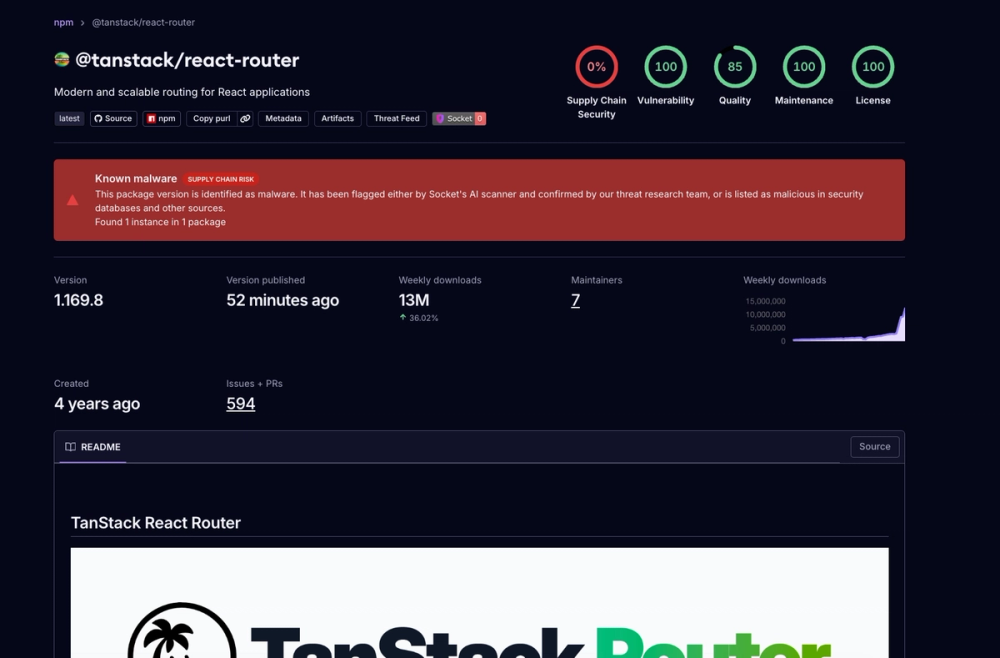
Socket: TanStack npm Packages Compromised
 securitylab.github.comadvisory