 opensourcemalware.comarticle
Why Conventional Reputation Feeds Miss Software Supply Chain Attacks
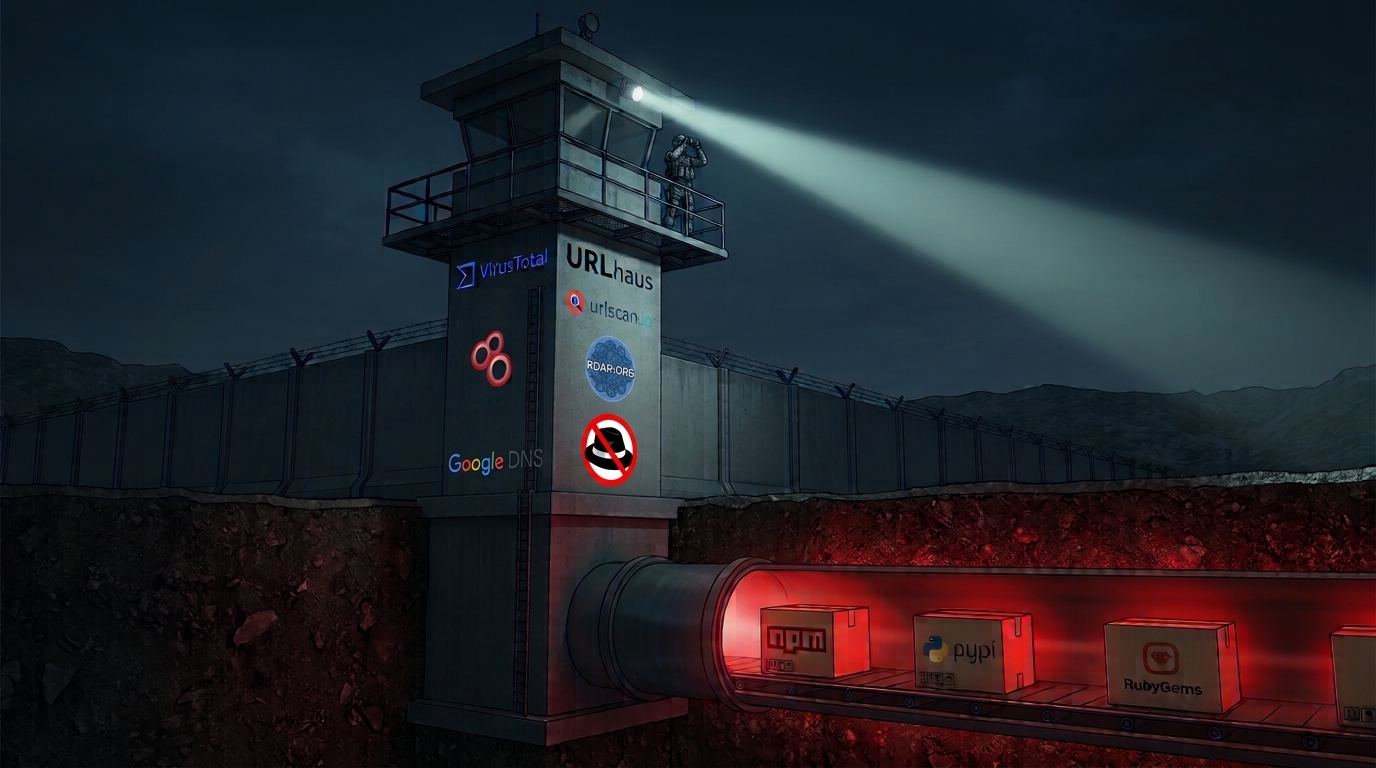
Study by OpenSourceMalware of 624 supply chain attack indicators checked against VirusTotal, URLhaus, AbuseIPDB, urlscan.io, Shodan and RDAP. At ingestion in October 2026, 70.7% of 450 network indicators fell at or below 2 VirusTotal detections. Months later, 71.3% of 174 indicators from ten 2026 campaigns were still blind spots, and no other feed caught anything VirusTotal missed. It ends with triage steps for install hooks and public IOCs per campaign.
What it is
OpenSourceMalware's measurement of how poorly reputation feeds cover supply chain attack infrastructure. It uses two cohorts: 450 network indicators (229 domains, 166 URLs, 55 IPs) checked at ingestion between 2 October and 2 November 2026, and 174 verified indicators from ten campaigns (March to October 2026) queried in a November 2026 snapshot.
What the numbers add
- Day zero by type: the share at or below 2 VirusTotal detections was 77.1% for payload URLs, 66.8% for C2/staging domains and 67.3% for IPs. The page notes that many SOAR and SIEM rules ignore anything under 3 detections.
- Payload files are worst: of 107 malicious scripts in the retrospective set, 49 were never uploaded to VirusTotal (404) and 45 were scanned clean. Together that is the 87.9% figure. The page's example is a Keyv credential-harvesting payload (SHA256
ad111858f73ef39e955ea4a6cdc83d92b53d5ca0248a94095ff0448c7b147e29) with 0 of 63 detections, while the headline droppersetup.mjsreached 24. - Campaign spread is wide: blind-spot rates were AntV 100%, PyPI stealer clusters 94.7%, TrapDoor 84.2%, Contagious Interview 76.9%, PolinRider 73.7%, Keyv/Cacheable 66.7%, Trivy/TeamPCP 58.3%, Axios 57.1%, IDE extensions 52.9% and Mini Shai-Hulud 46.7%. Excluding 13 abused shared services (webhook.site, rentry.co, GitHub release links), the overall rate is 71.4% (115 of 161).
- Other feeds on the 54 attacker-controlled network indicators: VirusTotal flagged 18 (66.7% blind). urlscan.io had a blind rate of 87.0% and scanned 12 of 54. AbuseIPDB flagged 6 (88.9% blind). URLhaus flagged 1 (98.1% blind). Every hit from these three was already in VirusTotal's detected set. RDAP marked 11 of 38 domains (28.9%) as newly registered, but that is a heuristic, not a verdict.
- Day-zero infrastructure traits: over 60% of staging domains were under 14 days old or on Vercel, Render or Netlify preview subdomains. Over 90% had no AbuseIPDB reports. Only about 15% had ever been scanned by urlscan.io.
Why it happens
Attacks run outbound from developer machines and CI runners, so perimeter-fed engines never see them. Attacker infrastructure is quiet and short-lived, so volume-based feeds never build a reputation. Payloads are short interpreted scripts whose malice depends on running inside an install hook. Of the 67 network indicators in the retrospective set, 13 (19.4%) were legitimate developer services such as Telegram bot APIs, GitHub raw content and webhook listeners.
What to do
The page's triage steps, in order:
- Inspect lifecycle hooks (
preinstall,postinstall,binding.gyp,tasks.json,setup.py) for child processes, base64 evaluation or network calls. Network activity in a hook is almost always anomalous. - Check publisher provenance: an unvetted maintainer, a version with no matching commit or tag upstream, or a surprise patch on a dormant project. Package age is not a safe signal.
- Trace where any outbound request went. Treat raw IPs, ephemeral serverless subdomains, webhook listeners and non-registry endpoints as indicators.
- If code ran, assume exfiltration and rotate CI environment variables, cloud IAM tokens, registry publishing keys,
.envfiles, AI service logins and SSH/GPG keys.
For spot-checking, the page lists one public IOC per campaign, including sfrclak.com (Axios), verify.build-standards.org (TrapDoor), x.oast.fun (AntV), git-tanstack.com (Mini Shai-Hulud), stanionstudios.com (Contagious Interview), 166.88.134.62 (PolinRider), status.oastify.com (PyPI stealers), holiday-themes.dev (IDE extensions) and csec-supply-chain-attack-1tcq.onrender.com (Trivy/TeamPCP).
Caveats
- The indicators come from the vendor's own analysis engine, so the sample is not independent.
- The vendor's own numbers differ in places: the URLhaus miss rate is 96.3% in one passage and 98.1% in the table, and VirusTotal engine counts are given as up to 75 and up to 92.
- The page offers no detection rule or tooling to replace the feeds beyond the manual triage list.
Organisations named here
- abuse.ch
- AbuseIPDB
- OpenSourceMalware
- URLhaus
- urlscan.io
Technologies named here
- VirusTotal
- npm
- URLhaus
- PyPI
- crates.io
- URLScan.io
- VS Code Marketplace
- AbuseIPDB
- Open VSX
- Shodan
- axios
- keyv
- Google DNS
- cacheable
- WHOIS
- flat-cache
- cache-manager
- AntV
- LiteLLM
- Checkmarx
- telnyx
- GitHub
- Vercel
- Render
- Netlify
- SIEM
- Aqua Security Trivy
- RDAP
Techniques named here
- Typosquatting
- Dependency confusion
- Maintainer account takeover
- Install lifecycle script abuse
- Blockchain-hosted command and control
- Exfiltration over legitimate web services
- Newly registered domain heuristic
- Out-of-band interaction endpoints
- Python AST parsing for secret extraction
- Self-propagating worm
- Software supply chain attack via malicious packages
Concepts named here
- Context-dependent malice in interpreted scripts
- Day-zero detection gap
- Feeds as degraded subset
- Headline bias
- Low-noise ephemeral infrastructure
- newly registered domains
- Outbound attacks from trusted developer environments
- Publisher provenance
- Reputation feed blind spot rate
- SOC alerting threshold
- Upstream versus perimeter threat intelligence
Threat actors named here
- Contagious Interview
- PolinRider
- Trivy compromise
- Mini Shai-Hulud worm
- Mini Shai-Hulud
- TeamPCP
- TrapDoor
- AntV
- AntV maintainer takeover (npm maintainer accounts atool and prop hijacked, 324 packages republished with malicious versions)
- Axios
- Axios account takeover (compromised npm maintainer credentials, backdoored axios releases)
- cacheable
- keyv
- Keyv / Cacheable compromise (worm derived from Mini Shai-Hulud, over 1,300 package versions affected)
- Malicious IDE extensions (VS Code Marketplace and Open VSX)
- PyPI stealer clusters (typosquatting and dependency confusion, exfiltration via Discord and Telegram bot webhooks)
- TrapDoor campaign (npm, PyPI and Crates.io typosquats; command domain verify.build-standards.org embedded in 37 backdoored packages)
Related in Supply Chain