 huntress.comwriteup
How Threat Actors Abuse Remote Management Tools | Huntress
Huntress details how low-skill threat actors daisy-chain legitimate RMM tools (ScreenConnect, Action1, HeartbeatRM, AnyDesk, Atera, etc.) via invitation and Social Security themed lures, LLM-generated infostealer scripts, and multi-fallback browser download tricks hosted on GitHub repos (VH851, Drasticc) to gain and disguise persistent access. It also documents firsthand observation of an actor who signed up to Huntress itself, revealing their toolchain (DeepSeek, Email Extractor, Proxy SwitchyOmega, 9Proxy, CertifyTheWeb, Sordum Hide from Uninstall List, and a fake Windows Security PIN harvesting binary pin.exe) and victim data such as W-9 forms and SSNs collected via Telegram based exfiltration.
What it is
Huntress research on RMM abuse cases from December 2025–January 2026, expanding on the daisy-chaining pattern with specific tools, metrics, and indicators. RMM abuse was Huntress's most-observed threat last year at 24% of all incidents, and surged 277% year-over-year. The reported actors are mostly low-skill operators chasing initial access, not sophisticated groups.
How it works
Several distinct chains observed:
- Action1 → ScreenConnect: threat actors abuse Action1 (legitimate, signed vulnerability-management/deployment tooling) to push ScreenConnect clients via MSI packages for persistent access.
- wscript → ScreenConnect: the same daisy-chain reused with
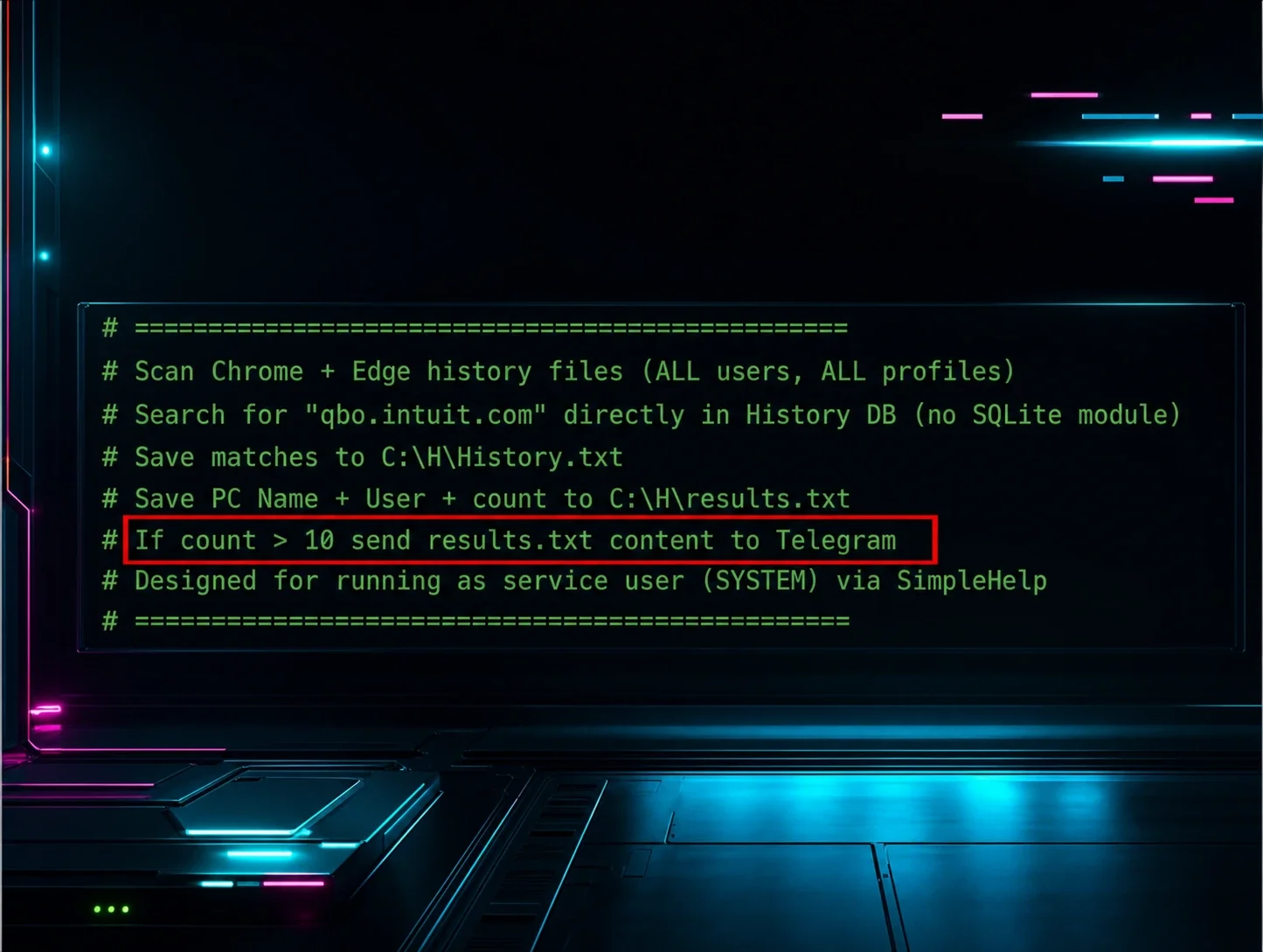
wscriptinstalling additional payloads. Tooling branded "InjectProx-hiro Remote Support" deploys a ScreenConnect client and fires a Telegram bot notification containing the victim's computer name. - Rogue RMM MSI → LLM-generated infostealer: MSI installers spawn infostealer scripts (assembled by LLMs, per coding style/comments) that parse browser history for financial/crypto references — QuickBooks, Coinbase — to identify monetizable access.
- HeartbeatRM: a lesser-known RMM delivered via invitation-themed lures.
Delivery is via broad phishing email and search-engine poisoning / watering-hole sites, funneling to invitation- or document-themed downloads. Lures impersonate the Social Security Administration and spike around US tax season.
Preconditions / Affected
Any environment where deployment/management software can run unmonitored. Huntress notes that any RMM or deployment tool offering trial or "free" deployment allowances is being abused or likely will be — the abused binaries are legitimately signed, so signature-based trust is the weak point.
What to do
The page names concrete indicators to hunt and report:
- Detections: alert on unexpected RMM installs, especially one RMM (or Action1/
wscript) deploying a second RMM like ScreenConnect via MSI. Watch for browser-history parsing and Telegram API callbacks post-install. - IOCs: GitHub accounts VH851 and Drasticc hosting phishing infrastructure (activity dating to Nov–Dec 2025); MSI lure
invitatapartyTo.msi; a reportyusing a custom domain via GitHub CNAME to control phishing-site presentation. - Huntress proactively reported the GitHub accounts.
Caveats
- The blog gives no full IOC list or hashes in the fetched text — only the named accounts/files above.
- Attacker maturity is low: one observed LLM-generated infostealer collected data locally but never implemented the Telegram exfiltration its own comments described, so exfil failed. Treat these operators as opportunistic and buggy, not precise.
Organisations named here
- A Series of Unfortunate RMM Events
Technologies named here
- Huntress
- ScreenConnect
- Action1
- HeartbeatRM
- Windows
- CertifyTheWeb
- AnyDesk
- DeepSeek
- Email Extractor
- Atera
- CentraStage
- Proxy SwitchyOmega 3
- Chrome Remote Desktop
- 9Proxy
- Lite 1.7 Email Extractor
- FleetDeck
- GoTo Resolve
- Sordum "Hide from Uninstall List"
- GoToTerm
- pin.exe
- Gorelo RMM
- Telegram
- lolrmm.io
- ImmyBot
- Itarian RMM
- Crowncloud
- LiteManager
- Cloudflare
- MeshAgent
- WScript
- Miradore
- NetSupport
- PDQ Connect
- PDQ Deploy
- Quick Assist
- RustDesk
- SimpleHelp
- Splashtop
- Synchro
- Tactical RMM
- UltraVNC
- WinVNC
- HideUL.exe
Techniques named here
- Daisy-chaining RMM tools
- Rogue RMM MSI installers for initial access
- LLM-generated infostealer scripts
- Multi-vector forced download on phishing page
- GitHub abused for phishing infrastructure with custom domain
- User-agent/OS fingerprinting to gate malicious content
- Mobile-only targeting
- Credential harvesting via fake email sign-in
- Abuse of Cloudflare to shield malicious infrastructure
- Hiding RMM installations from Add/Remove Programs
- Fake Windows Security PIN-harvesting prompt
- Search-engine poisoning and broad phishing email campaigns
Threat actors named here
- VH851
- Drasticc
- InjectProx-hiro Remote Support
Related in Threat Intel
 huntress.comwriteup
Reverse Engineering the Six Stages of MacSync Stealer and RAT
 huntress.comwriteup
AI-Coded Malware | Analyzing Vibe-Coded AD Enumeration | Huntress

 blog.talosintelligence.comtool
Introducing CAIRN: Frontier tracking for AI-integrated malware (Cisco Talos)
 huntress.comwriteup