 huntress.comwriteup
Threat Actor Defense Evasion: How Attackers Disable AV & EDR
Huntress SOC breaks down how attackers disable AV/EDR: blocking agent communications via malicious/hidden Windows Firewall rules (WFP), abusing Add/Remove or CLI to uninstall EDR agents, abusing Defender AV exclusions, and Bring Your Own Vulnerable Driver (BYOVD) attacks to gain kernel access and kill protected security processes. Includes real intrusion examples — a February 2026 SonicWall VPN-credential intrusion using a revoked-but-still-trusted 2006 EnCase forensic driver (exploiting a legacy Windows Driver Signature Enforcement exception) to kill 59 named security processes every second, and a March 2026 malvertising campaign (Google Ads for W-2/W-9 forms) that dropped a rogue ScreenConnect instance and used a vulnerable signed Huawei audio driver to terminate EDR/AV processes.
What it is
A Huntress SOC blog cataloguing four ways attackers move past AV/EDR from evasion into active "impair/disable" — mapped to MITRE ATT&CK Defense Evasion, technique Impair Defenses (the page writes it "T.1652"). The goal it names is a "dark zone": telemetry silenced so the attacker can move laterally, exfiltrate, and deploy ransomware with no visibility.
How it works
The four techniques, at the detail the page gives:
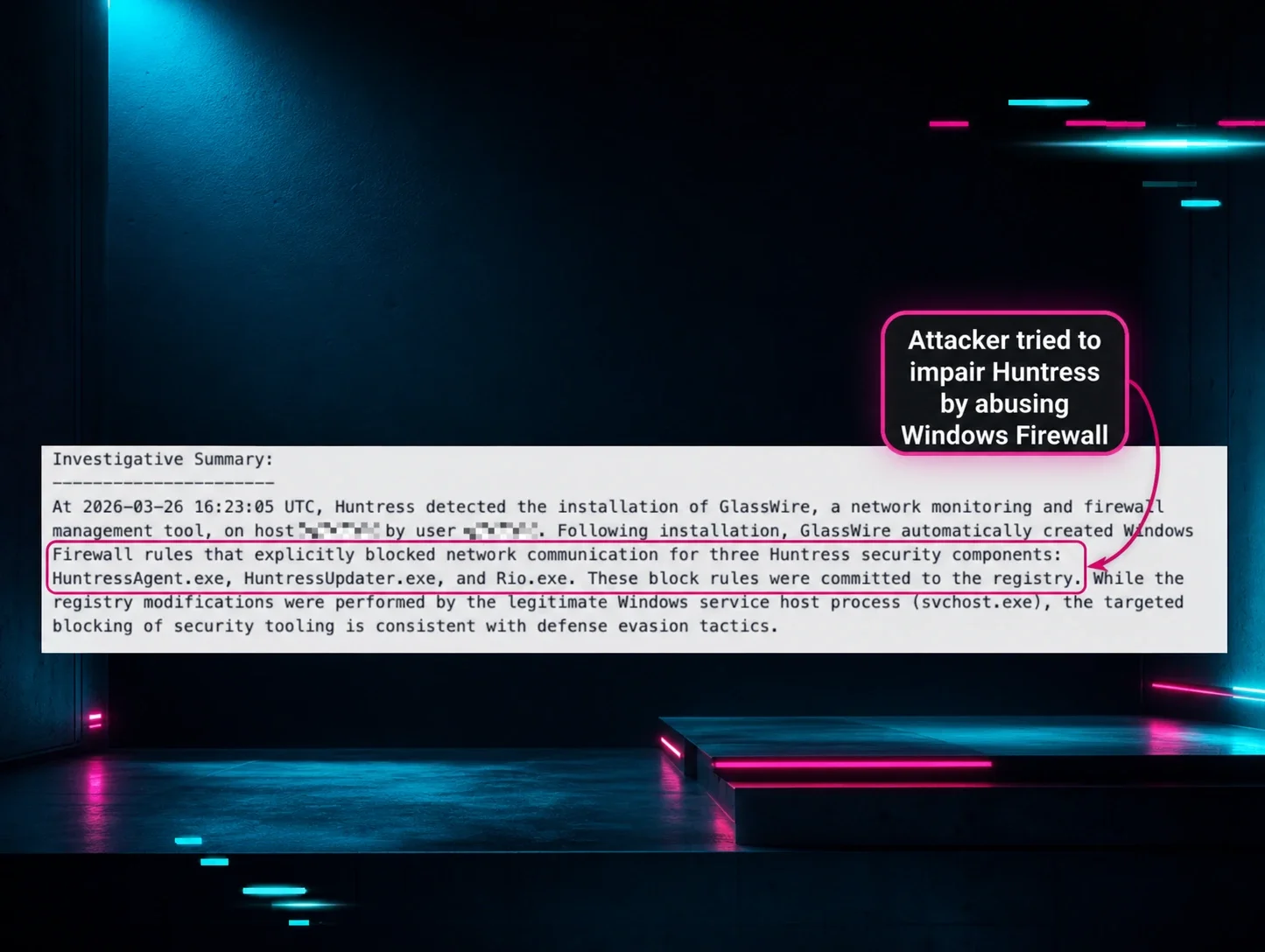
- Silencing agent comms — two variants. Directly creating Windows Firewall rules (effective but noisy) vs. using the Windows Filtering Platform (WFP) to create hidden firewall rules. Either blocks the agent from reaching its platform; the agent keeps running locally, so it looks healthy while sending no telemetry. Named tools that abuse this: EDRSandblast and EDRSilencer.
- Uninstalling the agent — after (or without needing) privilege escalation, via Add/Remove Programs over RDP/screenshare, or from the command line. Noisy, but works when there's no real-time detection.
- Defender-specific abuse — adding Defender AV exclusions (the page shows excluding
C:andC:\Windows) and firewall-rule abuse. - BYOVD — the page calls this the "new gold standard." A legitimately signed but vulnerable driver is loaded into the kernel, then exploited to gain kernel-mode access and terminate protected processes an admin couldn't kill.
The two 2026 intrusion examples (EnCase 2006 driver, 59-process hit list, per-second kill loop; and the Huawei-audio-driver ScreenConnect malvertising campaign) are already in the summary.
What to do
The page offers no patches or commands. Its one concrete engineering takeaway is a detection philosophy: Huntress says its Managed EDR now detects BYOVD by watching for real-time abuse of a vulnerable driver while the adversary is hands-on-keyboard — not the after-effect (AV stopped, agent killed). The implication for defenders building detections: alerting on the impact is too late in a per-second kill loop; catch the driver load/abuse itself.
Also treat a healthy-but-silent agent as suspicious — WFP-hidden firewall rules produce exactly that state.
Caveats
This is a vendor post; the "what Huntress does" section is a product pitch and the fetched text cuts off mid-sentence there. No CVEs, driver versions, or IOCs are given for either real-world case — the summary's dates and process count are the extent of the specifics. The T.1652 identifier as written does not match the standard Impair Defenses ID format; verify against MITRE before citing.
Organisations named here
- EnCase
- Huawei
- MITRE ATT&CK T1562
- SonicWall
- Windows Filtering Platform
Technologies named here
- Huntress Managed EDR
- Microsoft Defender Antivirus
- Windows Firewall
- EDRSandblast
- EDRSilencer
- Windows Driver Signature Enforcement
- Tamper Protection
- EnCase forensic driver
- Huawei audio driver
- TrueSight device driver
- SonicWall VPN
- ScreenConnect
- Windows Defender
- EDR
Techniques named here
- Impair Defenses
- Privilege escalation and EDR agent uninstallation
- Bring Your Own Vulnerable Driver
- Abusing Defender AV exclusions
- Kernel-mode process termination via vulnerable driver
Threat actors named here
- Unnamed threat actors
- Malvertising campaign targeting US taxpayers
Related in Blue Team & Detection
 huntress.comwriteup
AI-Coded Malware | Analyzing Vibe-Coded AD Enumeration | Huntress

 blog.talosintelligence.comtool
Introducing CAIRN: Frontier tracking for AI-integrated malware (Cisco Talos)
 huntress.comwriteup
Inside an Oracle Database SQL Injection Attack | Huntress
 huntress.comwriteup