 embracethered.comwriteup
Visual Studio Copilot and SSMS Remote Code Execution (CVE-2026-103572)
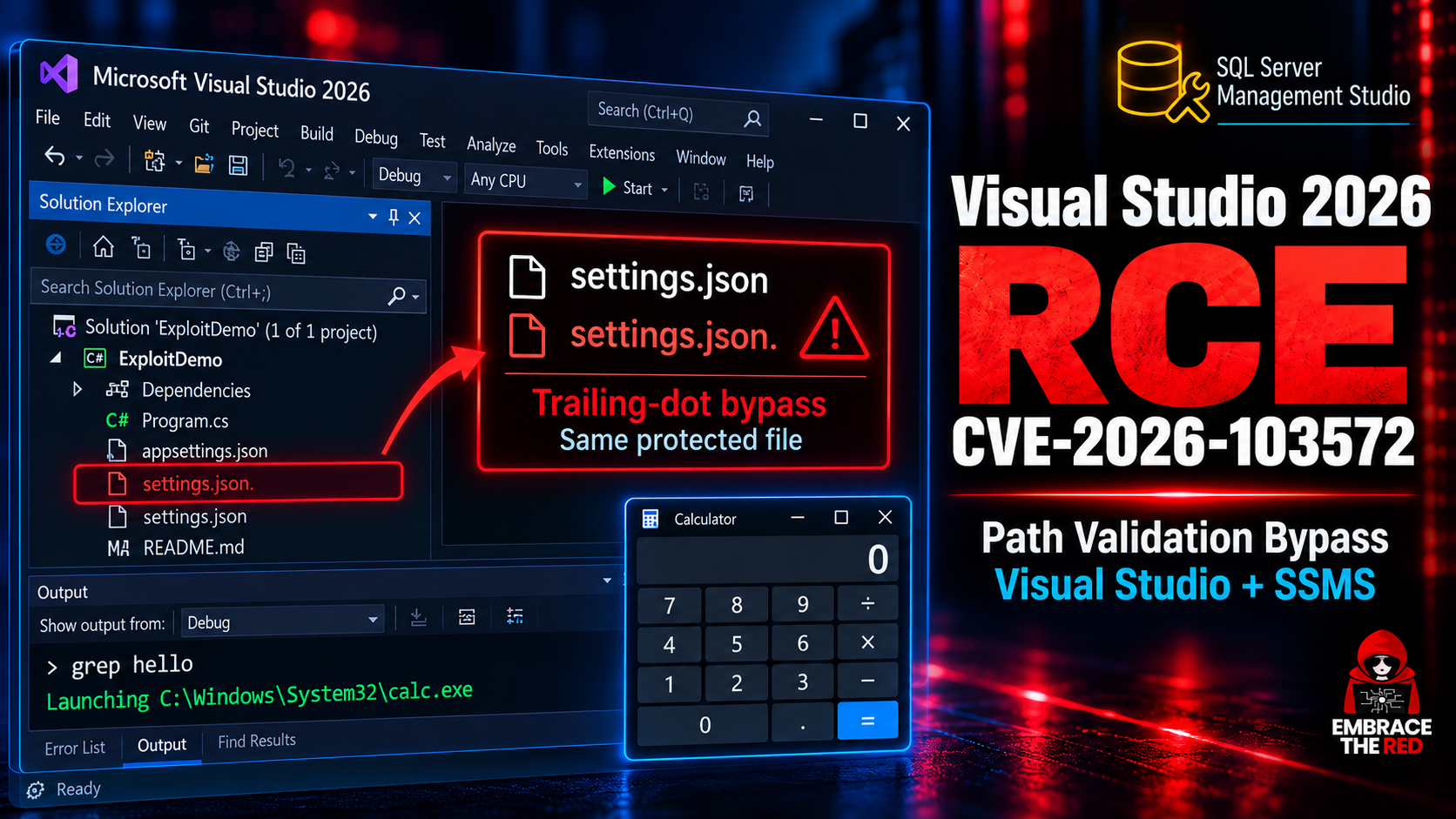
CVE-2026-103572 is a remote code execution bug in Microsoft.VisualStudio.Copilot.Core.dll, shared by Visual Studio and SQL Server Management Studio. A trailing dot (for example `.mcp.json.`) bypasses the protected-filename check in EditsFunctionHandler.GetEditConfirmationTypeAsync, so a hijacked Copilot can rewrite its own MCP and settings files and run commands. The post covers path traversal and InstallationID leaks, indirect prompt injection demos, the October 2026 patch (GetFullPath), and a $0 bounty.
What it is
CVE-2026-103572 is a file path validation bypass in Microsoft.VisualStudio.Copilot.Core.dll, the Copilot library shared by Visual Studio and SQL Server Management Studio (SSMS). Microsoft rated it Important, Remote Code Execution, CVSS 8.8. Visual Studio 2026 and older versions, including Visual Studio 2022, are affected. Johann Rehberger of Embrace The Red reported it on 4 August 2026, and the fix shipped on Patch Tuesday, 13 October 2026.
How it works
EditsFunctionHandler.GetEditConfirmationTypeAsync is meant to stop Copilot from writing to MCP and settings files. It compares the requested filename to a protected name. Windows ignores a trailing dot in a filename at the Win32 layer, so .mcp.json. differs from .mcp.json in the check but writes to .mcp.json.
The post lists these additional flaws:
~/.mcp.json.andsettings.VisualStudio.json.both bypass the check. The second also fails when Solutions are used.- Paths that start inside the trusted Extensions directory can contain
..\and resolve outside it. That lets Copilot readSSMS.isolation.iniand the user settings file without confirmation. SSMS.isolation.inidiscloses theInstallationID. That ID completes the pathC:\Users\<user>\AppData\Local\Microsoft\SSMS\22.0_<InstallationID>\settings.json, which makes the exploit work across installations.
Two attack chains follow from this. In both VS and SSMS, a hijacked agent adds a malicious MCP server to .mcp.json, adds its name to enabledMcpServers, removes it from disabledMcpServers, and the IDE launches the command. In VS only, the agent overwrites copilot.general.tools.ripgrepPath in settings.VisualStudio.json. with an arbitrary binary, which runs on the next Copilot search. The proof of concept pointed it at calc.exe.
flowchart LR
    A[Prompt injection] --> B[Hijacked Copilot]
    B --> C{Write target}
    C -->|.mcp.json.| D[Malicious MCP server]
    C -->|settings.VisualStudio.json.| E[ripgrepPath override, VS only]
    D --> F[IDE launches command]
    E --> F
Preconditions / Affected
- Visual Studio 2026, older Visual Studio including 2022, and SSMS (the demos used SSMS 22.0 paths).
- The agent must be hijacked or misaligned. The author demonstrated this through indirect prompt injection against the MAI-Code-1-Flash model, which he says resists injection poorly. He notes the payload could also arrive through data returned by an MCP server.
- The user must interact with the poisoned content.
What to do
Install the 13 October 2026 Patch Tuesday update for Visual Studio and SSMS. The author reports the fix adds a GetFullPath call, which strips trailing dots and resolves .. components before the check.
Caveats
- The author inspected the fix only briefly. He says it addresses the trailing-dot bypass and "should also" prevent some path traversal variants, so full coverage is unconfirmed.
- Microsoft paid a $0 bounty, calling the issue out of scope. This is the author's third unrewarded patched report in two months.
- The post does not say whether the traversal and
InstallationIDleaks received separate CVEs.
Organisations named here
- EditsFunctionHandler.GetEditConfirmationTypeAsync
- MAI-Code-1-Flash
- Microsoft.VisualStudio.Copilot.Core.dll
- MSRC
- NTFS trailing dot canonicalization
CVEs named here
- CVE-2026-103572
Technologies named here
- GitHub Copilot
- ripgrep
- Model Context Protocol
- Windows
- CVSS
- GetFullPath
- MAI-Code-1-Flash model (poor indirect prompt injection resilience, used in the demo)
- Microsoft.VisualStudio.Copilot.Core.dll
- MSRC
- SQL Server Management Studio
- Visual Studio
- Visual Studio 2022 and older versions (Copilot)
- Visual Studio 2026 (Copilot)
Techniques named here
- Path traversal
- Indirect prompt injection
- Installation-ID discovery
- Malicious MCP server configuration
- Overwriting the ripgrepPath setting
- Trailing-dot filename bypass
Related in AI Security

 blog.talosintelligence.comtool
Introducing CAIRN: Frontier tracking for AI-integrated malware (Cisco Talos)
 github.comadvisory
Flowise MCP Security Bypass Enables RCE
github.comrepoYesWeHack Claude Kit

 jfrog.comarticle