 newsletter.semianalysis.comarticle
Anthropic Subscriptions Offer 5x+ More Value Than OpenAI
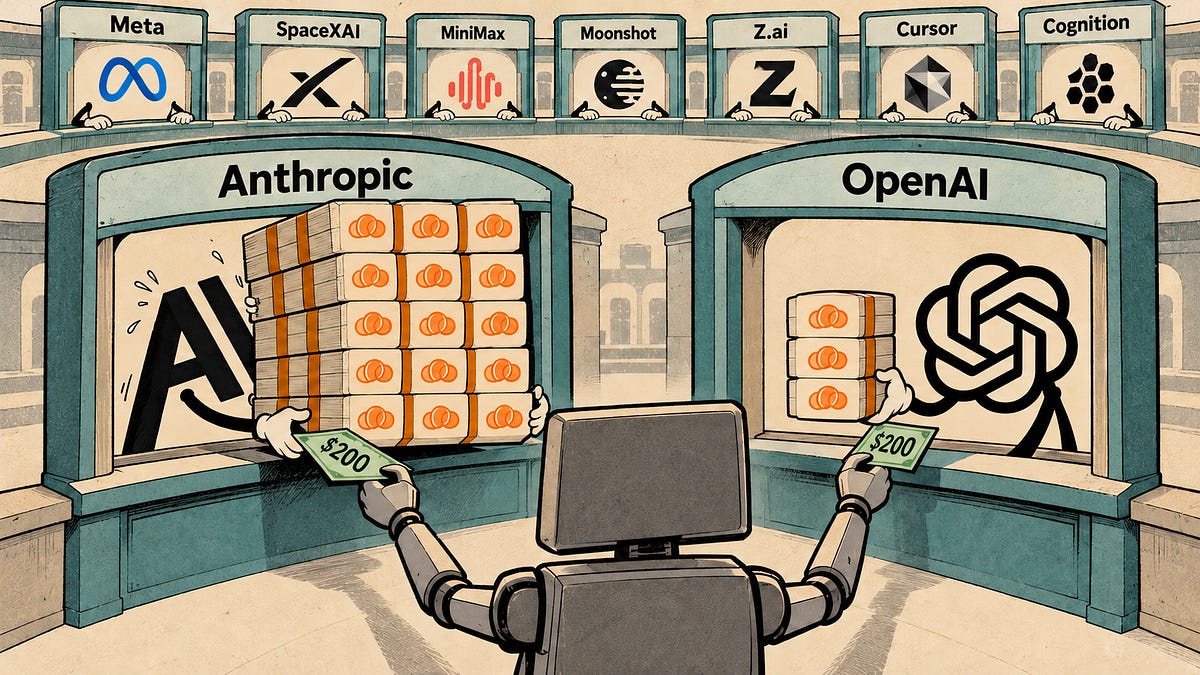
SemiAnalysis measures the real API-equivalent value of AI subscription plans by experimentally reverse-engineering how usage meters consume credits across input/output/cache token types for Anthropic, OpenAI, Meta, xAI, Cursor, Cognition, Z.ai, MiniMax, and Moonshot. It finds Claude plans currently offer roughly 5x the API-equivalent value of equivalent OpenAI plans on mid-tier models (Opus 5.5 vs GPT-6.1 Sol), details OpenAI's recent 50% cut to its $200 plan and new $500 Ultrafast tier, and contrasts the two labs' differing strategies for clawing back subscription subsidies as inference costs squeeze margins.
What it claims
Subscription "value" only makes sense for a specific (plan, model, workload) combination. Each plan grants hidden credits, and each model and token type consumes them at ratios that can differ sharply from API price ratios. Under SemiAnalysis's agentic workload mix:
- Frontier tier. Fable 5.1 and GPT-6 Astra are roughly at parity. A $200 Claude plan still has 50% of its limit left after $2,485 of Fable 5.1, because Fable is capped at half the limit. The equivalent OpenAI plan is exhausted after $2,897 of Astra.
- Mid tier. Opus 5.5 on Claude gives about 5x the API-equivalent value of GPT-6.1 Sol. The gap stays large when measured in raw tokens rather than dollars.
- Why labs care. For Anthropic, subscriptions are about 10% of revenue but over 40% of inference compute, and they lower blended revenue per MW by about $36M.
How it works
The method treats the provider's usage meter as a black box and probes one token type at a time:
- Input. War and Peace excerpts with a random tag on every call, so nothing gets cached. Gibberish was avoided because some models refuse it.
- Cache write. The same prompt marked for caching, with a new tag each call.
- Cache read. A fixed tag, so the first call writes the cache and every repeat reads it.
- Output. A technical-essay prompt. Mechanical repeat prompts get refused.
The meter moves in discrete units, so tokens are accumulated between meter ticks:
- Partial steps are dropped. The partial step before the first tick and the one after the last tick are discarded.
- Rate. The rate is meter movement divided by tokens across the complete steps.
- Stopping rule. Each step can be off by up to one request, and those errors don't compound. Steps are therefore added until the range is within ±5%.
- Overhead. Fixed per-request instructions are subtracted using the rates measured for the other token types.
- Free cache reads. If 500M cache-read tokens don't move the meter, cache reads are treated as free.
- Monthly cap. Rates are computed against every meter: the 5-hour window, weekly, and Fable's separate weekly meter. The weekly limits bind the monthly total.
- Dollar conversion. API-equivalent value = the share of the monthly limit used × plan price, applied to a blended per-MTok API price. The workload shape is SemiAnalysis's own September agentic usage ratios.
- Context ceiling. Measurements stay below long-context price tiers.
The method is sensitive enough to have caught one of three identical accounts with about 20% lower limits. The provider confirmed this was an "extremely tiny" A/B test, not a wholesale cut.
Evidence
OpenAI's $200 plan:
- Tokens per model tier were halved.
- Sol-class value fell by more than 50%, because 6.1 Sol also cut cached-input pricing.
- Plans bought before the cut keep the old limits until October 29. New purchases get the lower limits immediately.
OpenAI's $500 plan:
- Only 21% more Astra than the old $200 plan.
- Lower Sol-class value than the old $200 plan.
Per-dollar value across tiers:
- Before the cut, Pro 100 gave about 2x Plus on Astra, and Pro 200 gave another ~2x on top of that.
- Now Pro 100, 200 and 500 give identical tokens per dollar. Plus is comparable on Sol and worse on Astra.
- Anthropic's tiers were already flat per dollar.
Price cuts versus limits:
- OpenAI left Sol limits unchanged at the 6.1 release, so value dropped about 30%.
- Anthropic left Fable limits unchanged at 5.1 (which cut cache reads 75%).
- Anthropic raised Opus 5.5 limits by about 20% on Max and about 50% on Pro. That did not fully offset the API cut (20% on input/output, 60% on cache reads).
Margins (assuming 92% API gross margin):
| Utilisation | Opus 5.5 subscription margin | Fable 5.1 subscription margin |
|---|---|---|
| 100% (maxed out) | −369% | 1% |
| 20% | 6% | 80% |
The authors read this as Anthropic shrinking value on premium tiers, while OpenAI cut to Fable-level limits across the board.
Chinese labs: value per dollar rises with tier, averaging a little under OpenAI's ~12x.
Limits
- Workload dependence. All dollar figures assume SemiAnalysis's own agentic token mix. Your mix changes the answer.
- API-equivalent value can mislead. It is distorted when a model is unusually cheap or expensive at API prices.
- Token efficiency is not measured. The authors say reliable data on it doesn't exist.
- OpenAI Pro has no 5-hour limit. This makes it easier to consume a high share of the monthly limit. The authors judge it doesn't offset a ~4x gap.
- Incomplete coverage. Ultrafast (300 TPS) limits and third-party use of ChatGPT subscriptions (e.g. Devin) are still being tested. The third-party comparison with Cursor and Cognition is cut off in the fetched text.
- Charts and the live dashboard are not included. Most per-plan figures sit in charts absent from the text. The daily-tracking dashboard is paywalled for Tokenomics Model subscribers.
- Snapshot only. Limits change silently, so these numbers describe one point in time.
Organisations named here
Technologies named here
Techniques named here
- Cache write
- Cache read
- Step-based meter rate measurement
Related in ai-policy



 futureoflife.orgarticle
Future of Life Institute AI Safety Index — Summer 2026

 interconnects.aiarticle
Lessons from the hacks
 interconnects.aiarticle