 blog.talosintelligence.comwriteup
The Closed Quorum: Inside the First Reported Autonomous AI C2 Implant
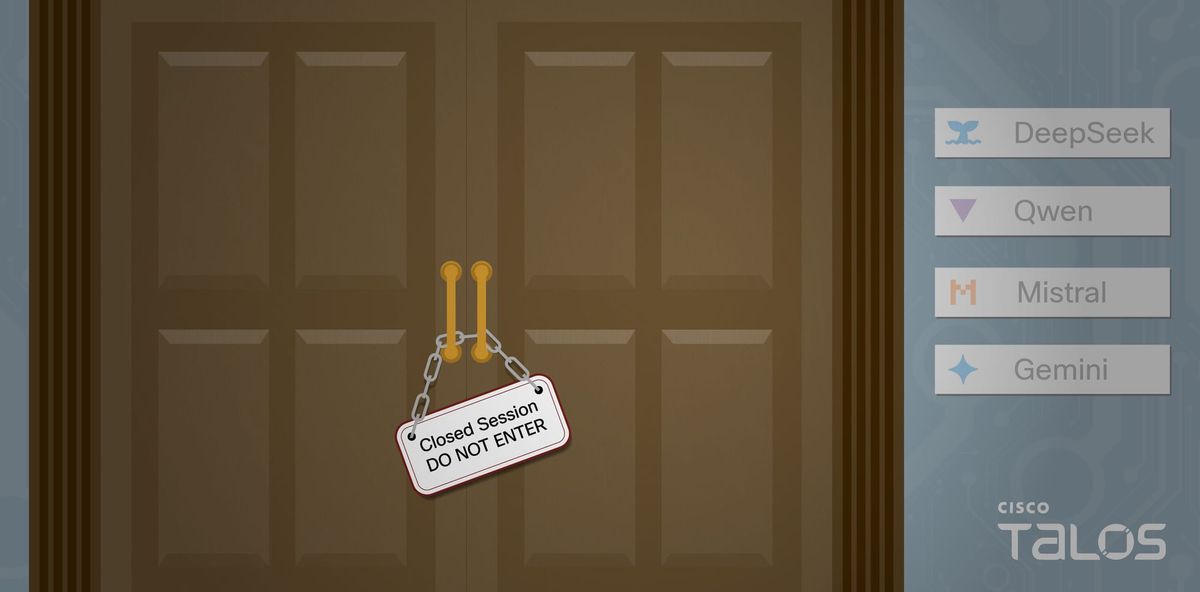
Cisco Talos' CAIRN project documents CLOSEDQUORUM, a 64-bit Go Windows implant that replaces traditional C2 infrastructure with a panel of up to four commercial LLM providers (DeepSeek, Qwen, Mistral, Gemini) that vote on the implant's next action via plurality voting, with each model queried against a structured JSON decision schema constrained to inject/persist/steal/move actions. Once deployed it autonomously dumps LSASS credentials, steals browser passwords and crypto wallets (MetaMask, Exodus, Ethereum), and exfiltrates AES-256-GCM-encrypted data to an operator's Discord webhook, all without further human tasking. The post details the developer's apparent credentials-as-a-service distribution model, deterministic tie-breaking favoring DeepSeek, and provides SHA256 hashes plus a YARA detection rule for the family (formerly tracked as BALZAK).
What it is
CLOSEDQUORUM is a 16.4MB, 64-bit Go Windows implant documented by Cisco Talos' CAIRN project (formerly tracked as BALZAK). The summary already covers its architecture, capabilities, and CaaS distribution model. What it does not carry is the detection guidance and the operational tells — the reason an engineer would act on this — plus several mechanism details that shape those detections.
Detection signals the summary omits
Talos states no single indicator identifies the architecture; the combination is what's distinct. Focus on behavior, not domain blocking — legitimate apps contact DeepSeek/OpenRouter/Mistral/Gemini/Discord independently. Hunt for a single Windows process that exhibits several of:
- AI-provider API traffic from an unexpected executable
- Similar requests to several model providers within a short interval
- Structured prompts carrying host context or offensive language (only visible via TLS inspection or provider-side telemetry)
- Process injection, LSASS access, or persistence creation (e.g., WMI)
- Discord webhook comms from the same process/host
- Repeated execution at randomized 5–15 minute intervals
The pivot: far fewer legitimate processes contact multiple model providers while also dumping LSASS or injecting into suspended processes.
Mechanism details that matter for hunting
- Failure fallback: if all models fail, the fallback decision is the literal string
consensus, which has no capability handler — the loop sleeps and retries rather than acting. Silence is a failure mode, not safety. - Encryption is obfuscation, not key separation: exfil is AES-256-GCM with a symmetric key derived from the current date (daily-rotating, derivable from the message timestamp). The developer can decrypt any operator's exfil; this is not true confidentiality separation.
- Distribution build is inert: public sample has
dummy_api_keyanddummy_webhook_url;movehas no handler in that build. Talos did not observe end-to-end execution. Development builds show build-time credential injection via-ldflags.
YARA rule notes
The published rule (author CAIRN, date = "2026-06-17", renamed from BALZAK 2026-07-03) mixes two detection layers with an explicit caveat: VT-metadata anchors (sandbox Lsass Dumper verdict, provider DNS, overlay tag) match on scan text, while binary-level strings — the system prompt "You are an advanced malware strategist. Provide ONLY executable decisions.", the decision schema, and DWARF function names (main.ModelOrchestrator, main.lsassDump, main.extractCryptoWallets, main.sendToDiscord, main.earlyBirdInject) — require a direct file scan. Any single condition branch (e.g., $prompt alone, or $schema and $orchestrator) fires.
Caveats
Talos has no confirmation of in-the-wild deployment; the developer was linked to carding-forum postings dating to 2025. Talos frames this as an early, limited demonstration of "effort displacement" rather than sophisticated malware — the precedent (encoding tactical attack logic as model-readable context) is the point, not the current binary's polish.
Organisations named here
- BALZAK
Technologies named here
- CAIRN
- Windows
- Google Chrome
- DeepSeek
- Qwen
- Microsoft Edge
- Mistral
- Mozilla Firefox
- Google Gemini
- MetaMask
- Discord webhook
- Exodus Wallet
- GoReSym
- Ethereum wallets
- YARA
- LSASS
- Go
- Gemini
Techniques named here
- LLM-as-C2 / autonomous decision orchestration
- LSASS credential dumping
- Browser credential theft
- Crypto wallet extraction
- Process hollowing
- Early bird APC injection
- Persistence establishment
- Encrypted exfiltration
- Deterministic tie-breaking in voting
- Randomized execution interval
Threat actors named here
- CLOSEDQUORUM
Related in AI Security
 blog.talosintelligence.comtool
Introducing CAIRN: Frontier tracking for AI-integrated malware (Cisco Talos)
 github.comadvisory
Flowise MCP Security Bypass Enables RCE
github.comrepoYesWeHack Claude Kit

 jfrog.comarticle